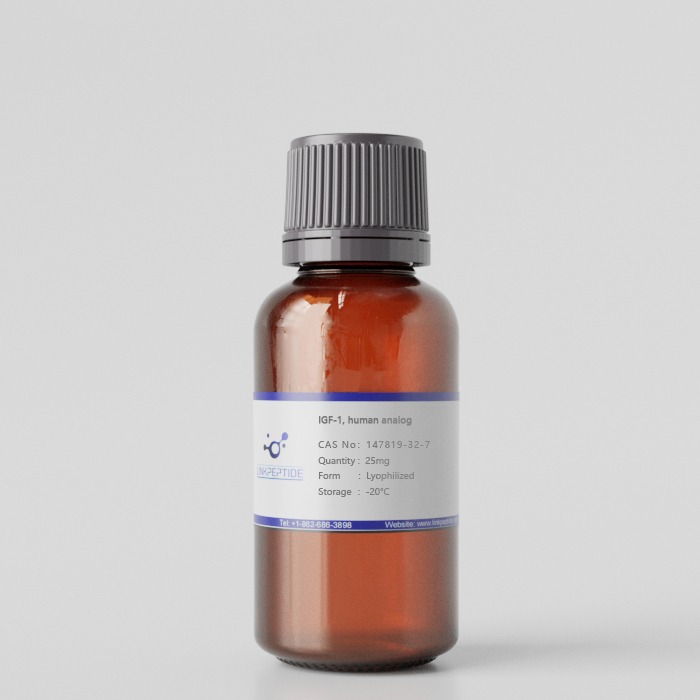
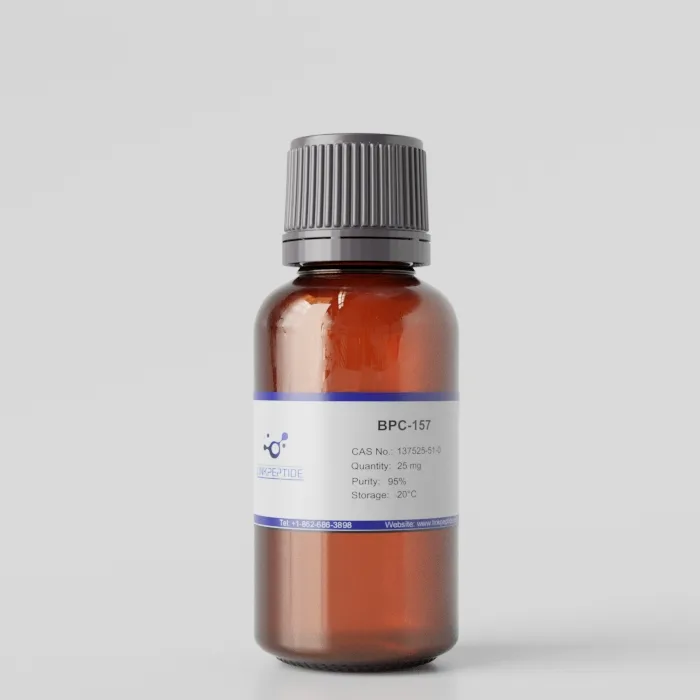
Product Name: IGF-1, human analog
Sequence One Letter Code: CYAAPLKPAKSC-OH
Sequence Three Letter Code: Cys-Tyr-Ala-Ala-Pro-Leu-Lys-Pro-Ala-Lys-Ser-Cys-OH
Cas No: 147819-32-7
Chemical Formula:C55H90N14O15S2
Molecular Weight: 1251.52
Purity: ≥ 95%
Form: Lyophilized
Storage Conditions: - 20 °C
SMILES: C[C@@H](C(=O)N[C@@H](CC12C=CC3(C(C1S2)S3)O)C(=O)N[C@@H](C)C(=O)N[C@@H](C)C(=O)N4CCC[C@H]4C(=O)N[C@@H](CC(C)C)C(=O)N[C@@H](CCCCN)C(=O)N5CCC[C@H]5C(=O)N[C@@H](C)C(=O)N[C@@H](CCCCN)C(=O)N[C@@H](C=O)C(=O)N[C@@H](C)C(=O)O)N
IUPAC: (2S)-2-[[(2S)-2-[[(2S)-6-amino-2-[[(2S)-2-[[(2S)-1-[(2S)-6-amino-2-[[(2S)-2-[[(2S)-1-[(2S)-2-[[(2S)-2-[[(2S)-2-[[(2S)-2-aminopropanoyl]amino]-3-(7-hydroxy-3,8-dithiatricyclo[5.1.0.02,4]oct-5-en-4-yl)propanoyl]amino]propanoyl]amino]propanoyl]pyrrolidine-2-carbonyl]amino]-4-methylpentanoyl]amino]hexanoyl]pyrrolidine-2-carbonyl]amino]propanoyl]amino]hexanoyl]amino]-3-oxopropanoyl]amino]propanoic acid
INCHIKEY: CWDBKYUARDUIEM-KTQAENQISA-N
InChI=1S/C55H88N14O15S2/c1-27(2)24-35(65-50(79)39-17-12-22-68(39)51(80)31(6)61-43(72)29(4)59-47(76)36(66-42(71)28(3)58)25-54-18-19-55(84)41(86-55)40(54)85-54)46(75)64-34(15-9-11-21-57)52(81)69-23-13-16-38(69)49(78)60-30(5)44(73)63-33(14-8-10-20-56)45(74)67-37(26-70)48(77)62-32(7)53(82)83/h18-19,26-41,84H,8-17,20-25,56-58H2,1-7H3,(H,59,76)(H,60,78)(H,61,72)(H,62,77)(H,63,73)(H,64,75)(H,65,79)(H,66,71)(H,67,74)(H,82,83)/t28-,29-,30-,31-,32-,33-,34-,35-,36-,37-,38-,39-,40?,41?,54?,55?/m0/s1
Source / Species: human
Conjugation: Unconjugated
Application: Human IGF-1, also known as insulin-like growth factor 1 or somatomedin C, is a peptide hormone structurally related to insulin and produced in response to growth hormone signaling. IGF-1 mediates many growth-promoting and anabolic effects of growth hormone, including cell proliferation, differentiation, survival, and tissue development. This peptide is widely studied in endocrinology, metabolism, regenerative biology, and growth disorder research. Human IGF-1 is commonly used to investigate IGF receptor signaling, cellular growth pathways, tissue repair, developmental biology, metabolic regulation, and hormone-dependent mechanisms involved in normal physiology and disease.
Get a Quote
 LinkPeptide