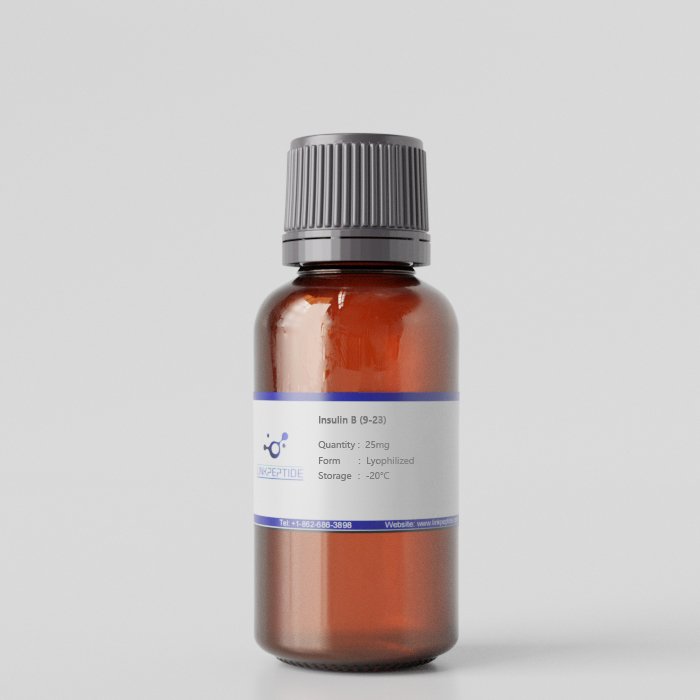
Product Name: Insulin B (9-23)
Sequence One Letter Code: SHLVEALYLVCGERG
Sequence Three Letter Code: H-Ser-His-Leu-Val-Glu-Ala-Leu-Tyr-Leu-Val-Cys-Gly-Glu-Arg-Gly-OH
Chemical Formula:C72H116N20O22S
Molecular Weight: 1645.9
Purity: 95%
Form: Lyophilized
Storage Conditions: - 20 °C
Research Area: Diabetes and Metabolic Syndrome
Source / Species: pig
Conjugation: Unconjugated
Code Nacres: NA.26
Application: Insulin B (9–23) is a synthetic peptide derived from the insulin B chain and represents a central immunodominant epitope in type 1 diabetes (T1D) research. This sequence binds the class II MHC allele I-A^g7, a molecule strongly associated with T1D susceptibility in NOD mice. As a candidate initiating self-antigen, Insulin B (9–23) is capable of activating autoreactive CD4⁺ T cells that mediate pancreatic β-cell destruction and progressive hyperglycemia. Experimental immunization with this peptide induces insulitis and autoantibody production, supporting its pathogenic relevance. It is widely used to investigate antigen presentation, T cell priming, peripheral tolerance mechanisms, and strategies for antigen-specific immunotherapy. The peptide also serves as a model system for studying MHC–peptide binding registers and autoimmune epitope recognition. Insulin B (9–23) remains a foundational research tool for dissecting early immune events in autoimmune diabetes and for evaluating tolerance-inducing interventions.
Current Research: Insulin B (9–23) remains one of the most intensively studied autoantigenic epitopes in type 1 diabetes (T1D) research. Derived from the insulin B chain, this peptide represents a dominant CD4⁺ T cell epitope in the non-obese diabetic (NOD) mouse model and binds the class II MHC molecule I-A^g7, a key genetic determinant of T1D susceptibility. Structural and biochemical studies have demonstrated that Insulin B (9–23) can bind I-A^g7 in multiple registers, generating distinct peptide–MHC conformations that influence T cell receptor (TCR) recognition. This atypical binding behavior is thought to contribute to defective thymic negative selection and the escape of autoreactive T cells into the periphery. Current research has focused on defining how Insulin B (9–23) initiates autoimmune responses. Evidence supports the concept that insulin is a primary autoantigen in T1D, with β-cell–derived insulin peptides presented by antigen-presenting cells in pancreatic lymph nodes early in disease progression. Autoreactive CD4⁺ T cells specific for Insulin B (9–23) promote inflammatory infiltration of pancreatic islets (insulitis), facilitate epitope spreading, and provide help to autoreactive B cells, leading to insulin autoantibody production. These events collectively drive progressive β-cell destruction and hyperglycemia. Mechanistic studies have also highlighted the importance of antigen processing. Variations in how insulin is cleaved within β cells or dendritic cells can alter the availability of the 9–23 epitope. Post-translational modifications and hybrid insulin peptides (HIPs), formed through peptide fusion events, have been shown to enhance immunogenicity and may amplify autoreactive T cell responses. Such findings have broadened understanding of how self-antigens acquire pathogenic potential. Insulin B (9–23) has become central to tolerance-induction strategies. Experimental approaches including peptide immunotherapy, altered peptide ligands (APLs), nanoparticle-based antigen delivery, and tolerogenic dendritic cell platforms have used this epitope to induce regulatory T cells (Tregs) or promote immune deviation. In NOD mice, mucosal or low-dose administration of Insulin B (9–23) can delay diabetes onset and reduce insulitis, supporting its utility in antigen-specific immunomodulation. These studies inform translational efforts aimed at preventing or halting early-stage T1D in at-risk individuals. Advanced immunological tools, including MHC class II tetramers loaded with Insulin B (9–23), now allow direct visualization and phenotypic characterization of antigen-specific CD4⁺ T cells in vivo. Single-cell sequencing and TCR repertoire analyses have revealed clonal expansion patterns and functional heterogeneity among insulin-reactive T cells, providing insight into disease progression and therapeutic response. Overall, Insulin B (9–23) continues to serve as a foundational model epitope for dissecting antigen presentation, autoreactive T cell activation, and mechanisms of immune tolerance in autoimmune diabetes. Its well-defined immunobiology makes it indispensable for both mechanistic studies and the development of antigen-specific therapeutic strategies.
Get a Quote
 LinkPeptide