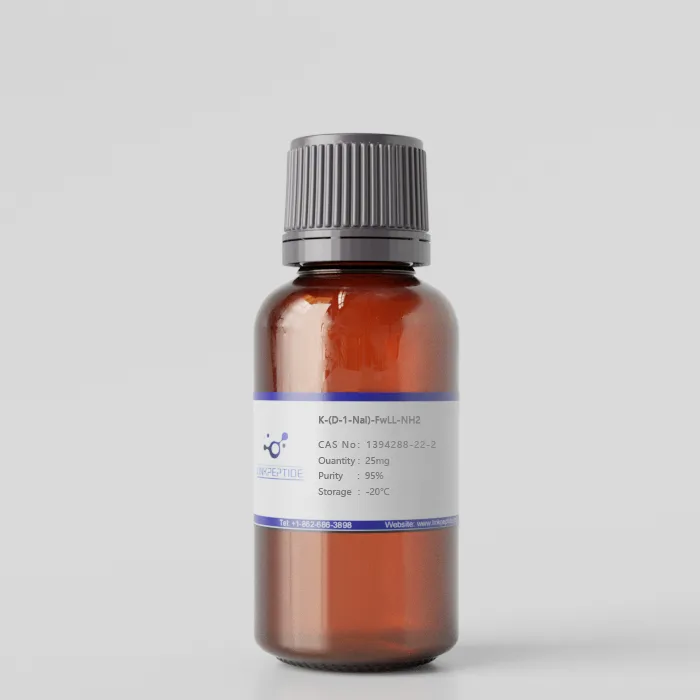
Product Name:K-(D-1-Nal)-FwLL-NH2
CAS No:1394288-22-2
Purity:95%
Molar Mass:902.13
Chemical Formula:C51H67N9O6
Storage:Store at -20 degrees Celsius
Sequence:K{Nal}FWLL-NH2
Target:ghrelin receptor
Application:K-(D-1-Nal)-FwLL-NH2 is a synthetic peptide that acts as a selective agonist of the ghrelin receptor (also known as the growth hormone secretagogue receptor, GHS-R). The ghrelin receptor is involved in regulating appetite, energy balance, and the release of growth hormone. By activating the ghrelin receptor, this peptide can influence metabolic processes and has been used in research to explore ghrelin's role in appetite control, obesity, and metabolic disorders. Its selective action on the ghrelin receptor makes it valuable for studying therapeutic targets related to weight management and metabolic diseases.
Current Research:
K-(D-1-Nal)-FwLL-NH? is a synthetic peptide designed to inhibit the interaction between p53, a key tumor suppressor, and MDM2, its negative regulator. By blocking MDM2, this peptide stabilizes p53, enhancing its tumor-suppressing functions, including cell cycle arrest and apoptosis.
Mechanism of Action
The peptide mimics the transactivation domain of p53, competitively binding to MDM2 and preventing it from targeting p53 for ubiquitination and degradation. This inhibition increases intracellular p53 levels, promoting its transcriptional activity and tumor-suppressive effects. Its specificity for the p53-MDM2 interaction makes it a valuable tool for studying p53-related pathways.
Research Applications
Cancer Research: This peptide is used to investigate mechanisms of p53 reactivation in cancers where the protein is functionally inactivated due to MDM2 overexpression.
Drug Development: It serves as a model for designing small molecules or other therapeutic peptides aimed at disrupting the p53-MDM2 interaction.
Cellular Studies: The peptide is utilized to understand the downstream effects of p53 activation, including regulation of apoptosis and DNA repair.
Significance
K-(D-1-Nal)-FwLL-NH? holds promise in the field of oncology, providing insights into restoring p53 activity in MDM2-driven cancers. Its targeted approach helps in elucidating the therapeutic potential of p53 activation as a strategy for cancer treatment.
Conclusion
This peptide represents a potent inhibitor of the p53-MDM2 interaction, offering significant utility in cancer research and drug development focused on reactivating tumor suppressor pathways. Its use in preclinical studies continues to advance our understanding of p53-mediated tumor suppression.
Reference:
Get a Quote
 LinkPeptide