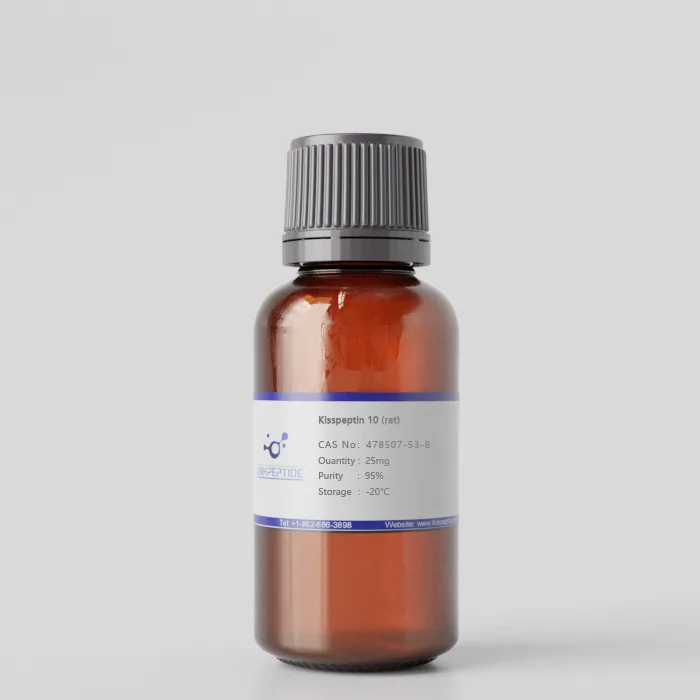
Product Name:Kisspeptin 10 (rat)
CAS No:478507-53-8
Purity:95%
Molar Mass:1318.45
Chemical Formula:C63H83N17O15
Storage:Store at -20 degrees Celsius
Sequence:YNWNSFGLRY-NH2
Application:Kisspeptin 10 (rat) is a biologically active fragment of the Kisspeptin peptide, consisting of 10 amino acids. This peptide is crucial for regulating the hypothalamic-pituitary-gonadal (HPG) axis in rats, playing a significant role in reproductive functions, including the onset of puberty and fertility. Kisspeptin 10 binds to the G-protein-coupled receptor GPR54 (Kiss1R), stimulating the release of gonadotropin-releasing hormone (GnRH), which subsequently influences the secretion of luteinizing hormone (LH) and follicle-stimulating hormone (FSH). It is widely used in research focused on reproductive endocrinology, fertility, and the investigation of reproductive disorders in animal models.
Current Research:
Kisspeptin-10 (rat), a decapeptide with the sequence Tyr-Asn-Trp-Asn-Ser-Phe-Gly-Leu-Arg-Tyr-NH₂, is a potent endogenous ligand for the G protein-coupled receptor GPR54 (also known as KISS1R). This peptide plays a pivotal role in regulating the hypothalamic-pituitary-gonadal (HPG) axis, thereby influencing reproductive physiology.
Role in Reproductive Physiology
Kisspeptin-10 is integral to the activation of gonadotropin-releasing hormone (GnRH) neurons, which in turn stimulate the secretion of luteinizing hormone (LH) and follicle-stimulating hormone (FSH) from the anterior pituitary gland. This cascade is essential for the initiation of puberty and the maintenance of reproductive function. In rodent models, administration of Kisspeptin-10 has been shown to induce the release of LH and FSH, underscoring its critical role in reproductive endocrinology.
Metabolic Implications
Beyond its reproductive functions, Kisspeptin-10 has been implicated in metabolic regulation. Studies indicate that Kisspeptin-10 can modulate lipid metabolism in the liver and influence insulin secretion. In vivo administration of Kisspeptin-10 in rats has been associated with increased lipid metabolism in hepatic tissues. Additionally, Kisspeptin-10 has been observed to potentiate insulin secretion in both human and mouse pancreatic islets, suggesting a role in glucose homeostasis.
Cardiovascular Effects
Kisspeptin-10 exhibits vasoconstrictive properties and acts as an inhibitor of angiogenesis. These actions are mediated through its interaction with GPR54, leading to physiological effects such as modulation of blood vessel tone and inhibition of new blood vessel formation. These properties position Kisspeptin-10 as a molecule of interest in cardiovascular research.
Therapeutic Potential
The multifaceted roles of Kisspeptin-10 in reproductive, metabolic, and cardiovascular systems highlight its potential as a therapeutic target. Modulating Kisspeptin-10 activity could offer novel approaches for treating reproductive disorders, metabolic syndromes, and certain cardiovascular conditions. However, further research is necessary to fully elucidate its mechanisms and to develop safe and effective therapeutic strategies.
Reference:
Get a Quote
 LinkPeptide