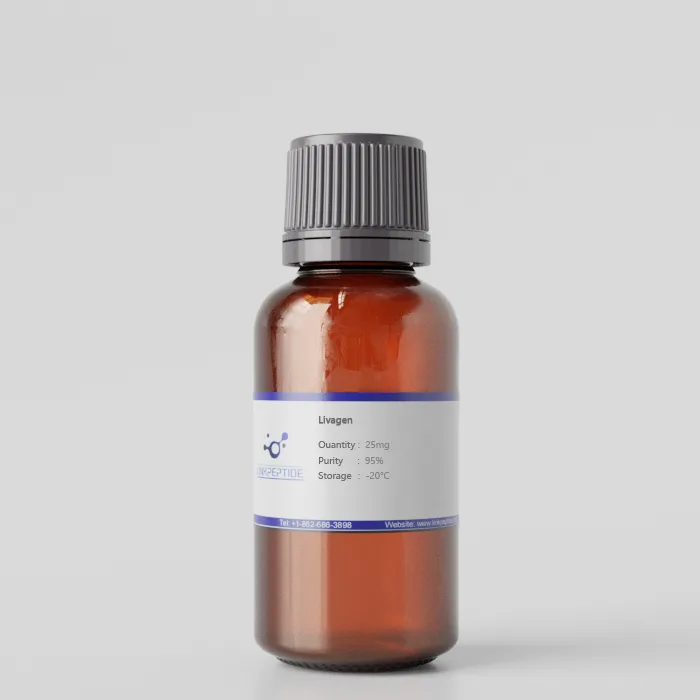
Product Name:Livagen
Purity:95%
Chemical Formula:C18H31N5O9
Molar Mass:461.5
IUPAC Name:(4S)-5-[[(2S)-3-carboxy-1-[[(1S)-1-carboxyethyl]amino]-1-oxopropan-2-yl]amino]-4-[[(2S)-2,6-diaminohexanoyl]amino]-5-oxopentanoic acid
SMILES:C[C@@H](C(=O)O)NC(=O)[C@H](CC(=O)O)NC(=O)[C@H](CCC(=O)O)NC(=O)[C@H](CCCCN)N
InChIKey:IKVDKWACACMDLR-BJDJZHNGSA-N
InChI:InChI=1S/C18H31N5O9/c1-9(18(31)32)21-17(30)12(8-14(26)27)23-16(29)11(5-6-13(24)25)22-15(28)10(20)4-2-3-7-19/h9-12H,2-8,19-20H2,1H3,(H,21,30)(H,22,28)(H,23,29)(H,24,25)(H,26,27)(H,31,32)/t9-,10-,11-,12-/m0/s1
Storage:-20 degree Celsius
Sequence:KEDA
Application:Livagen is a short synthetic peptide (Glu-Asp-Ala) derived from thymic tissue and developed as a bioregulator of immune and epigenetic functions. It interacts with specific DNA regions, restoring balanced gene expression associated with thymic activity, chromatin structure, and immune system modulation. Livagen has been studied for its ability to improve immune competence in aging, reduce chronic inflammation, and enhance cellular repair in immune-related and degenerative conditions. It supports research into immunosenescence, thymic involution, and age-associated epigenetic drift. Livagen is especially valuable in studies on healthy longevity, regenerative biology, and systemic homeostasis.
Current Research:Introduction: Peptide Bioregulation and the Role of Livagen Livagen is a short dipeptide (Glu-Asp-Ala) classified under peptide bioregulators, originally developed through research at the Saint Petersburg Institute of Bioregulation and Gerontology. It belongs to a family of compounds that modulate gene expression by targeting specific DNA sequences, influencing cellular behavior in a tissue-specific and age-dependent manner. Livagen is derived from thymic peptides and mimics their action in restoring immune balance, promoting cellular regeneration, and slowing epigenetic aging. It has gained attention for its potential to reverse immune aging, support chromatin stability, and enhance DNA methylation balance, crucial for genomic integrity in older organisms. Mechanism of Action: Epigenetic Modulation and DNA Binding Livagen functions through direct interaction with nuclear chromatin, selectively binding to regions rich in GC nucleotide sequences. This binding alters the conformation of chromatin, making certain genes more accessible to transcription or silencing others that are overactive. Livagen has demonstrated the ability to: Normalize gene expression profiles associated with aging and immune senescence Stabilize heterochromatin, which tends to degrade with age Regulate the methylation state of cytosine residues, which are key to controlling gene expression fidelity Reactivate silenced genes involved in immune surveillance, thymopoiesis, and DNA repair These properties make Livagen a potent candidate for anti-aging and immunoregulatory interventions in research. Applications in Immunosenescence and Aging As the thymus involutes with age, there is a decline in the production of T cells and thymic hormones, leading to immunosenescence—a state of reduced immunity and chronic low-grade inflammation. Livagen has been shown in rodent and early human studies to: Restore T-cell differentiation Increase expression of MHC class I and II molecules Reduce autoimmune reactivity Improve immune surveillance against infections and malignancies In aging animals, Livagen administration resulted in improved response to vaccines, enhanced resistance to viral infections, and reduction in chronic inflammatory markers. Chromatin Remodeling and DNA Repair Another critical function of Livagen lies in its role as a chromatin modifier. It enhances the activity of histone deacetylases (HDACs) and DNA methyltransferases, supporting DNA repair mechanisms, particularly in aged or stressed cells. This activity has been explored in models of: Radiation exposure Chemical-induced genotoxicity Accelerated aging syndromes Livagen has been observed to reduce DNA strand breaks, normalize nucleolar morphology, and promote genomic stability—actions that are central to both anti-aging research and oncology prevention. Support in Epigenetic Longevity Research Livagen contributes to epigenetic reprogramming strategies by maintaining DNA methylation fidelity and preventing aberrant gene expression. Studies have shown that Livagen-treated animals have gene expression profiles resembling younger organisms, particularly in immune and detoxification pathways. It is also being evaluated alongside other bioregulators such as Thymogen, Epitalon, and Endoluten in geroprotective protocols, suggesting that peptide-based modulation of chromatin could represent a safe, effective approach to systemic rejuvenation. Neuroprotective and Regenerative Insights Preliminary research indicates Livagen may also affect neural regeneration and cognitive preservation by reducing neuroinflammation and enhancing synaptic gene expression. While data is limited, early results suggest potential applications in: Neurodegenerative disease models Cognitive decline Brain aging Further exploration is needed, but its broad epigenetic control hints at systemic regenerative effects, not limited to the immune system alone. Conclusion: A Small Peptide with Broad Regulatory Potential Livagen represents a precise and elegant approach to regulating gene expression, chromatin architecture, and immune balance—especially in the context of aging. Its small size belies its wide-ranging influence across immune, genomic, and regenerative systems. As research in epigenetic longevity and peptide therapeutics advances, Livagen continues to offer valuable insight into how short peptides can guide biological repair and resilience.
Reference:
Get a Quote
 LinkPeptide