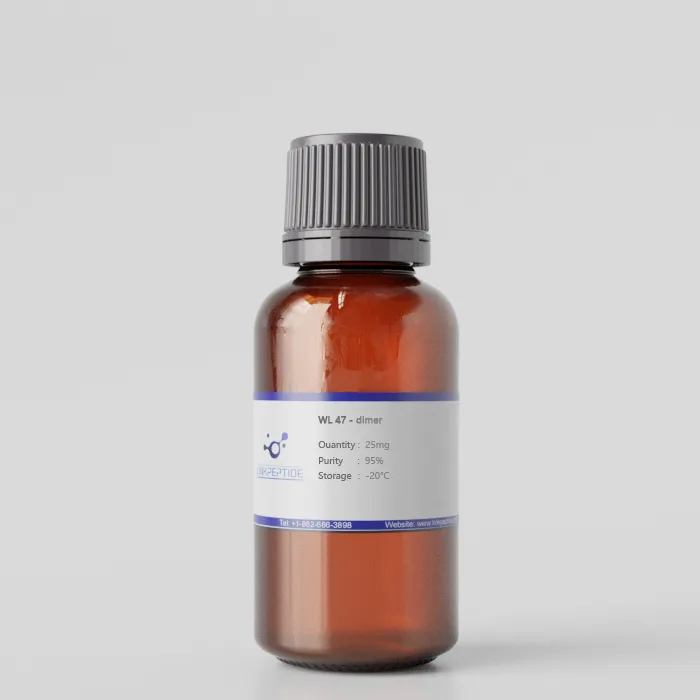
Product Name: LL-37, reverse sequence
Sequence One Letter Code: SETRPVLNRLFDKIRQVIRKFEKGIKEKSKRFFDGLL
Sequence Three Letter Code: H-Ser-Glu-Thr-Arg-Pro-Val-Leu-Asn-Arg-Leu-Phe-Asp-Lys-Ile-Arg-Gln-Val-Ile-Arg-Lys-Phe-Glu-Lys-Gly-Ile-Lys-Glu-Lys-Ser-Lys-Arg-Phe-Phe-Asp-Gly-Leu-Leu-OH
Chemical Formula:C205H340N60O53
Molecular Weight: 4493.6
Purity: 95%
Form: Lyophilized
Storage Conditions: - 20 °C
Research Area: Infection Disease Research
Source / Species: human
Conjugation: Unconjugated
Code Nacres: NA.26
Application: LL-37, reverse sequence is a synthetic control peptide composed of the human cathelicidin LL-37 amino acid sequence arranged in reverse order. Although similar in length and overall composition to native LL-37, the reversed sequence alters secondary structure and functional activity. This peptide is commonly used as a negative or structural control in studies examining antimicrobial activity, membrane interactions, and immunomodulatory effects of LL-37. It enables discrimination between sequence-specific biological functions and nonspecific effects related to peptide charge, amphipathicity, or length. The reverse sequence peptide supports mechanistic investigations into innate immunity, host defense peptides, and structure–function relationships in antimicrobial peptide research.
Current Research: Human LL-37 is the only member of the cathelicidin family identified in humans and functions as a multifunctional host defense peptide involved in antimicrobial activity, immune modulation, and regulation of inflammatory responses. Derived from the C-terminal region of hCAP-18, LL-37 adopts an amphipathic α-helical structure under membrane-mimetic conditions and exerts broad-spectrum activity against Gram-positive and Gram-negative bacteria, fungi, and certain enveloped viruses. In addition to its direct microbicidal properties, LL-37 modulates chemotaxis, cytokine production, dendritic cell differentiation, and epithelial barrier integrity. To rigorously define the sequence-specific determinants of LL-37 function, researchers frequently employ LL-37 reverse sequence peptide as a synthetic control. This peptide contains the identical amino acid composition as native LL-37 but arranged in reverse order. Although comparable in length, net charge, and overall residue distribution, the inversion of sequence orientation substantially alters its secondary structure, spatial amphipathicity, and receptor-binding interfaces. As a result, the reverse sequence peptide generally lacks the biological activities characteristic of native LL-37, making it a valuable negative or structural control in mechanistic studies. One of the principal applications of LL-37 reverse sequence peptide is in antimicrobial assays. Native LL-37 disrupts microbial membranes through electrostatic interactions with negatively charged phospholipids, followed by membrane insertion and destabilization. These effects depend not only on cationic charge but also on the precise alignment of hydrophobic and hydrophilic residues that enable α-helix formation and amphipathic topology. Reversing the sequence disrupts this organized distribution, often diminishing or abolishing membrane-permeabilizing capacity. By comparing bactericidal or fungicidal activity of LL-37 with its reverse counterpart, investigators can distinguish sequence-dependent antimicrobial mechanisms from nonspecific effects related solely to peptide length or charge density. Membrane interaction studies further illustrate the importance of structural orientation. Biophysical techniques such as circular dichroism spectroscopy, nuclear magnetic resonance, and lipid vesicle leakage assays demonstrate that native LL-37 undergoes conformational transitions upon contact with lipid bilayers. The reverse sequence peptide, despite sharing physicochemical parameters, frequently exhibits altered helical propensity and reduced membrane insertion efficiency. These comparisons enable detailed structure–function analyses that clarify how residue positioning governs membrane affinity, pore formation, and lipid selectivity. Beyond direct antimicrobial activity, LL-37 is recognized as an immunomodulatory peptide that influences innate and adaptive immunity. It acts as a chemoattractant via formyl peptide receptor-like 1 (FPRL1/FPR2), enhances uptake of nucleic acids, modulates Toll-like receptor signaling, and shapes cytokine responses in macrophages and epithelial cells. In studies investigating these immunological pathways, the reverse sequence peptide serves as a critical specificity control. For example, differential induction of cytokines or chemotactic responses in the presence of native LL-37 but not the reversed peptide supports the conclusion that receptor engagement and downstream signaling depend on defined sequence motifs rather than general cationic properties. The LL-37 reverse sequence peptide also contributes to investigations of peptide-induced cytotoxicity and host cell interactions. At elevated concentrations, LL-37 can affect mammalian cell membranes, influence apoptosis pathways, or alter epithelial permeability. Employing the reverse sequence allows researchers to determine whether observed cellular effects are mediated by specific structural domains or reflect broader amphipathic peptide behavior. This distinction is particularly important in therapeutic development, where minimizing off-target or nonspecific membrane effects is essential. In antimicrobial peptide engineering, the reverse sequence peptide provides insight into the evolutionary and structural constraints governing host defense peptide activity. By maintaining amino acid composition while altering sequence order, researchers can assess the relative contributions of primary sequence orientation, helicity, and amphipathic moment to biological function. Such comparative analyses inform rational design of next-generation antimicrobial agents with optimized potency and reduced cytotoxicity. Overall, LL-37 reverse sequence peptide represents a strategically designed control reagent that preserves global physicochemical characteristics while disrupting native structural organization. Its use enables precise discrimination between sequence-specific biological activities and nonspecific effects attributable to charge, hydrophobicity, or peptide length. As studies continue to explore the complex roles of LL-37 in innate immunity, inflammation, and antimicrobial defense, the reverse sequence peptide remains an indispensable tool for elucidating structure–function relationships and validating mechanistic conclusions in host defense peptide research.
Get a Quote
 LinkPeptide