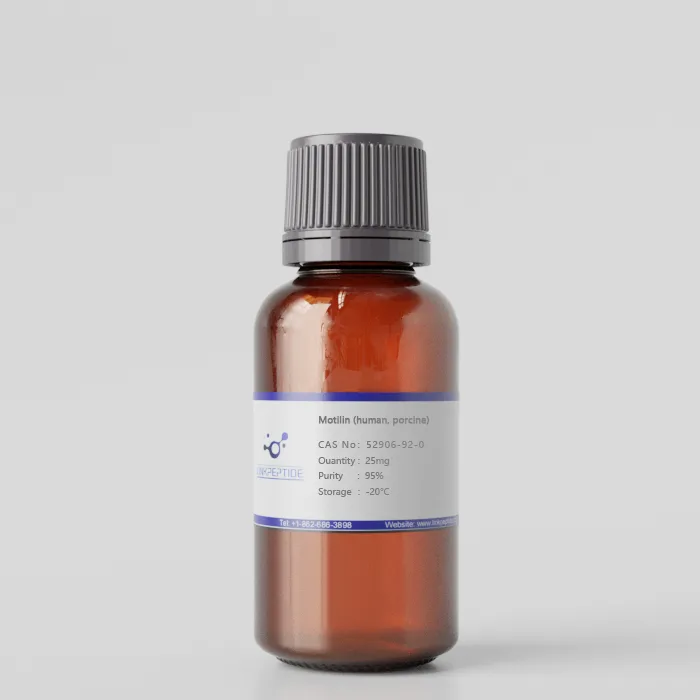
Product Name:Motilin (human, porcine)
CAS No:52906-92-0
Purity:95%
Molar Mass:2699.07
Chemical Formula:C120H188N34O35S
Storage:Store at -20 degrees Celsius
Sequence:FVPIFTYGELQRMQEKERNKGQ
Application:
Motilin (human, porcine) is a peptide hormone primarily involved in regulating gastrointestinal motility. It is produced in the small intestine and plays a crucial role in stimulating gastric emptying and the migrating motor complex, which are waves of electrical activity that sweep through the intestines during fasting. Motilin binds to specific receptors on smooth muscle cells in the gastrointestinal tract, promoting contractions that aid in the digestive process. This hormone is significant in research focused on gastrointestinal disorders, such as gastroparesis and functional dyspepsia, and is studied for its potential therapeutic applications in enhancing gastrointestinal motility in related conditions.
Current Research:
Motilin is a 22-amino acid peptide hormone produced primarily by enteroendocrine cells in the mucosa of the small intestine. It plays a critical role in regulating gastrointestinal motility. The sequence of motilin is conserved between humans and pigs, making porcine motilin a widely used model for studying its physiological functions in humans.
Structure
Motilin’s amino acid sequence is: Phe-Val-Pro-Ile-Phe-Thr-Val-Gly-Gly-Phe-Thr-Gly-Gly-Lys-Gly-Gln-Lys-Gln-Glu-Leu-Gln-His. The structural integrity of motilin is crucial for its activity, particularly its interaction with the motilin receptor (MTLR), a G protein-coupled receptor expressed in gastrointestinal tissues.
Physiological Functions
Regulation of Gastrointestinal Motility:
Motilin is secreted cyclically during the fasting state and induces phase III of the migrating motor complex (MMC), which consists of strong peristaltic contractions that clear the stomach and small intestine of residual content.
It helps regulate interdigestive motility patterns and prepares the digestive tract for the next meal.
Stimulation of Gastric Emptying:
By enhancing antral and duodenal contractions, motilin promotes the passage of gastric contents into the small intestine.
Appetite Modulation:
Recent studies suggest motilin may play a role in appetite regulation, linking gut motility to feeding behavior.
Research and Clinical Applications
Prokinetic Agents: Motilin and motilin receptor agonists, such as erythromycin, are explored as potential treatments for conditions like gastroparesis and other motility disorders.
Pharmacological Studies: Understanding motilin’s mechanism of action aids in developing therapeutic agents targeting motilin receptors for gastrointestinal disorders.
Basic Research: Studying motilin’s role in MMC provides insights into normal and pathological motility patterns in the digestive system.
Conclusion
Motilin is a key regulatory peptide in gastrointestinal physiology, orchestrating fasting-state motility and facilitating digestive efficiency. Its conserved structure across species, including humans and pigs, makes it a vital subject for translational research in gastroenterology.
Reference:
Get a Quote



 LinkPeptide