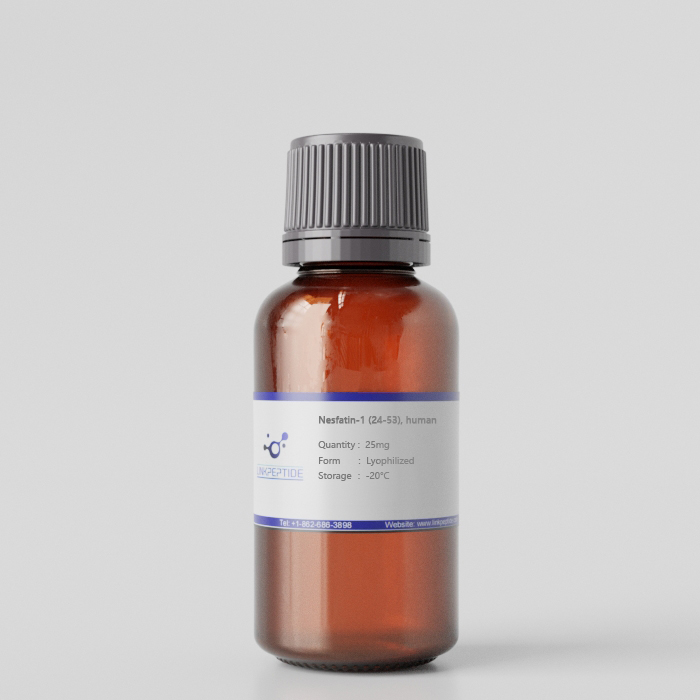
Product Name: Nesfatin-1 (24-53), human
Sequence One Letter Code: PDTGLYYDEYLKQVIDVLETDKHFREKLQK-NH2
Sequence Three Letter Code: Pro-Asp-Thr-Gly-Leu-Tyr-Tyr-Asp-Glu-Tyr-Leu-Lys-Gln-Val-Ile-Asp-Val-Leu-Glu-Thr-Asp-Lys-His-Phe-Arg-Glu-Lys-Leu-Gln-Lys-NH2
Chemical Formula:C168H260N42O51
Molecular Weight: 3684.4
Purity: 95%
Form: Lyophilized
Storage Conditions: - 20 °C
Research Area: Diabetes and Metabolic Syndrome
Source / Species: human
Conjugation: Unconjugated
Code Nacres: NA.26
Application: Nesfatin-1 (24–53), human is a synthetic peptide derived from the Nucleobindin-2 precursor and represents a biologically active region of the anorexigenic hormone nesfatin-1. This peptide participates in central regulation of appetite, body weight, and fluid intake. Altered circulating levels have been associated with metabolic imbalance and obesity. Beyond energy homeostasis, nesfatin-1 has been implicated in modulation of stress responses and anxiety-related behaviors. This peptide is widely used in neuroendocrine and metabolic research to investigate appetite regulation, hypothalamic signaling pathways, and interactions between stress physiology and metabolic control.
Current Research: Nesfatin-1 (24–53), human is a synthetic peptide corresponding to residues 24–53 of the Nucleobindin-2 (NUCB2) precursor protein and represents a biologically active region within the full-length 82–amino acid nesfatin-1 sequence. Nesfatin-1 was originally identified as an anorexigenic neuropeptide expressed in hypothalamic nuclei, and subsequent research has established it as a multifunctional regulator of energy balance, neuroendocrine signaling, and stress physiology. The 24–53 fragment encompasses a core functional domain implicated in appetite suppression and central signaling activity. Current research highlights nesfatin-1 as an important modulator of hypothalamic circuits governing food intake and body weight. It is expressed in appetite-regulating regions such as the paraventricular nucleus (PVN), arcuate nucleus (ARC), and lateral hypothalamic area (LHA). Central administration of nesfatin-1 or its active fragments reduces food consumption in rodent models, primarily by decreasing meal size rather than altering meal frequency. The 24–53 region contributes significantly to this anorexigenic effect and is commonly used in mechanistic studies to isolate functional motifs within the larger peptide. Although the specific receptor for nesfatin-1 has not been definitively identified, evidence supports involvement of G protein–coupled receptor–mediated pathways. Nesfatin-1 signaling has been associated with intracellular calcium mobilization, activation of MAPK and PI3K pathways, and modulation of AMP-activated protein kinase (AMPK) activity in hypothalamic neurons. These signaling cascades intersect with established appetite-regulating systems, including melanocortin, corticotropin-releasing hormone (CRH), and oxytocin pathways. Ongoing studies aim to clarify how the 24–53 region contributes to receptor engagement and downstream signaling specificity. In metabolic research, circulating nesfatin-1 levels have been examined in relation to obesity, metabolic syndrome, and type 2 diabetes. Clinical studies report altered plasma concentrations in individuals with metabolic imbalance, though findings vary depending on cohort characteristics and disease stage. Experimental models suggest that nesfatin-1 influences not only appetite but also peripheral glucose metabolism and insulin secretion. The peptide has been shown to modulate pancreatic β-cell function and improve glucose tolerance in some settings, indicating a broader role in systemic energy homeostasis. Beyond metabolic regulation, nesfatin-1 is increasingly recognized for its involvement in stress and anxiety-related behaviors. It is co-expressed with stress-responsive neuropeptides and participates in hypothalamic–pituitary–adrenal (HPA) axis activation. Experimental administration of nesfatin-1 influences corticosterone release and alters anxiety-like behavior in rodent models. These findings suggest that nesfatin-1 integrates metabolic status with stress signaling, potentially coordinating adaptive responses to environmental and physiological challenges. Recent research also explores interactions between nesfatin-1 and inflammatory signaling. Chronic low-grade inflammation associated with obesity may influence nesfatin-1 expression and action, while nesfatin-1 itself may modulate cytokine production in certain contexts. These observations position the peptide at the intersection of metabolic and immune regulation. Methodologically, Nesfatin-1 (24–53), human is used in intracerebroventricular and site-specific hypothalamic injection studies to evaluate acute feeding responses and signaling pathway activation. In vitro assays often include calcium imaging, electrophysiological recordings in hypothalamic neurons, and analysis of phosphorylation events in metabolic signaling pathways. Peripheral metabolic effects are assessed through glucose tolerance tests, insulin secretion assays, and adipocyte functional studies. There is also growing interest in the therapeutic potential of nesfatin-1 analogs for obesity and metabolic disorders. Structure–activity relationship studies using defined fragments such as 24–53 help identify minimal active sequences that retain biological efficacy while improving stability and pharmacokinetics. Overall, Nesfatin-1 (24–53), human represents a functionally significant segment of an anorexigenic neuropeptide central to energy balance and neuroendocrine regulation. Its involvement in appetite suppression, metabolic control, and stress modulation makes it a valuable tool for investigating hypothalamic signaling networks and the integration of metabolic and behavioral responses in health and disease.
Get a Quote



 LinkPeptide