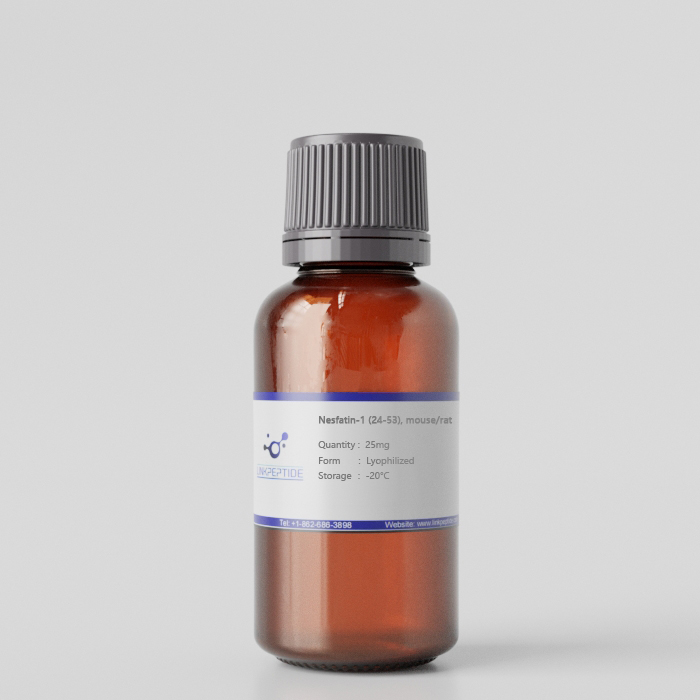
Product Name: Nesfatin-1 (24-53), mouse/rat
Sequence One Letter Code: PDTGLYYDEYLKQVIEVLETDPHFREKLQK-NH2
Sequence Three Letter Code: Pro-Asp-Thr-Gly-Leu-Tyr-Tyr-Asp-Glu-Tyr-Leu-Lys-Gln-Val-Ile-Glu-Val-Leu-Glu-Thr-Asp-Pro-His-Phe-Arg-Glu-Lys-Leu-Gln-Lys-NH2
Chemical Formula:C168H257N41O51
Molecular Weight: 3667.3
Purity: 95%
Form: Lyophilized
Storage Conditions: - 20 °C
Research Area: Neurological Disease Research
Source / Species: mouse,rat
Conjugation: Unconjugated
Code Nacres: NA.26
Application: Nesfatin-1 (24–53), mouse/rat is a synthetic peptide derived from the Nucleobindin-2 (NUCB2) precursor and represents a biologically active region of nesfatin-1, an anorexigenic neuropeptide. This fragment contributes to central regulation of appetite, fluid intake, and body weight. In rodent models, nesfatin-1 reduces food consumption and limits weight gain, while altered circulating levels in humans have been associated with metabolic imbalance. Beyond metabolic regulation, nesfatin-1 is implicated in stress-related and anxiety-associated behaviors. This peptide is used in studies examining neuroendocrine control of feeding, metabolic disorders, obesity, and the integration of stress signaling with energy homeostasis pathways.
Current Research: Nesfatin-1 (24–53), mouse/rat is a synthetic peptide corresponding to amino acid residues 24–53 of the Nucleobindin-2 (NUCB2) precursor protein and represents a biologically active region within the full-length nesfatin-1 sequence. Nesfatin-1 is an 82–amino acid neuropeptide generated by post-translational processing of NUCB2 and is widely recognized for its anorexigenic and metabolic regulatory functions. The 24–53 fragment encompasses a core functional domain implicated in appetite suppression and neuroendocrine signaling. Nesfatin-1 is highly expressed in hypothalamic nuclei involved in energy balance regulation, including the paraventricular nucleus (PVN), arcuate nucleus (ARC), and lateral hypothalamic area (LHA). It is also detected in brainstem autonomic centers and peripheral tissues such as adipose tissue, pancreas, and gastrointestinal tract. Central administration of nesfatin-1 in rodent models results in reduced food intake, decreased meal size, and attenuation of body weight gain. The 24–53 region contributes to these anorexigenic effects, supporting its use in mechanistic studies of appetite control. At the signaling level, nesfatin-1 engages intracellular pathways associated with calcium influx, MAPK activation, and modulation of autonomic output. Although a definitive receptor has not yet been fully characterized, functional evidence suggests interaction with G protein–coupled receptor–mediated pathways that influence hypothalamic neuronal excitability. Nesfatin-1 activity intersects with established appetite-regulating systems, including melanocortin, corticotropin-releasing hormone (CRH), oxytocin, and sympathetic pathways. The 24–53 fragment provides a defined experimental tool to evaluate these signaling interactions with reduced structural complexity compared to the full-length peptide. In metabolic research, nesfatin-1 has been linked to glucose homeostasis and lipid metabolism. Experimental studies indicate that nesfatin-1 can influence insulin secretion, improve glucose tolerance, and modulate adipocyte function. Altered circulating nesfatin-1 levels have been reported in individuals with obesity, type 2 diabetes mellitus, and metabolic syndrome, although the directionality of these changes varies across studies. The peptide’s involvement in energy expenditure and adiposity regulation has made it a subject of interest for understanding mechanisms underlying metabolic imbalance. Beyond feeding behavior, nesfatin-1 is implicated in stress-related and affective responses. It is co-expressed with stress-responsive neuropeptides and participates in hypothalamic–pituitary–adrenal (HPA) axis regulation. Experimental models demonstrate that nesfatin-1 administration can influence anxiety-like behaviors and stress reactivity. This dual role in metabolic and stress pathways highlights its function as an integrative neuroendocrine modulator linking energy balance with emotional and autonomic regulation. Nesfatin-1 (24–53), mouse/rat is commonly used in intracerebroventricular (ICV) or site-specific brain injection studies to assess acute and chronic effects on food intake, body weight, and neuroendocrine signaling. In vitro assays may include calcium imaging, electrophysiological recordings, and kinase activation analysis in hypothalamic neurons. Peripheral metabolic parameters—such as glucose levels, insulin sensitivity, lipid profiles, and adipocyte gene expression—are frequently measured in animal studies evaluating systemic effects. The defined fragment also supports mechanistic exploration of structure–activity relationships within nesfatin-1. By isolating the 24–53 region, researchers can assess the contribution of this domain to receptor engagement and downstream signaling. This approach aids in identifying minimal functional motifs and potential therapeutic targets. Overall, Nesfatin-1 (24–53), mouse/rat represents a functionally significant segment of an anorexigenic neuropeptide central to appetite suppression and metabolic regulation. Its applications span neuroendocrine control of feeding, obesity and diabetes research, stress physiology, and the study of signaling networks integrating energy homeostasis with behavioral responses.
Get a Quote
 LinkPeptide