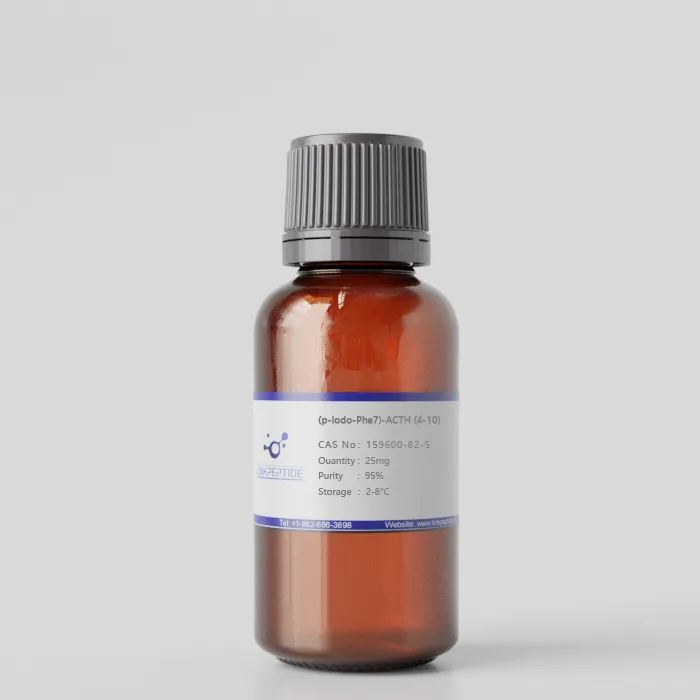
Product Name:(p-Iodo-Phe7)-ACTH (4-10)
Form:TFA salt
Purity:95%
Storage:2-8 degree Celsius
Cas No:159600-82-5
Molar Mass:1088
Chemical Formula:C44H58IN13O10S
IUPAC Name:(4S)-4-[[(2S)-2-amino-4-methylsulfanylbutanoyl]amino]-5-[[(2S)-1-[[(2S)-1-[[(2S)-1-[[(2S)-1-(carboxymethylamino)-3-(1H-indol-3-yl)-1-oxopropan-2-yl]amino]-5-(diaminomethylideneamino)-1-oxopentan-2-yl]amino]-3-(4-iodophenyl)-1-oxopropan-2-yl]amino]-3-(1H-imidazol-5-yl)-1-oxopropan-2-yl]amino]-5-oxopentanoic acid
SMILES:CSCC[C@@H](C(=O)N[C@@H](CCC(=O)O)C(=O)N[C@@H](CC1=CN=CN1)C(=O)N[C@@H](CC2=CC=C(C=C2)I)C(=O)N[C@@H](CCCN=C(N)N)C(=O)N[C@@H](CC3=CNC4=CC=CC=C43)C(=O)NCC(=O)O)N
InChIKey:JEHNDLZVGYWOAY-LXOXETEGSA-N
InChI:InChI=1S/C44H58IN13O10S/c1-69-16-14-29(46)38(63)54-32(12-13-36(59)60)41(66)58-35(19-27-21-49-23-53-27)43(68)56-33(17-24-8-10-26(45)11-9-24)42(67)55-31(7-4-15-50-44(47)48)40(65)57-34(39(64)52-22-37(61)62)18-25-20-51-30-6-3-2-5-28(25)30/h2-3,5-6,8-11,20-21,23,29,31-35,51H,4,7,12-19,22,46H2,1H3,(H,49,53)(H,52,64)(H,54,63)(H,55,67)(H,56,68)(H,57,65)(H,58,66)(H,59,60)(H,61,62)(H4,47,48,50)/t29-,31-,32-,33-,34-,35-/m0/s1
Sequence:Met-Glu-His-p-iodo-Phe-Arg-Trp-Gly
Application:
(p-Iodo-Phe⁷)-ACTH (4-10) is a synthetic ACTH fragment modified with para-iodophenylalanine (p-Iodo-Phe) at position 7. This short bioactive peptide retains a core sequence involved in melanocortin receptor interactions, making it valuable in neuroendocrine, cognitive, and immune research. The iodo substitution may enhance peptide stability, receptor binding affinity, and bioavailability. Studies suggest that (p-Iodo-Phe⁷)-ACTH (4-10) influences neurotransmitter regulation, stress responses, and immune function. This peptide is widely used in peptide-receptor interaction research, neuroprotection studies, and inflammation regulation, with potential applications in neurological disorders, cognitive enhancement, and immune modulation.
Current Research:
Introduction
(p-Iodo-Phe⁷)-ACTH (4-10) is a modified ACTH peptide fragment that includes a para-iodophenylalanine (p-Iodo-Phe) substitution at position 7, potentially altering its receptor binding, metabolic stability, and biological activity. While full-length ACTH (1-39) is primarily involved in adrenal steroidogenesis, shorter ACTH fragments such as ACTH (4-10) exhibit neuromodulatory and immunoregulatory effects. The p-Iodo-Phe⁷ modification is designed to improve peptide stability and receptor selectivity, making it a valuable research tool in neurology, endocrinology, and immunology.
Neurobiological and Cognitive Research
ACTH fragments, including (p-Iodo-Phe⁷)-ACTH (4-10), have been studied for their role in cognition and neurotransmitter regulation. Research findings indicate:
Potential cognitive-enhancing effects, making it relevant for memory retention and neuroplasticity research.
Modulation of neurotransmitter systems, particularly dopamine and serotonin, which influence mood, learning, and synaptic signaling.
Possible neuroprotective effects, with relevance to Alzheimer’s, Parkinson’s, and neurodegenerative disease models.
The iodinated modification may improve the peptide’s stability and receptor affinity, making it a strong candidate for cognitive and neuroendocrine research.
Stress Regulation and Mood Disorders
ACTH-derived peptides influence stress adaptation, making (p-Iodo-Phe⁷)-ACTH (4-10) a potential research target for:
Anxiety and depression models, investigating its effects on HPA axis function and neuropeptide signaling.
Cortisol regulation studies, exploring how it may impact stress resilience and emotional regulation.
Neuropsychiatric disorder research, particularly in PTSD, chronic stress, and affective disorders.
The presence of p-Iodo-Phe⁷ may enhance receptor selectivity, potentially improving its role in stress response modulation.
Immunomodulatory and Anti-Inflammatory Effects
Like other melanocortin-based peptides, (p-Iodo-Phe⁷)-ACTH (4-10) is studied for its immune-modulating effects. Research suggests that it:
Regulates cytokine production, potentially reducing pro-inflammatory markers (TNF-α, IL-6, IL-1β).
Modulates immune cell function, influencing T-cell and macrophage activity.
Has applications in inflammatory and autoimmune disease models, such as multiple sclerosis and rheumatoid arthritis.
These properties make it a promising candidate for neuroimmune research and inflammatory disorder studies.
Peptide Stability and Receptor Binding Studies
The p-Iodo-Phe⁷ substitution introduces a halogenated amino acid, which may:
Improve peptide stability, extending biological half-life in research settings.
Enhance receptor binding affinity, particularly for melanocortin receptor interactions.
Modify metabolic pathways, making it useful for pharmacokinetic and peptide drug development studies.
These structural modifications make (p-Iodo-Phe⁷)-ACTH (4-10) a valuable research tool for studying peptide pharmacology and receptor-targeted therapies.
Potential Research and Therapeutic Applications
Due to its modified receptor-binding properties, neuromodulatory potential, and immune-regulating effects, (p-Iodo-Phe⁷)-ACTH (4-10) is being explored for:
Cognitive enhancement and neuroprotection, particularly for memory loss and neurodegeneration.
Neuroimmune research, focusing on stress resilience and neuroinflammatory diseases.
Peptide-based therapeutic development, targeting melanocortin system modulation and inflammation control.
Conclusion
(p-Iodo-Phe⁷)-ACTH (4-10) is a structurally modified ACTH fragment with applications in neurology, immunology, and stress physiology research. The iodinated modification enhances peptide stability and receptor interactions, making it useful for studies on cognitive enhancement, neuroprotection, and immune response regulation. Ongoing research continues to explore its therapeutic potential in neurodegenerative diseases, psychiatric disorders, and immune dysfunctions.
Get a Quote
 LinkPeptide