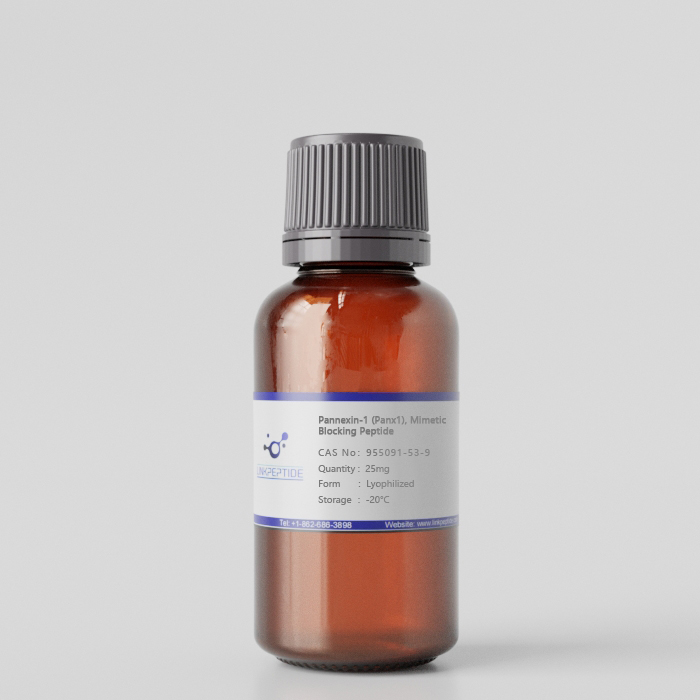
Product Name: Pannexin-1 (Panx1), Mimetic Blocking Peptide
Sequence One Letter Code: WRQAAFVDSY
Sequence Three Letter Code: H-Trp-Arg-Gln-Ala-Ala-Phe-Val-Asp-Ser-Tyr-OH
Cas No: 955091-53-9
Chemical Formula:C58H79N15O16
Molecular Weight: 1242.4
Purity: 95%
Form: Lyophilized
Storage Conditions: - 20 °C
Research Area: Inflammation and Immunology Research
SMILES: C[C@@H](C(=O)N[C@@H](CC1=CC=CC=C1)C(=O)N[C@@H](C(C)C)C(=O)N[C@@H](CC(=O)O)C(=O)N[C@@H](CO)C(=O)N[C@@H](CC2=CC=C(C=C2)O)C(=O)O)NC(=O)[C@H](C)NC(=O)[C@H](CCC(=O)N)NC(=O)[C@H](CCCN=C(N)N)NC(=O)[C@H](CC3=CNC4=CC=CC=C43)N
IUPAC: (3S)-3-[[(2S)-2-[[(2S)-2-[[(2S)-2-[[(2S)-2-[[(2S)-5-amino-2-[[(2S)-2-[[(2S)-2-amino-3-(1H-indol-3-yl)propanoyl]amino]-5-(diaminomethylideneamino)pentanoyl]amino]-5-oxopentanoyl]amino]propanoyl]amino]propanoyl]amino]-3-phenylpropanoyl]amino]-3-methylbutanoyl]amino]-4-[[(2S)-1-[[(1S)-1-carboxy-2-(4-hydroxyphenyl)ethyl]amino]-3-hydroxy-1-oxopropan-2-yl]amino]-4-oxobutanoic acid
INCHIKEY: JCJASTVQGSKHKZ-QZHJRRRASA-N
INCHI:
InChI=1S/C58H79N15O16/c1-29(2)47(56(87)70-42(26-46(77)78)53(84)72-44(28-74)55(86)71-43(57(88)89)24-33-16-18-35(75)19-17-33)73-54(85)41(23-32-11-6-5-7-12-32)69-49(80)31(4)65-48(79)30(3)66-51(82)40(20-21-45(60)76)68-52(83)39(15-10-22-63-58(61)62)67-50(81)37(59)25-34-27-64-38-14-9-8-13-36(34)38/h5-9,11-14,16-19,27,29-31,37,39-44,47,64,74-75H,10,15,20-26,28,59H2,1-4H3,(H2,60,76)(H,65,79)(H,66,82)(H,67,81)(H,68,83)(H,69,80)(H,70,87)(H,71,86)(H,72,84)(H,73,85)(H,77,78)(H,88,89)(H4,61,62,63)/t30-,31-,37-,39-,40-,41-,42-,43-,44-,47-/m0/s1
Source / Species: Human, mouse, rat
Conjugation: Unconjugated
Code Nacres: NA.26
Application: This mimetic peptide is designed to selectively inhibit Pannexin-1 (Panx1) channels, membrane proteins that form large-pore channels involved in ATP release and intercellular signaling. Panx1 channels play a key role in inflammatory signaling pathways, particularly in macrophages expressing the ATP-gated P2X7 receptor. Inhibition of Panx1 with this peptide blocks dye uptake and suppresses processing and release of the pro-inflammatory cytokine IL-1β without significantly affecting ionic currents. Because of its selective mechanism, the peptide is widely used to investigate purinergic signaling and ATP-mediated inflammatory responses. It supports studies of innate immunity, macrophage activation, and cytokine release pathways, and is commonly applied in research examining inflammatory signaling and cell–cell communication in immune and epithelial systems.
Current Research: Introduction to Pannexin-1 Channels Intercellular communication is essential for coordinating immune responses and maintaining tissue homeostasis. Among the membrane proteins involved in these processes, Pannexin-1 (Panx1) channels have gained significant attention for their role in ATP release and purinergic signaling. Panx1 forms large-pore membrane channels that allow small molecules, including ATP, to pass from the cytoplasm to the extracellular environment. Extracellular ATP functions as an important signaling molecule that activates purinergic receptors on neighboring cells, triggering a variety of downstream responses. In immune cells such as macrophages, Panx1-mediated ATP release contributes to inflammatory signaling pathways that regulate cytokine production and immune activation. Because of this central role, Panx1 channels have become important targets for studying immune signaling and inflammatory disease mechanisms. Mimetic Peptides as Selective Channel Inhibitors To investigate the biological functions of Panx1 channels, researchers often use mimetic peptides designed to selectively inhibit Panx1 activity. These peptides are derived from sequences corresponding to specific regions of the Panx1 protein and are engineered to interfere with channel function. The Panx1 mimetic peptide acts as a selective inhibitor of Pannexin-1 channels, blocking their ability to form large pores that permit the passage of signaling molecules. By inhibiting Panx1-mediated membrane permeability, the peptide provides a controlled experimental approach for examining how these channels regulate cellular signaling. Unlike broad pharmacological inhibitors that may affect multiple ion channels, mimetic peptides offer improved specificity, making them valuable tools for dissecting the precise role of Panx1 in complex signaling networks. Role of Panx1 in ATP Release and Purinergic Signaling One of the most important functions of Panx1 channels is the release of ATP into the extracellular space. Once released, ATP acts as a signaling molecule that activates purinergic receptors on nearby cells. Among these receptors, the P2X7 receptor is particularly important in immune cells. Macrophages expressing P2X7 receptors respond to extracellular ATP by initiating signaling pathways that lead to inflammatory responses. Panx1 channels contribute to this process by facilitating ATP release, which amplifies purinergic signaling and promotes communication between immune cells. By selectively inhibiting Panx1, the mimetic peptide allows researchers to examine how ATP release influences macrophage activation, immune signaling, and inflammatory responses. Effects on Cytokine Processing and Release Panx1 activity has been closely linked to the regulation of inflammatory cytokines, particularly interleukin-1 beta (IL-1β). IL-1β is a pro-inflammatory cytokine produced by immune cells during infection or tissue damage and plays a key role in innate immune responses. Studies using Panx1 inhibitory peptides have shown that blocking Panx1 channels can suppress the processing and release of IL-1β. This effect occurs because ATP-mediated signaling through the P2X7 receptor contributes to activation of inflammatory pathways that promote cytokine maturation and secretion. Importantly, inhibition of Panx1 channels with the mimetic peptide can block dye uptake and cytokine release without significantly altering ionic currents across the membrane. This selective mechanism allows researchers to study large-pore channel activity independently from traditional ion channel functions. Applications in Inflammation and Immune Signaling Research The Panx1 mimetic peptide is widely used in research investigating purinergic signaling and ATP-mediated inflammatory pathways. By selectively inhibiting Panx1 channels, scientists can evaluate how ATP release contributes to immune cell activation and inflammatory signaling cascades. This peptide is particularly valuable in studies involving macrophage activation, where Panx1 channels participate in signaling events that regulate cytokine production and immune responses. In these experimental systems, the peptide can help determine how Panx1-mediated signaling influences the magnitude and timing of inflammatory reactions. In addition to macrophages, Panx1 channels are expressed in various cell types, including epithelial and immune cells. As a result, the peptide can also be applied in research examining cell–cell communication, epithelial signaling, and immune system regulation. Supporting Studies of Innate Immunity and Cell Communication Because Panx1 channels contribute to ATP release and inflammatory signaling, the mimetic peptide is frequently used in studies focused on innate immunity and intercellular communication. By blocking Panx1 activity, researchers can investigate how extracellular ATP acts as a signaling mediator between cells. These experiments help clarify the molecular mechanisms underlying immune activation, cytokine release, and inflammatory responses. Understanding these processes is essential for identifying potential therapeutic strategies for inflammatory diseases and immune-related disorders. Conclusion The Panx1 mimetic peptide is a selective inhibitor of Pannexin-1 channels and serves as an important research tool for studying ATP-mediated signaling and inflammation. By blocking Panx1 channel activity, the peptide suppresses dye uptake and reduces IL-1β processing and release without significantly affecting ionic currents. Its specificity and effectiveness make it widely used in studies of purinergic signaling, macrophage activation, innate immunity, and inflammatory cytokine pathways. Through these applications, the peptide supports research exploring the mechanisms of immune signaling and the role of intercellular communication in inflammatory processes.
Get a Quote
 LinkPeptide

![[Phe1Ψ(CH2-NH)Gly2]Nociceptin(1-13)NH2](https://www.linkpeptide.com/wp-content/uploads/2024/10/Phe1¶aCH2-NHGly2Nociceptin1-13NH2-jpg.webp "[Phe1Ψ(CH2-NH)Gly2]Nociceptin(1-13)NH2")
![SCYLLATOXIN [Tyr2]-](https://www.linkpeptide.com/wp-content/uploads/2024/10/SCYLLATOXIN-Tyr2-jpg-2.webp "SCYLLATOXIN [Tyr2]-")