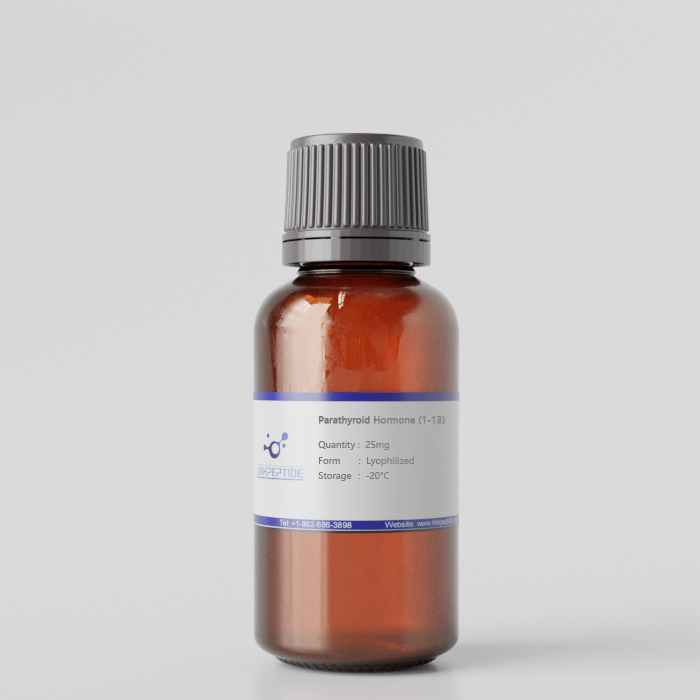
Product Name: Parathyroid Hormone (1-13)
Sequence One Letter Code: SVSEIQLMHNLGK
Sequence Three Letter Code: H-Ser-Val-Ser-Glu-Ile-Gln-Leu-Met-His-Asn-Leu-Gly-Lys-OH
Chemical Formula:C62H106N18O20S1
Molecular Weight: 1455.8
Purity: 95%
Form: Lyophilized
Storage Conditions: - 20 °C
Research Area: Endocrinology Disease Research
Source / Species: human, pig, horse, monkey
Conjugation: Unconjugated
Code Nacres: NA.26
Application: Parathyroid Hormone (1–13) is a synthetic peptide representing the biologically active N-terminal region of parathyroid hormone responsible for receptor activation. This fragment is commonly used as a surrogate for full-length PTH in analytical, biochemical, and immunological assays. It is particularly valuable for developing and validating diagnostic methods capable of distinguishing intact PTH from truncated forms, which is essential for accurate assessment of calcium homeostasis and bone metabolism disorders. The peptide supports research in endocrinology, osteoporosis, and clinical assay development related to parathyroid and mineral metabolism diseases.
Current Research: Parathyroid Hormone (1–13) is a synthetic peptide corresponding to the N-terminal 13 amino acids of human parathyroid hormone (PTH), encompassing the receptor-activating region of the molecule. Full-length PTH is an 84–amino acid peptide secreted by the parathyroid glands and plays a central role in regulating calcium and phosphate homeostasis. The N-terminal domain, particularly residues 1–13 and 1–34, is responsible for binding and activating the parathyroid hormone type 1 receptor (PTH1R), a class B G protein–coupled receptor expressed primarily in bone and kidney. The N-terminal region of PTH is essential for receptor engagement and downstream signaling. Upon binding to PTH1R, PTH stimulates adenylate cyclase via G_s protein activation, increasing intracellular cAMP levels and activating protein kinase A (PKA). It can also activate phospholipase C through G_q coupling, contributing to calcium mobilization and additional signaling cascades. These pathways mediate PTH’s physiological effects, including stimulation of osteoclast-mediated bone resorption (indirectly via osteoblast signaling), enhancement of renal calcium reabsorption, and promotion of phosphate excretion. Although the (1–34) fragment retains full biological activity and is used therapeutically (e.g., teriparatide), the shorter (1–13) fragment contains key residues involved in receptor activation and is frequently employed in analytical and structural studies. Parathyroid Hormone (1–13) serves as a minimal active-region surrogate for investigating receptor-binding motifs, antibody recognition sites, and epitope mapping. Its defined length makes it particularly suitable for biochemical assays requiring high specificity and reduced structural complexity. In clinical endocrinology, accurate measurement of circulating PTH is essential for diagnosing and managing disorders such as primary and secondary hyperparathyroidism, hypoparathyroidism, chronic kidney disease–related mineral bone disorder (CKD-MBD), and osteoporosis. Circulating PTH exists not only as intact PTH (1–84) but also as various truncated fragments, particularly C-terminal fragments that accumulate in renal impairment. Immunoassays must distinguish biologically active intact PTH from inactive fragments to provide clinically meaningful results. Parathyroid Hormone (1–13) is widely used in the development and validation of diagnostic assays designed to detect intact PTH. Because the N-terminal sequence is present only in full-length hormone and not in many truncated forms, antibodies targeting this region are incorporated into “second-generation” or “intact” PTH assays. The synthetic (1–13) peptide serves as a calibration standard, specificity control, or competitive binding reagent in immunoassay optimization. In biochemical research, the peptide is also applied in receptor-binding assays and structure–function analyses. Studies examining PTH1R activation mechanisms use defined N-terminal fragments to probe receptor conformational changes, ligand–receptor interaction interfaces, and signal bias. Structural studies, including crystallography and computational modeling, rely on short N-terminal peptides to elucidate the molecular determinants of receptor activation. In osteoporosis and bone metabolism research, PTH signaling is studied in the context of anabolic versus catabolic bone effects. Intermittent PTH exposure promotes bone formation, whereas continuous exposure favors bone resorption. Although the (1–13) fragment is not typically used therapeutically, it provides a mechanistic tool for dissecting receptor activation domains relevant to bone biology. Overall, Parathyroid Hormone (1–13) is a defined N-terminal fragment that captures the receptor-interacting region of PTH. It supports analytical assay development, immunological specificity testing, and receptor signaling studies. Its applications span endocrinology research, diagnostic assay validation, and investigations into calcium and bone metabolism disorders.
Get a Quote


 LinkPeptide