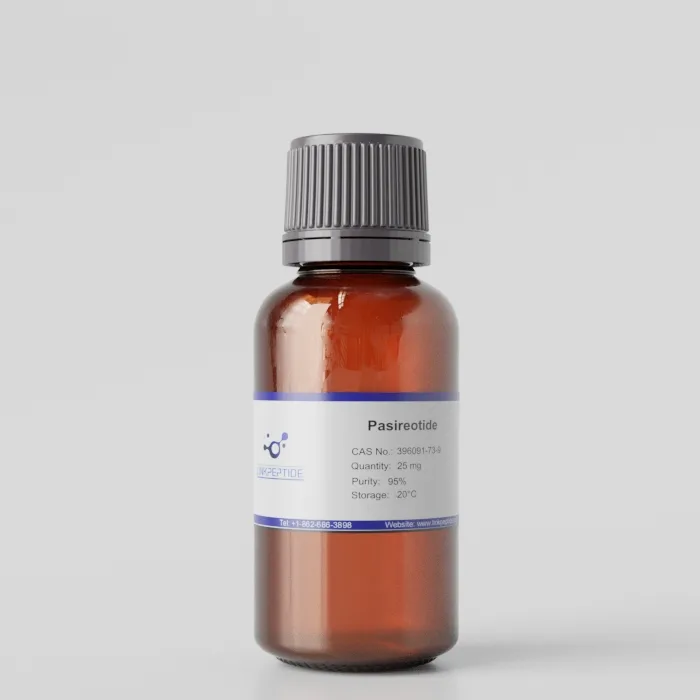
Product Name: Pasireotide
Form: Acetate salt
CAS No: 396091-73-9
Molar Mass: 1047.21
Chemical Formula: C58H66N10O9
Synonyms: SOM230
Storage: Store at -20 degrees Celsius
Sequence: Cyclo[{4-(NH2-C2H4-NH-CO-O-)Pro}-Phg-{D-Trp}-K-{Tyr(4-Bzl)}-F]
Target: somatostatin receptors
Application:
Pasireotide (CAS: 396091-73-9) is a synthetic cyclohexapeptide analog of somatostatin used in the treatment of Cushing's disease, a condition characterized by excessive cortisol production due to pituitary adenomas. It functions by binding to somatostatin receptors, particularly subtype 1, 2, 3, and 5 (SST1, SST2, SST3, and SST5), which are overexpressed in corticotroph adenomas. Pasireotide inhibits the secretion of adrenocorticotropic hormone (ACTH) from pituitary adenomas, thereby reducing cortisol production by the adrenal glands. This leads to the normalization of cortisol levels and alleviation of symptoms associated with Cushing's disease, such as weight gain, hypertension, and glucose intolerance. In pharmaceutical chemistry, pasireotide's targeted binding to somatostatin receptors represents a significant advancement in the management of Cushing's disease, offering a specific and effective therapeutic option for patients with this rare endocrine disorder. Its application underscores its importance in endocrinology and improving hormonal balance in individuals with Cushing's disease. Additionally, ongoing research explores pasireotide's potential in other neuroendocrine disorders and its role in combination therapies, highlighting its versatility in endocrine therapeutics.
Current Research:
Pasireotide, a synthetic cyclohexapeptide and somatostatin analog, has emerged as a pivotal agent in the treatment of endocrine disorders. With high affinity for multiple somatostatin receptor subtypes (SSTR1, SSTR2, SSTR3, and SSTR5), pasireotide offers broader therapeutic potential compared to traditional analogs like octreotide. Its enhanced receptor binding profile has positioned it as a cornerstone in managing complex conditions, such as Cushing's disease and acromegaly.
In drug discovery, pasireotide represents a paradigm shift due to its ability to target multiple SSTR pathways. Its action in suppressing adrenocorticotropic hormone (ACTH) secretion makes it highly effective for hypercortisolism management in Cushing's disease. Studies highlight its ability to normalize cortisol levels in patients resistant to other treatments, offering hope for those with limited options.
Pasireotide also demonstrates efficacy in treating acromegaly by inhibiting growth hormone secretion and reducing insulin-like growth factor 1 (IGF-1) levels. Unlike traditional therapies, its broader receptor engagement allows for therapeutic effects in patients with diverse receptor expression profiles.
Emerging research is exploring pasireotide’s potential in oncology, particularly in neuroendocrine tumors (NETs). Its antiproliferative effects, mediated through SSTR signaling, indicate utility in slowing tumor growth and reducing symptoms associated with hormone secretion. Additionally, preclinical investigations suggest potential benefits in pancreatic and pituitary tumors, where SSTR overexpression is common.
Challenges in pasireotide application, such as hyperglycemia induced by its impact on pancreatic islet cells, are being addressed through innovative combination therapies and molecular modifications to mitigate adverse effects.
Pasireotide’s versatility highlights the role of receptor-specific targeting in modern drug discovery. For researchers, it serves as a model for developing multi-receptor ligands, advancing treatments for endocrine and oncological disorders while underscoring the therapeutic promise of somatostatin analogs.
Get a Quote
 LinkPeptide