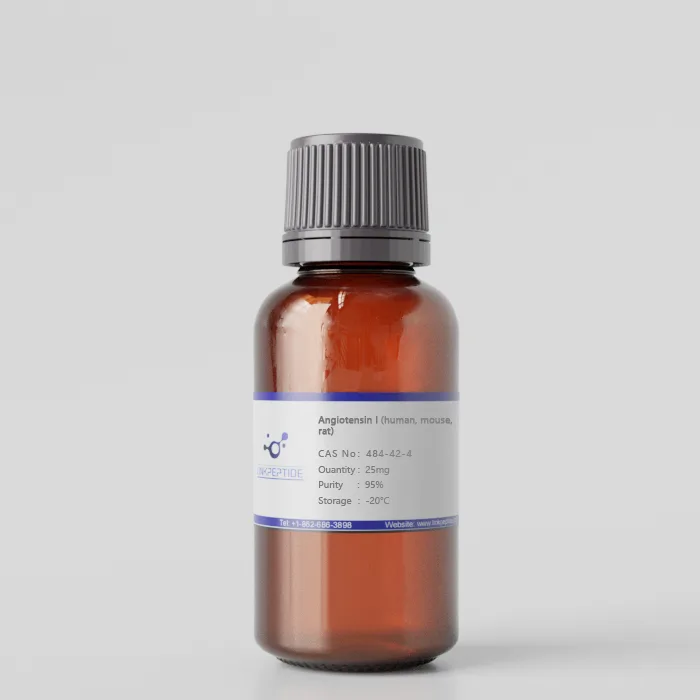
Product Name: Proadrenomedullin N-term peptide, PAMP (1-20)
Sequence One Letter Code: ARLDVASEFRKKWNKWALSR-NH2
Sequence Three Letter Code: H-Ala-Arg-Leu-Asp-Val-Ala-Ser-Glu-Phe-Arg-Lys-Lys-Trp-Asn-Lys-Trp-Ala-Leu-Ser-Arg-NH3
Cas No: 150238-87-2
Chemical Formula:C112H178N36O27
Molecular Weight: 2461
Purity: 95%
Form: Lyophilized
Storage Conditions: - 20 °C
Research Area: Cardiovascular Disease Research
SMILES: C[C@@H](C(=O)N[C@@H](CCCNC(=N)N)C(=O)N[C@@H](CC(C)C)C(=O)N[C@@H](CC(=O)O)C(=O)N[C@@H](C(C)C)C(=O)N[C@@H](C)C(=O)N[C@@H](CO)C(=O)N[C@@H](CCC(=O)O)C(=O)N[C@@H](CC1=CC=CC=C1)C(=O)N[C@@H](CCCNC(=N)N)C(=O)N[C@@H](CCCCN)C(=O)N[C@@H](CCCCN)C(=O)N[C@@H](CC2=CNC3=CC=CC=C32)C(=O)N[C@@H](CC(=O)N)C(=O)N[C@@H](CCCCN)C(=O)N[C@@H](CC4=CNC5=CC=CC=C54)C(=O)N[C@@H](C)C(=O)N[C@@H](CC(C)C)C(=O)N[C@@H](CO)C(=O)N[C@@H](CCCNC(=N)N)C(=O)N)N
IUPAC: (4S)-5-[[(2S)-1-[[(2S)-1-[[(2S)-6-amino-1-[[(2S)-6-amino-1-[[(2S)-1-[[(2S)-4-amino-1-[[(2S)-6-amino-1-[[(2S)-1-[[(2S)-1-[[(2S)-1-[[(2S)-1-[[(2S)-1-amino-5-carbamimidamido-1-oxopentan-2-yl]amino]-3-hydroxy-1-oxopropan-2-yl]amino]-4-methyl-1-oxopentan-2-yl]amino]-1-oxopropan-2-yl]amino]-3-(1H-indol-3-yl)-1-oxopropan-2-yl]amino]-1-oxohexan-2-yl]amino]-1,4-dioxobutan-2-yl]amino]-3-(1H-indol-3-yl)-1-oxopropan-2-yl]amino]-1-oxohexan-2-yl]amino]-1-oxohexan-2-yl]amino]-5-carbamimidamido-1-oxopentan-2-yl]amino]-1-oxo-3-phenylpropan-2-yl]amino]-4-[[(2S)-2-[[(2S)-2-[[(2S)-2-[[(2S)-2-[[(2S)-2-[[(2S)-2-[[(2S)-2-aminopropanoyl]amino]-5-carbamimidamidopentanoyl]amino]-4-methylpentanoyl]amino]-3-carboxypropanoyl]amino]-3-methylbutanoyl]amino]propanoyl]amino]-3-hydroxypropanoyl]amino]-5-oxopentanoic acid
INCHIKEY: PIRWNASAJNPKHT-SHZATDIYSA-N
INCHI:
InChI=1S/C112H178N36O27/c1-57(2)46-77(102(168)147-85(56-150)107(173)132-70(90(118)156)35-23-43-125-110(119)120)139-92(158)61(8)130-100(166)80(49-64-53-128-68-30-15-13-28-66(64)68)142-97(163)73(34-19-22-42-115)136-105(171)82(51-86(117)151)144-104(170)81(50-65-54-129-69-31-16-14-29-67(65)69)143-96(162)72(33-18-21-41-114)135-94(160)71(32-17-20-40-113)134-95(161)75(37-25-45-127-112(123)124)137-103(169)79(48-63-26-11-10-12-27-63)141-99(165)76(38-39-87(152)153)138-108(174)84(55-149)146-93(159)62(9)131-109(175)89(59(5)6)148-106(172)83(52-88(154)155)145-101(167)78(47-58(3)4)140-98(164)74(133-91(157)60(7)116)36-24-44-126-111(121)122/h10-16,26-31,53-54,57-62,70-85,89,128-129,149-150H,17-25,32-52,55-56,113-116H2,1-9H3,(H2,117,151)(H2,118,156)(H,130,166)(H,131,175)(H,132,173)(H,133,157)(H,134,161)(H,135,160)(H,136,171)(H,137,169)(H,138,174)(H,139,158)(H,140,164)(H,141,165)(H,142,163)(H,143,162)(H,144,170)(H,145,167)(H,146,159)(H,147,168)(H,148,172)(H,152,153)(H,154,155)(H4,119,120,125)(H4,121,122,126)(H4,123,124,127)/t60-,61-,62-,70-,71-,72-,73-,74-,75-,76-,77-,78-,79-,80-,81-,82-,83-,84-,85-,89-/m0/s1
Source / Species: human
Conjugation: Unconjugated
Code Nacres: NA.26
Application: PAMP (1–20) is a biologically active peptide generated through post-translational processing of proadrenomedullin. It is broadly expressed in multiple tissues and exerts its effects through specific cell surface receptors. PAMP participates in diverse physiological processes, including vasodilation, bronchodilation, hormone secretion, angiogenesis, apoptosis, and cell migration. Dysregulated PAMP signaling has been implicated in cardiovascular and renal disorders, stroke, metabolic disease, and cancer progression. This peptide is widely used in cardiovascular, metabolic, and oncology research to study receptor-mediated signaling pathways, vascular regulation, and peptide hormone–dependent cellular responses.
Current Research: PAMP (1–20), also known as proadrenomedullin N-terminal 20 peptide, is a bioactive fragment generated by proteolytic processing of the proadrenomedullin precursor. Proadrenomedullin gives rise to multiple biologically active peptides, including adrenomedullin (ADM) and PAMP, each with distinct receptor interactions and physiological roles. PAMP (1–20) corresponds to the N-terminal region of the precursor and is widely expressed in cardiovascular, renal, pulmonary, endocrine, and neural tissues. Current research characterizes PAMP as a multifunctional regulatory peptide involved in cardiovascular homeostasis and neurohumoral signaling. One of its most studied effects is vasodilation. PAMP can reduce vascular tone through receptor-mediated pathways that influence intracellular calcium dynamics and nitric oxide signaling in vascular smooth muscle and endothelial cells. These actions contribute to blood pressure regulation and modulation of systemic vascular resistance. In experimental models, exogenous PAMP administration produces hypotensive responses, supporting its role in cardiovascular control. Beyond vasodilation, PAMP has been shown to exert bronchodilatory effects in airway tissues, suggesting participation in pulmonary smooth muscle regulation. This has prompted investigations into its relevance in respiratory physiology and inflammatory airway conditions. The peptide’s ability to modulate smooth muscle contractility appears to involve GPCR-dependent signaling pathways that regulate second messengers such as cAMP and intracellular calcium. In endocrine and metabolic research, PAMP influences hormone secretion and metabolic balance. Studies indicate regulatory effects on insulin release and adrenal hormone secretion, implicating the peptide in glucose homeostasis and stress responses. Alterations in circulating levels of proadrenomedullin-derived peptides have been associated with metabolic syndrome and cardiovascular risk, positioning PAMP within broader networks that integrate vascular and metabolic signaling. Angiogenesis and cell migration are additional areas of active investigation. PAMP has been reported to promote endothelial cell migration and contribute to angiogenic processes under certain conditions. These properties intersect with tumor biology, where peptide-mediated vascular remodeling and cell motility may influence tumor progression and metastasis. Dysregulated PAMP signaling has been implicated in oncogenic contexts, although its role may vary depending on tumor type and microenvironmental factors. Apoptosis modulation represents another dimension of PAMP activity. Experimental studies suggest that PAMP can influence survival pathways in endothelial and other cell types, potentially through modulation of MAPK and PI3K/AKT signaling cascades. These pathways link peptide hormone signaling to cellular proliferation, stress adaptation, and tissue remodeling. In renal physiology, PAMP contributes to regulation of renal blood flow and sodium handling. Its vasodilatory and natriuretic-related actions are investigated in models of hypertension and kidney injury. Because proadrenomedullin peptides are elevated in certain renal and cardiovascular disorders, PAMP is of interest as both a mechanistic mediator and a potential biomarker-associated factor. Methodologically, PAMP (1–20) is used in receptor activation assays, vascular ring contraction studies, calcium imaging experiments, and hormone secretion assays. In vivo studies assess hemodynamic parameters, renal function, and metabolic endpoints following systemic administration. Molecular investigations focus on identifying receptor subtypes, downstream effectors, and cross-talk with other vasoactive peptides. Overall, PAMP (1–20) is a biologically active proadrenomedullin-derived peptide with diverse roles in vascular regulation, endocrine signaling, and cellular homeostasis. Its involvement in vasodilation, bronchodilation, hormone secretion, angiogenesis, and apoptosis underscores its significance in cardiovascular, metabolic, renal, and oncologic research. As interest grows in peptide-mediated regulation of systemic homeostasis, PAMP remains a valuable tool for dissecting receptor-mediated signaling pathways and disease-associated signaling dysregulation.
Get a Quote
 LinkPeptide

![Lys-[Des-Arg9]Bradykinin](https://www.linkpeptide.com/wp-content/uploads/2024/10/Lys-Des-Arg9Bradykinin-jpg-3.webp "Lys-[Des-Arg9]Bradykinin")