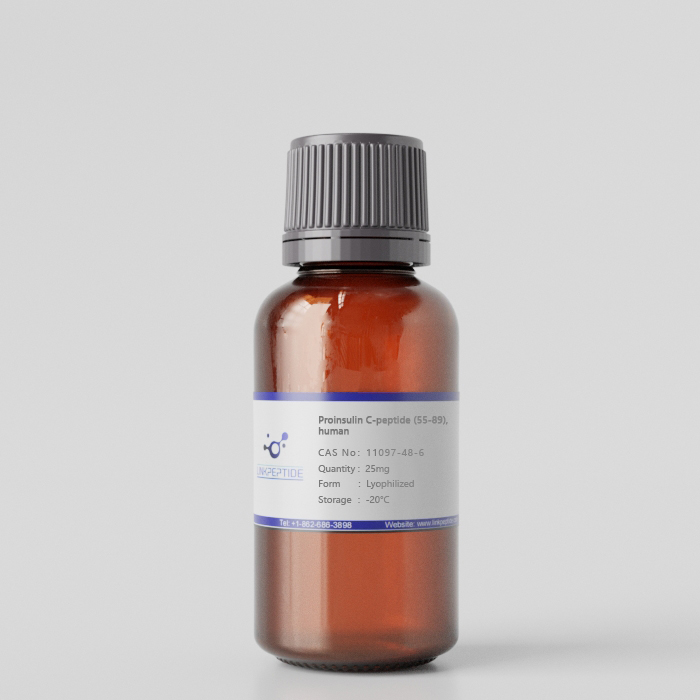
Product Name: Proinsulin C-peptide (55-89), human
Sequence One Letter Code: RREAEDLQVGQVELGGGPGAGSLQPLALEGSLQKR
Sequence Three Letter Code: H-Arg-Arg-Glu-Ala-Glu-Asp-Leu-Gln-Val-Gly-Gln-Val-Glu-Leu-Gly-Gly-Gly-Pro-Gly-Ala-Gly-Ser-Leu-Gln-Pro-Leu-Ala-Leu-Glu-Gly-Ser-Leu-Gln-Lys-Arg-OH
Cas No: 11097-48-6
Chemical Formula:C153H259N49O52
Molecular Weight: 3617.3
Purity: 95%
Form: Lyophilized
Storage Conditions: - 20 °C
Research Area: Diabetes and Metabolic Syndrome
SMILES: C[C@@H](C(=O)NCC(=O)N[C@@H](CO)C(=O)N[C@@H](CC(C)C)C(=O)N[C@@H](CCC(=O)N)C(=O)N1CCC[C@H]1C(=O)N[C@@H](CC(C)C)C(=O)N[C@@H](C)C(=O)N[C@@H](CC(C)C)C(=O)N[C@@H](CCC(=O)O)C(=O)NCC(=O)N[C@@H](CO)C(=O)N[C@@H](CC(C)C)C(=O)N[C@@H](CCC(=O)N)C(=O)N[C@@H](CCCCN)C(=O)N[C@@H](CCCNC(=N)N)C(=O)O)NC(=O)CNC(=O)[C@@H]2CCCN2C(=O)CNC(=O)CNC(=O)CNC(=O)[C@H](CC(C)C)NC(=O)[C@H](CCC(=O)O)NC(=O)[C@H](C(C)C)NC(=O)[C@H](CCC(=O)N)NC(=O)CNC(=O)[C@H](C(C)C)NC(=O)[C@H](CCC(=O)N)NC(=O)[C@H](CC(C)C)NC(=O)[C@H](CC(=O)O)NC(=O)[C@H](CCC(=O)O)NC(=O)[C@H](C)NC(=O)[C@H](CCC(=O)O)NC(=O)[C@H](CCCNC(=N)N)NC(=O)[C@H](CCCNC(=N)N)N
IUPAC: (4S)-5-[[(2S)-1-[[(2S)-1-[[(2S)-5-amino-1-[[(2S)-1-[[2-[[(2S)-5-amino-1-[[(2S)-1-[[(2S)-1-[[(2S)-1-[[2-[[2-[[2-[(2S)-2-[[2-[[(2S)-1-[[2-[[(2S)-1-[[(2S)-1-[[(2S)-5-amino-1-[(2S)-2-[[(2S)-1-[[(2S)-1-[[(2S)-1-[[(2S)-1-[[2-[[(2S)-1-[[(2S)-1-[[(2S)-5-amino-1-[[(2S)-6-amino-1-[[(1S)-4-carbamimidamido-1-carboxybutyl]amino]-1-oxohexan-2-yl]amino]-1,5-dioxopentan-2-yl]amino]-4-methyl-1-oxopentan-2-yl]amino]-3-hydroxy-1-oxopropan-2-yl]amino]-2-oxoethyl]amino]-4-carboxy-1-oxobutan-2-yl]amino]-4-methyl-1-oxopentan-2-yl]amino]-1-oxopropan-2-yl]amino]-4-methyl-1-oxopentan-2-yl]carbamoyl]pyrrolidin-1-yl]-1,5-dioxopentan-2-yl]amino]-4-methyl-1-oxopentan-2-yl]amino]-3-hydroxy-1-oxopropan-2-yl]amino]-2-oxoethyl]amino]-1-oxopropan-2-yl]amino]-2-oxoethyl]carbamoyl]pyrrolidin-1-yl]-2-oxoethyl]amino]-2-oxoethyl]amino]-2-oxoethyl]amino]-4-methyl-1-oxopentan-2-yl]amino]-4-carboxy-1-oxobutan-2-yl]amino]-3-methyl-1-oxobutan-2-yl]amino]-1,5-dioxopentan-2-yl]amino]-2-oxoethyl]amino]-3-methyl-1-oxobutan-2-yl]amino]-1,5-dioxopentan-2-yl]amino]-4-methyl-1-oxopentan-2-yl]amino]-3-carboxy-1-oxopropan-2-yl]amino]-4-[[(2S)-2-[[(2S)-2-[[(2S)-2-[[(2S)-2-amino-5-carbamimidamidopentanoyl]amino]-5-carbamimidamidopentanoyl]amino]-4-carboxybutanoyl]amino]propanoyl]amino]-5-oxopentanoic acid
INCHIKEY: JEPNOJXFZHBCTB-ZCUALFGZSA-N
INCHI:
InChI=1S/C153H259N49O52/c1-71(2)55-94(193-134(237)91(40-48-119(222)223)189-148(251)122(78(15)16)200-135(238)86(33-41-105(156)205)179-112(212)67-175-147(250)121(77(13)14)199-136(239)88(35-43-107(158)207)188-139(242)97(58-74(7)8)194-142(245)100(61-120(224)225)197-133(236)90(39-47-118(220)221)182-124(227)80(18)177-129(232)89(38-46-117(218)219)186-130(233)84(29-23-51-167-152(162)163)183-126(229)82(155)27-22-50-166-151(160)161)128(231)172-63-110(210)169-62-109(209)170-68-115(215)201-53-25-31-103(201)145(248)174-64-111(211)176-79(17)123(226)171-65-113(213)180-101(69-203)144(247)196-99(60-76(11)12)141(244)190-92(36-44-108(159)208)149(252)202-54-26-32-104(202)146(249)198-95(56-72(3)4)137(240)178-81(19)125(228)192-96(57-73(5)6)138(241)185-85(37-45-116(216)217)127(230)173-66-114(214)181-102(70-204)143(246)195-98(59-75(9)10)140(243)187-87(34-42-106(157)206)132(235)184-83(28-20-21-49-154)131(234)191-93(150(253)254)30-24-52-168-153(164)165/h71-104,121-122,203-204H,20-70,154-155H2,1-19H3,(H2,156,205)(H2,157,206)(H2,158,207)(H2,159,208)(H,169,210)(H,170,209)(H,171,226)(H,172,231)(H,173,230)(H,174,248)(H,175,250)(H,176,211)(H,177,232)(H,178,240)(H,179,212)(H,180,213)(H,181,214)(H,182,227)(H,183,229)(H,184,235)(H,185,241)(H,186,233)(H,187,243)(H,188,242)(H,189,251)(H,190,244)(H,191,234)(H,192,228)(H,193,237)(H,194,245)(H,195,246)(H,196,247)(H,197,236)(H,198,249)(H,199,239)(H,200,238)(H,216,217)(H,218,219)(H,220,221)(H,222,223)(H,224,225)(H,253,254)(H4,160,161,166)(H4,162,163,167)(H4,164,165,168)/t79-,80-,81-,82-,83-,84-,85-,86-,87-,88-,89-,90-,91-,92-,93-,94-,95-,96-,97-,98-,99-,100-,101-,102-,103-,104-,121-,122-/m0/s1
Source / Species: human
Conjugation: Unconjugated
Code Nacres: NA.26
Application: Proinsulin C-Peptide (55–89), human, corresponds to the connecting peptide sequence within human proinsulin, the precursor molecule composed of insulin A and B chains linked by the C-peptide region. During insulin biosynthesis, the C-peptide ensures correct folding and disulfide bond formation of the insulin chains before being cleaved by prohormone convertases at paired basic residues. Although absent from mature insulin, C-peptide is co-stored and co-secreted with insulin in near equimolar amounts and exhibits a longer circulatory half-life. This property makes it a reliable marker of pancreatic β-cell function and endogenous insulin secretion. Proinsulin C-Peptide (55–89) is widely used in metabolic and diabetes research to study insulin biosynthesis, secretion dynamics, and C-peptide–mediated signaling pathways relevant to glucose homeostasis and endocrine regulation.
Current Research: Proinsulin C-Peptide (55–89), human, corresponds to the connecting (C-) peptide region of human proinsulin, the precursor molecule composed of the insulin A chain and B chain linked by this central segment. During insulin biosynthesis within pancreatic β cells, preproinsulin undergoes signal peptide removal in the endoplasmic reticulum to form proinsulin. The C-peptide region plays a critical structural role at this stage, maintaining proper alignment of the A and B chains and facilitating correct disulfide bond formation essential for functional insulin maturation. Following proper folding, proinsulin is transported to secretory granules, where prohormone convertases cleave at paired basic residues flanking the C-peptide. This proteolytic processing releases mature insulin and free C-peptide, which are subsequently co-stored and co-secreted into circulation in near equimolar amounts. Although C-peptide is not part of the final insulin molecule, its parallel secretion profile makes it a valuable indicator of endogenous insulin production. A key distinguishing feature of C-peptide is its longer circulatory half-life compared with insulin. While insulin is subject to rapid hepatic first-pass metabolism, C-peptide is cleared primarily by the kidneys, resulting in more stable plasma concentrations. This pharmacokinetic difference makes Proinsulin C-Peptide (55–89) an important tool in metabolic research and clinical investigations aimed at assessing pancreatic β-cell function. Measurement of C-peptide levels allows accurate evaluation of insulin secretion dynamics, particularly in individuals receiving exogenous insulin therapy where direct insulin quantification may not reflect endogenous production. Beyond its established role as a biomarker, C-peptide has been shown to exert biological activity through interaction with specific cell surface sites. Experimental studies suggest that it can trigger intracellular signaling events involving calcium influx and activation of downstream pathways such as phospholipase C, protein kinase C isoforms, ERK1/2, JNK, and Akt. These signaling cascades link C-peptide to cellular processes including survival, proliferation, and cytoskeletal regulation. Additionally, C-peptide has been reported to influence Na⁺/K⁺-ATPase activity and endothelial nitric oxide synthase, implicating it in vascular and microcirculatory function. Proinsulin C-Peptide (55–89) is widely used in studies examining insulin biosynthesis and secretion dynamics. In vitro and ex vivo systems employ the peptide to investigate β-cell physiology, prohormone processing efficiency, and regulated exocytosis mechanisms. Its defined sequence enables controlled analysis of C-peptide–specific signaling effects separate from insulin action, facilitating exploration of distinct endocrine regulatory pathways. In diabetes research, this peptide supports investigation into residual β-cell activity in type 1 diabetes, altered secretion patterns in type 2 diabetes, and the relationship between C-peptide levels and microvascular complications. Studies exploring potential protective effects of C-peptide on renal, neural, and vascular tissues frequently utilize defined C-peptide constructs to delineate mechanistic pathways. Overall, Proinsulin C-Peptide (55–89), human, provides a structurally defined and physiologically relevant tool for studying insulin biosynthesis, endocrine secretion dynamics, and C-peptide–mediated signaling. Its importance as both a biomarker of β-cell function and a biologically active peptide makes it central to metabolic, diabetes, and endocrine research focused on glucose homeostasis and pancreatic regulation.
Get a Quote
 LinkPeptide