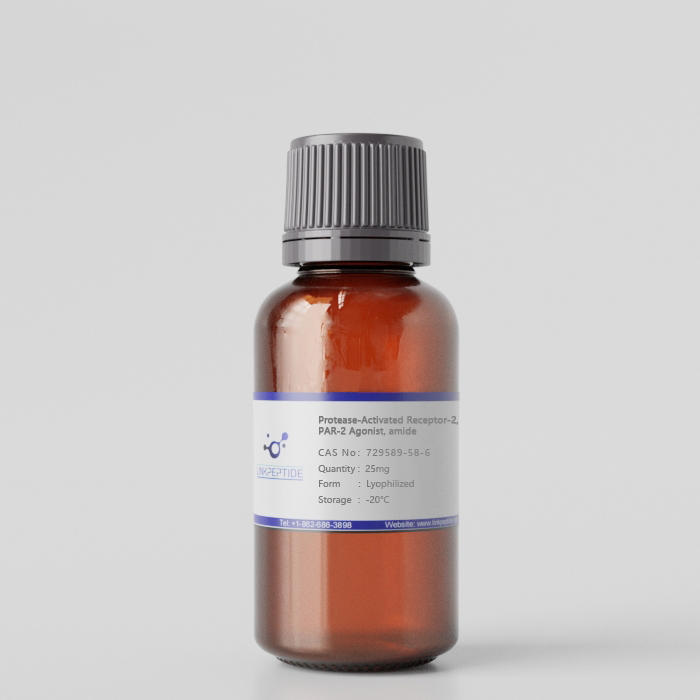
Product Name: Protease-Activated Receptor-2, PAR-2 Agonist, amide
Sequence One Letter Code: 2-Furoyl-LIGRLO-NH2
Sequence Three Letter Code: 2-Furoyl-Leu-Ile-Gly-Arg-Leu-Orn-NH2
Cas No: 729589-58-6
Chemical Formula:C36H63N11O8
Molecular Weight: 778
Purity: 95%
Form: Lyophilized
Storage Conditions: - 20 °C
Research Area: Inflammation and Immunology Research
SMILES: CC[C@H](C)[C@@H](C(=O)NCC(=O)N[C@@H](CCCN=C(N)N)C(=O)N[C@@H](CC(C)C)C(=O)N[C@@H](CCCN)C(=O)N)NC(=O)[C@H](CC(C)C)NC(=O)C1=CC=CO1
IUPAC: N-[(2S)-1-[[(2S,3S)-1-[[2-[[(2S)-5-(diaminomethylideneamino)-1-[[(2S)-1-[[(2S)-1,5-diamino-1-oxopentan-2-yl]amino]-4-methyl-1-oxopentan-2-yl]amino]-1-oxopentan-2-yl]amino]-2-oxoethyl]amino]-3-methyl-1-oxopentan-2-yl]amino]-4-methyl-1-oxopentan-2-yl]furan-2-carboxamide
INCHIKEY: OSKIRYSKGDEIOG-WTWMNNMUSA-N
INCHI:
InChI=1S/C36H63N11O8/c1-7-22(6)29(47-33(52)26(18-21(4)5)46-34(53)27-13-10-16-55-27)35(54)42-19-28(48)43-24(12-9-15-41-36(39)40)31(50)45-25(17-20(2)3)32(51)44-23(30(38)49)11-8-14-37/h10,13,16,20-26,29H,7-9,11-12,14-15,17-19,37H2,1-6H3,(H2,38,49)(H,42,54)(H,43,48)(H,44,51)(H,45,50)(H,46,53)(H,47,52)(H4,39,40,41)/t22-,23-,24-,25-,26-,29-/m0/s1
Source / Species: human
Conjugation: Unconjugated
Code Nacres: NA.26
Application: Protease-Activated Receptor-2 (PAR-2) Agonist, amide (2-furoyl-LIGRLO-NH₂), is a potent and selective synthetic peptide that activates PAR-2, a G protein–coupled receptor involved in inflammatory, nociceptive, and vascular signaling. This agonist induces robust intracellular calcium mobilization in human and rodent PAR-2–expressing cells and demonstrates enhanced potency compared with earlier PAR-2 activators in tissue-based assays. PAR-2 signaling contributes to inflammatory responses, gastrointestinal physiology, and pain pathways. This peptide is widely used in research examining receptor-mediated calcium signaling, inflammatory mechanisms, sensory biology, and pathophysiological processes regulated by PAR-2 activation.
Current Research: Protease-Activated Receptor-2 (PAR-2) Agonist, amide (2-furoyl-LIGRLO-NH₂), is a synthetic hexapeptide analog designed to selectively activate PAR-2, a member of the protease-activated receptor family of G protein–coupled receptors (GPCRs). PAR-2 is physiologically activated by serine proteases such as trypsin, tryptase, and certain coagulation factors, which cleave the receptor’s N-terminal extracellular domain to expose a tethered ligand sequence. The synthetic agonist mimics this tethered ligand while incorporating a 2-furoyl modification at the N-terminus and C-terminal amidation to enhance potency, receptor affinity, and metabolic stability. Mechanistically, PAR-2 activation couples to multiple G protein pathways, including G_q/11, G_i/o, and G_12/13, leading to phospholipase C activation, inositol trisphosphate (IP₃) generation, and rapid intracellular calcium mobilization. The 2-furoyl-LIGRLO-NH₂ peptide induces robust calcium transients in PAR-2–expressing human and rodent cells, making it a widely adopted tool in calcium imaging assays. Compared with earlier PAR-2 agonists such as SLIGRL, the 2-furoyl derivative demonstrates enhanced potency and improved efficacy in tissue-based and in vitro systems. In inflammatory research, PAR-2 is recognized as a key mediator linking protease activity to immune signaling. Activation promotes production of pro-inflammatory cytokines, chemokines, and adhesion molecules in epithelial, endothelial, and immune cells. The receptor is implicated in conditions such as inflammatory bowel disease, asthma, dermatitis, and arthritis. Using 2-furoyl-LIGRLO-NH₂, investigators can selectively stimulate PAR-2 to dissect downstream signaling pathways, including MAPK activation, NF-κB–dependent transcription, and prostaglandin synthesis. PAR-2 also plays a prominent role in nociception and sensory biology. It is expressed in primary sensory neurons and contributes to pain sensitization through calcium-dependent signaling and modulation of ion channels such as TRPV1. Administration of PAR-2 agonist peptides in animal models induces hyperalgesia and inflammatory pain responses, providing a mechanistic link between protease activity and pain signaling. The enhanced potency of 2-furoyl-LIGRLO-NH₂ allows reproducible activation in neuronal cultures and in vivo models. In vascular and gastrointestinal physiology, PAR-2 influences smooth muscle contraction, epithelial barrier integrity, and secretory responses. Activation can regulate vascular permeability and endothelial function, contributing to inflammatory edema and barrier modulation. In the gastrointestinal tract, PAR-2 signaling affects motility, secretion, and mucosal immune responses. The peptide agonist is frequently used to study receptor-mediated changes in epithelial transport and barrier dynamics. Methodologically, 2-furoyl-LIGRLO-NH₂ is applied in fluorescence-based calcium flux assays, electrophysiological recordings, ERK phosphorylation studies, cytokine expression analyses, and in vivo inflammatory models. Its selectivity for PAR-2 allows investigators to distinguish PAR-2–dependent signaling from related receptors such as PAR-1 or PAR-4, which respond to thrombin rather than trypsin-like proteases. Additionally, the peptide serves as a pharmacologic reference in studies evaluating PAR-2 antagonists and biased signaling modulators. Because GPCRs can exhibit pathway-specific activation profiles, 2-furoyl-LIGRLO-NH₂ is used to characterize downstream signaling bias, receptor desensitization, and internalization dynamics. Overall, Protease-Activated Receptor-2 Agonist, amide (2-furoyl-LIGRLO-NH₂), is a potent and selective activator of PAR-2 that enables detailed investigation of receptor-mediated calcium signaling, inflammatory responses, nociceptive pathways, and vascular regulation. Its enhanced potency and stability make it a valuable tool in mechanistic and translational research focused on protease-driven pathophysiological processes.
Get a Quote
 LinkPeptide