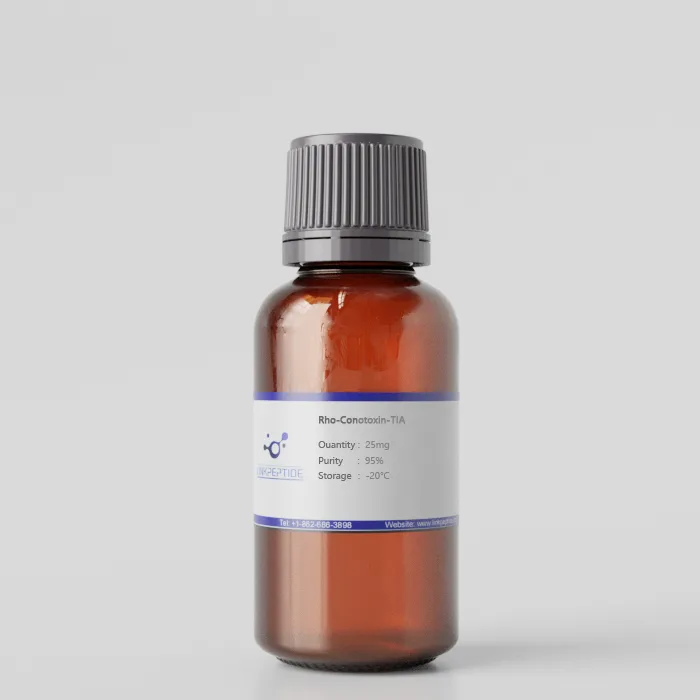
Product Name:Rho-Conotoxin-TIA
Purity:95%
Molar Mass:2390.9
Chemical Formula:C105H160N36O21S4
Storage:Store at -20 degrees Celsius
Sequence:Phe-Asn-Trp-Arg-Cys5-Cys6-Leu-Ile-Pro-Ala-Cys11-Arg-Arg-Asn-His-Lys-Lys-Phe-Cys19-NH2
Target:Blocker of ??1-adrenoreceptor
Application:Rho-Conotoxin TIA is a peptide toxin derived from the venom of the marine cone snail Conus tulipa. It selectively targets and inhibits alpha1-adrenoceptors, which are G-protein-coupled receptors involved in regulating smooth muscle contraction, vascular tone, and neurotransmitter release. By blocking these receptors, Rho-Conotoxin TIA interferes with adrenergic signaling, making it a valuable tool for studying the physiological roles of alpha1-adrenoceptors in cardiovascular function, smooth muscle control, and related disorders. Researchers use this toxin to explore therapeutic potential for conditions such as hypertension, vasospasm, and other disorders where alpha1-adrenergic signaling is implicated.
Current Research:
Rho-Conotoxin TIA (??-TIA) is a peptide toxin isolated from the venom of the fish-hunting cone snail Conus tulipa. This 19-amino-acid conopeptide functions as a selective antagonist of ???-adrenergic receptors (???-ARs), which are G protein-coupled receptors involved in various physiological processes, including vascular smooth muscle contraction and neurotransmitter release.
Structural Characteristics
The amino acid sequence of ??-TIA is:
Phe-Asn-Trp-Arg-Cys-Cys-Leu-Ile-Pro-Ala-Cys-Arg-Arg-Asn-His-Lys-Lys-Phe-Cys-NH?
This sequence includes two disulfide bonds, forming a characteristic conotoxin fold that is crucial for its receptor-binding specificity.
Mechanism of Action
??-TIA exhibits subtype-selective inhibition of ???-ARs:
???B-AR: Acts as a noncompetitive antagonist, binding to an allosteric site distinct from the orthosteric ligand-binding site.
???A-AR and ???D-AR: Functions as a competitive antagonist, directly competing with endogenous ligands for receptor binding.
The peptide shows approximately 10-fold selectivity for ???B-AR over ???A-AR and ???D-AR, with reported half-maximal inhibitory concentration (IC??) values of 2 nM for ???B-AR, 18 nM for ???A-AR, and 25 nM for ???D-AR.
Research Applications
Due to its specificity and potency, ??-TIA serves as a valuable tool in pharmacological research:
Receptor Characterization: Assists in elucidating the structural and functional dynamics of ???-AR subtypes, particularly in distinguishing between different receptor subtypes.
Drug Development: Insights into its interaction with ???-ARs contribute to the design of novel therapeutics for cardiovascular disorders and conditions involving dysfunctional adrenergic signaling.
Structural Studies
The high-resolution solution NMR structure of ??-TIA has been determined, providing detailed insights into its conformation and interaction with target receptors.
Conclusion
Rho-Conotoxin TIA is a potent and selective antagonist of ???-adrenergic receptors, offering significant insights into adrenergic signaling and potential therapeutic avenues for related disorders. Its applications extend from fundamental research to the development of novel pharmacological agents.
Reference:
Get a Quote
 LinkPeptide

![SCYLLATOXIN [Tyr2]-](https://www.linkpeptide.com/wp-content/uploads/2024/10/SCYLLATOXIN-Tyr2-jpg-2.webp "SCYLLATOXIN [Tyr2]-")