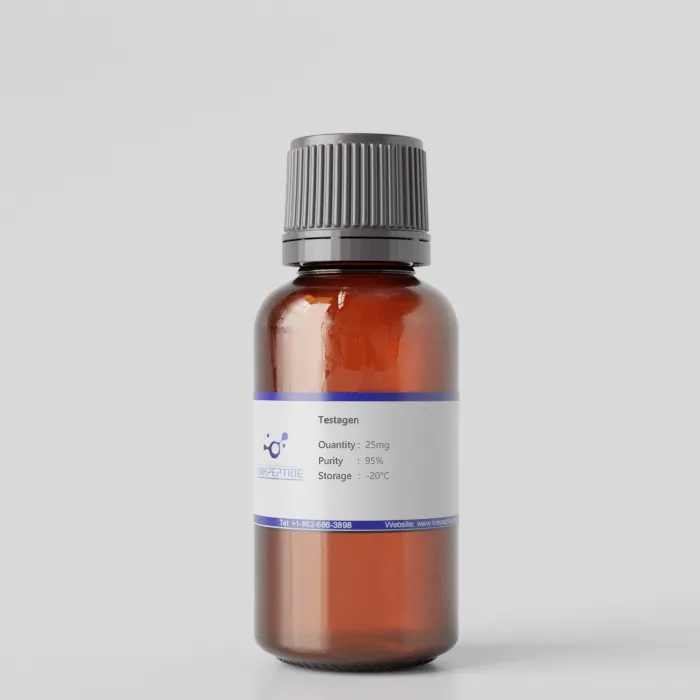
Product Name:Testagen
Purity:95%
Chemical Formula:C17H29N5O9
Molar Mass:447.4
Synonyms:Lys-Glu-Asp-Gly, 123863700
IUPAC Name:(4S)-5-[[(2S)-3-carboxy-1-(carboxymethylamino)-1-oxopropan-2-yl]amino]-4-[[(2S)-2,6-diaminohexanoyl]amino]-5-oxopentanoic acid
SMILES:C(CCN)C[C@@H](C(=O)N[C@@H](CCC(=O)O)C(=O)N[C@@H](CC(=O)O)C(=O)NCC(=O)O)N
InChIKey:HKEYFJLTNCUNAD-DCAQKATOSA-N
InChI:InChI=1S/C17H29N5O9/c18-6-2-1-3-9(19)15(29)21-10(4-5-12(23)24)17(31)22-11(7-13(25)26)16(30)20-8-14(27)28/h9-11H,1-8,18-19H2,(H,20,30)(H,21,29)(H,22,31)(H,23,24)(H,25,26)(H,27,28)/t9-,10-,11-/m0/s1
Storage:-20 degree Celsius
Sequence:KEDG
Application:Testagen is a short peptide bioregulator derived from testicular tissue, designed to support the restoration and maintenance of testicular endocrine function. It modulates gene expression related to spermatogenesis, testosterone synthesis, and Leydig cell activity, making it valuable in studies on age-related androgen decline, male infertility, and endocrine system aging. Testagen enhances testicular tissue repair, supports hormonal feedback stability, and improves sperm quality and testicular histology in preclinical models. It is a key research tool in andrology, gerontology, and peptide-based reproductive system support, particularly in the study of hypogonadism and male reproductive longevity.
Current Research:
Introduction: What Is Testagen?
Testagen is a cytogenetic peptide bioregulator, developed through the scientific research of the St. Petersburg Institute of Bioregulation and Gerontology. It is derived from testicular tissue peptides and functions by regulating gene expression within testicular cells, particularly Leydig and Sertoli cells, which are critical for testosterone production and spermatogenesis, respectively.
Like other bioregulators in its class, Testagen exerts epigenetic activity, binding to specific DNA sequences to restore physiological gene activity suppressed by aging, chronic stress, or hormonal disruption. This makes it highly relevant in studies involving androgen deficiency, testicular aging, and male reproductive dysfunction.
Mechanism of Action: Epigenetic Regulation of Testicular Function
Testagen operates through chromatin-level interactions, where it:
Modulates the expression of genes related to:
Testosterone synthesis (e.g., StAR, CYP11A1)
Spermatogenesis regulation
Mitochondrial function and oxidative defense
Enhances cellular protein synthesis in testicular tissues
Reduces oxidative and inflammatory stress, which commonly impair testicular function
This action supports the functional integrity of Leydig and Sertoli cells, helping to normalize hormone levels and maintain sperm production capacity.
Applications in Hypogonadism and Androgen Decline
In preclinical models of age-related hypogonadism, Testagen has demonstrated the ability to:
Restore plasma testosterone levels
Improve testicular histological structure, including seminiferous tubule diameter and germ cell layers
Increase spermatogenic activity
Reduce testicular fibrosis and lipid peroxidation markers
These effects suggest that Testagen can be used in research investigating non-steroidal restoration of androgen production, offering a potential strategy for mitigating the effects of aging on the male endocrine system.
Fertility and Reproductive Health Support
Testagen is also being studied in male infertility models, particularly in cases involving:
Oligospermia or asthenospermia
Hormonal imbalances
Oxidative testicular damage
It has been shown to:
Improve sperm count and motility
Enhance sperm morphology
Support Sertoli cell integrity, essential for germ cell maturation
Its role in reducing testicular inflammation and improving microcirculation also contributes to an environment more favorable for fertility restoration in experimental settings.
Endocrine System Modulation
Testagen influences not only testicular tissue but also supports HPT axis (hypothalamic-pituitary-testicular) balance. It has been reported to:
Stabilize LH and FSH levels
Enhance testosterone response to gonadotropin stimulation
Reduce stress-induced suppression of the reproductive axis
This makes it a valuable peptide for understanding the regulation of the male endocrine system under various stressors, including aging, metabolic dysfunction, and chronic illness.
Use in Anti-Aging and Gerontology Research
With the age-associated decline in testicular mass, hormone levels, and fertility markers, Testagen has been proposed as part of geroprotective peptide protocols for men. When combined with peptides such as:
Epitalon (pineal gland – circadian support)
Glandokort (adrenal gland – stress axis)
Vladonix (thymus – immune balance)
Testagen may contribute to systemic endocrine restoration, supporting both reproductive capacity and hormonal vitality as part of broader aging management strategies.
Conclusion
Testagen is a targeted peptide bioregulator offering a unique mechanism of action to restore testicular function, support testosterone biosynthesis, and improve male reproductive health. Its ability to regulate gene activity at the source of hormonal and sperm production makes it a valuable tool in research on hypogonadism, male infertility, and androgenic aging. As interest grows in peptide-based organ regeneration, Testagen provides a promising non-hormonal approach to supporting male endocrine and reproductive longevity.
Reference:
Get a Quote
 LinkPeptide