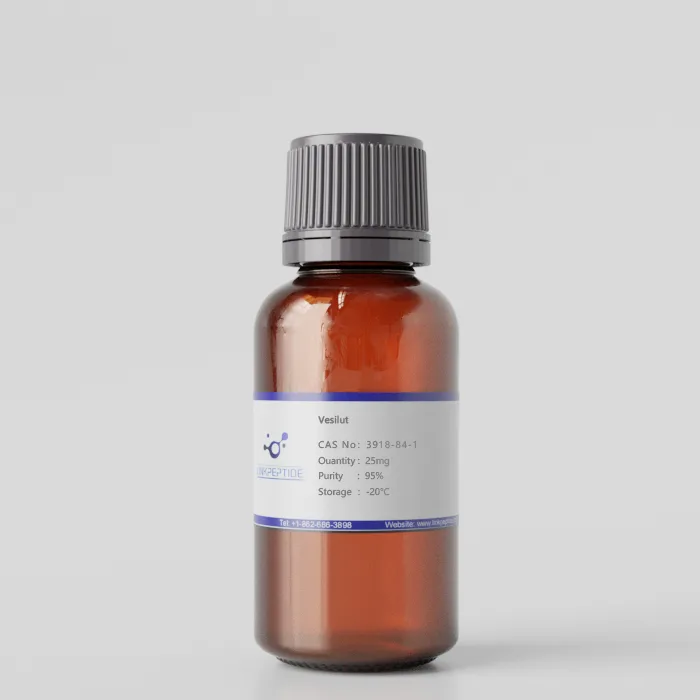
Product Name:Vesilut
Cas No:3918-84-1
Purity:95%
Chemical Formula:C9H14N2O7
Molar Mass:262.22
Synonyms:3918-84-1; H-GLU-ASP-OH; Glu-Asp-OH; alpha-Glutamylaspartic acid; Glu-Asp
IUPAC Name:(2S)-2-[[(2S)-2-amino-4-carboxybutanoyl]amino]butanedioic acid
SMILES:C(CC(=O)O)[C@@H](C(=O)N[C@@H](CC(=O)O)C(=O)O)N
InChIKey:FYYSIASRLDJUNP-WHFBIAKZSA-N
InChI:InChI=1S/C9H14N2O7/c10-4(1-2-6(12)13)8(16)11-5(9(17)18)3-7(14)15/h4-5H,1-3,10H2,(H,11,16)(H,12,13)(H,14,15)(H,17,18)/t4-,5-/m0/s1
Storage:-20 degree Celsius
Sequence:ED
Application:Vesilut is a short peptide bioregulator derived from urinary bladder tissue, developed to support the restoration and regulation of bladder structure and function. It works by modulating gene expression involved in urothelial integrity, smooth muscle tone, and inflammatory balance. Vesilut has been studied in models of overactive bladder, chronic cystitis, urinary incontinence, and age-related urogenital decline, where it improves bladder capacity, reduces inflammation, and enhances tissue regeneration. It is particularly valuable in geriatric urology, pelvic floor dysfunction, and urothelial repair research, offering a non-hormonal, epigenetic tool for urinary system support.
Current Research:
Introduction: What Is Vesilut? Vesilut is a cytogenetic peptide bioregulator derived from porcine urinary bladder tissue, developed to restore and maintain the functional integrity of the lower urinary tract, particularly the bladder wall and urothelium. Like other tissue-specific peptides from the Russian school of peptide bioregulation, Vesilut acts at the epigenetic level, influencing DNA activity in target cells to normalize gene expression impaired by aging, inflammation, or mechanical stress. It is studied in both male and female urological conditions, with a focus on bladder dysfunction, chronic irritation, and degenerative urogenital changes. Mechanism of Action: Epigenetic Urothelial Modulation Vesilut binds to GC-rich regions of nuclear DNA, modulating transcription in: Urothelial epithelial cells Bladder smooth muscle cells Local immune and inflammatory cells Through this mechanism, Vesilut helps: Stimulate urothelium regeneration Regulate smooth muscle tone Suppress chronic inflammation Promote neurogenic support for micturition control By restoring transcriptional homeostasis, Vesilut reactivates tissue repair pathways while reducing aberrant inflammatory signaling. Applications in Overactive Bladder and Urge Incontinence In preclinical and observational studies of patients with overactive bladder (OAB) and urge incontinence, Vesilut has been shown to: Reduce urinary urgency and frequency Improve bladder capacity and compliance Normalize voiding intervals Decrease inflammatory cytokines in the bladder wall These improvements are attributed to enhanced urothelial barrier integrity, better autonomic regulation, and reduced hypersensitivity of bladder receptors. Vesilut’s mechanism is distinct from antimuscarinic or β3-agonist drugs, offering a non-receptor-based approach to urological symptom control. Support in Chronic Cystitis and Inflammatory Bladder Conditions Vesilut is under investigation for use in chronic bladder inflammation, including: Interstitial cystitis (IC) / bladder pain syndrome Radiation-induced cystitis Chemical or infectious cystitis It has been reported to: Accelerate urothelial regeneration Reduce mast cell activity Improve mucosal defense Relieve dysuria and suprapubic discomfort Its anti-inflammatory and regenerative action is especially important in cases where immune-mediated damage and epithelial thinning are present, offering a research tool for bladder mucosal protection. Urological Aging and Geriatric Urotherapy Aging is associated with a natural decline in: Bladder compliance Detrusor contractility Neural sensitivity Hormonal support of urogenital tissues Vesilut has been studied in elderly populations with age-related urological disorders, where it supports: Bladder muscle tone Reduction of nocturia Post-void residual control Neurogenic coordination of bladder emptying Its role in rejuvenating local tissue gene expression makes it particularly suited for use in gerontology and functional urology. Safety and Use Vesilut is: Non-toxic and well-tolerated Suitable for long-term use in chronic conditions Compatible with conventional urological therapies Safe for both male and female subjects It is typically administered in cyclic regimens, often in combination with other bioregulators targeting endocrine, immune, or vascular systems. Conclusion Vesilut is a bladder-specific peptide bioregulator offering a novel, epigenetic approach to supporting urinary system health, reducing bladder inflammation, and restoring normal urodynamics. Its action on urothelial regeneration and neuro-muscular coordination positions it as a valuable research compound in urology, pelvic health, and aging-related urinary disorders. As interest in peptide-based regenerative strategies grows, Vesilut provides a promising, non-hormonal modality for urinary tract restoration.
Reference:
Get a Quote
 LinkPeptide