 LinkPeptide
A Century of Discovery: The Evolution of Insect Neuropeptide and Peptide Hormone Research
Blog 180
Abstract
Insect neuropeptides and peptide hormones have been the subject of research for more than a century, evolving from early bioassays with crude extracts to modern genomic and structural approaches. Initially discovered as mysterious regulators of molting and reproduction, these small signaling molecules are now recognized as master regulators of insect physiology. They govern essential processes including development, metabolism, feeding, reproduction, circadian rhythms, and stress adaptation. Advances in mass spectrometry, molecular cloning, and peptidomics have revealed dozens of peptide families and their receptors, highlighting both evolutionary conservation and species-specific innovations. Beyond their biological importance, insect neuropeptides offer practical applications in agriculture and biotechnology, particularly as targets for sustainable pest control strategies. This historical perspective traces the milestones that shaped the field and underscores how insect peptide research continues to bridge fundamental biology with translational opportunities.
From Hidden Messengers to Central Regulators
In the early days of insect physiology, scientists were intrigued by mysterious internal signals that seemed to orchestrate molting, metamorphosis, and reproduction. Crude gland extracts hinted at the existence of potent regulators, but their chemical nature was unknown. Over time, these elusive messengers were revealed to be neuropeptides and peptide hormones—small but powerful molecules that continue to reshape our understanding of insect biology.
What began as a handful of observations has grown into a field that now recognizes dozens of peptide families, each with specialized roles in regulating insect life. These peptides govern processes as diverse as growth, energy metabolism, feeding, reproduction, circadian rhythms, and stress adaptation. Acting both as local neuromodulators within the nervous system and as systemic hormones carried through the hemolymph, they form an intricate network that coordinates physiology and behavior.
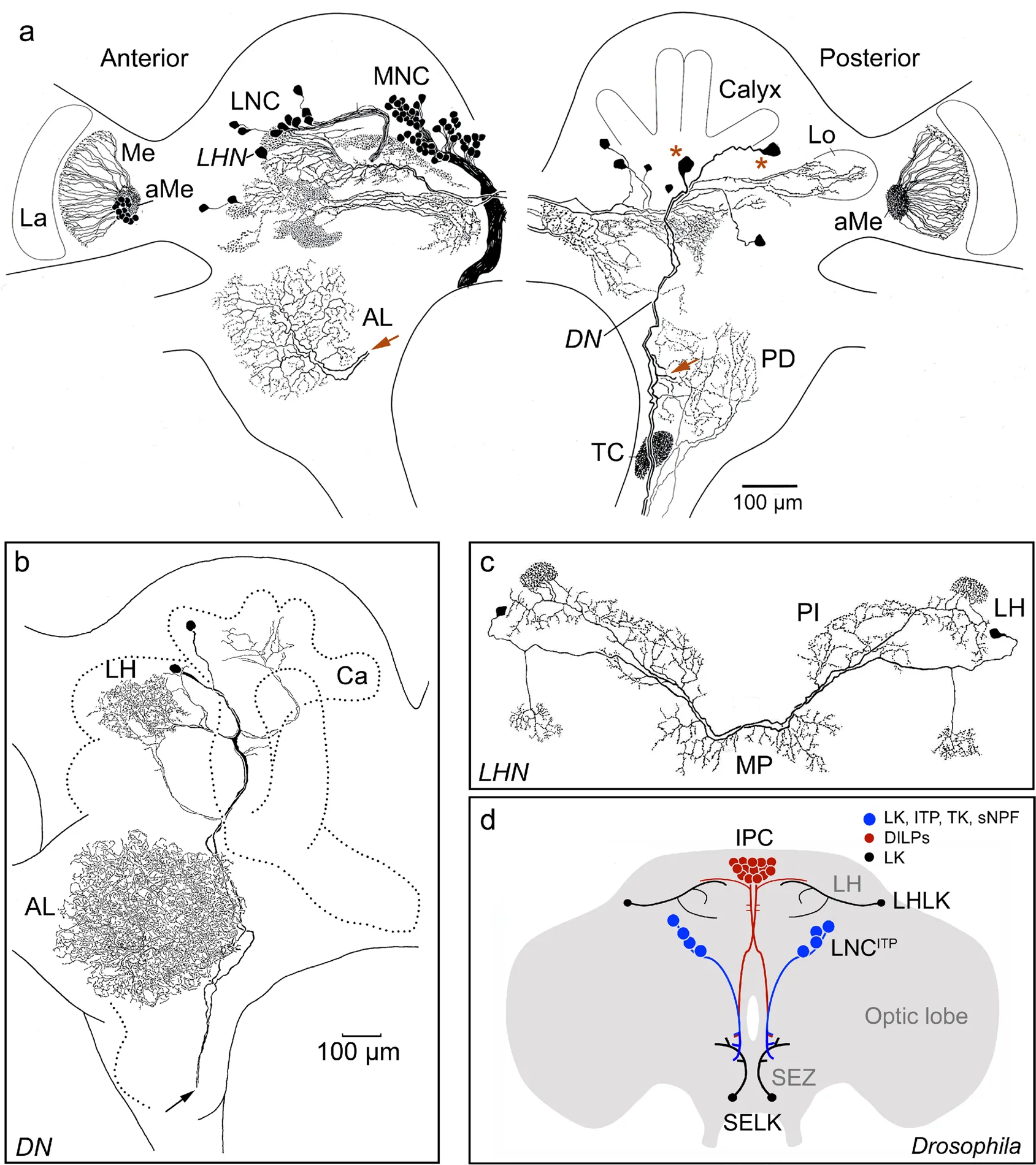
Leucokinin (LK)-expressing neurons in the brain of the cockroach Leucophaea maderae (Rhyparobia maderae) and fly Drosophila illustrate differences in cell number and identifiable neurons.
The story of insect neuropeptide research also reflects the broader trajectory of modern biology. From painstaking bioassays and laborious chemical isolation to today’s mass spectrometry, molecular cloning, and genomic tools, the field has continually advanced in step with technology. More than a history of discoveries, it is a story of how basic research into tiny messengers in insects has opened doors to insights in evolution, pest control, and biotechnology.
Laying the Foundations: Hormones Behind Molting and Metamorphosis
The roots of insect neuropeptide research can be traced back to the early 20th century, when entomologists began noticing that certain tissues influenced development and reproduction. One of the earliest clues came from experiments showing that extracts of insect brains or endocrine glands could trigger physiological changes such as molting or ovarian maturation. These crude bioassays laid the foundation for the idea that chemical messengers—what we now call neuropeptides and peptide hormones—were central to insect life.
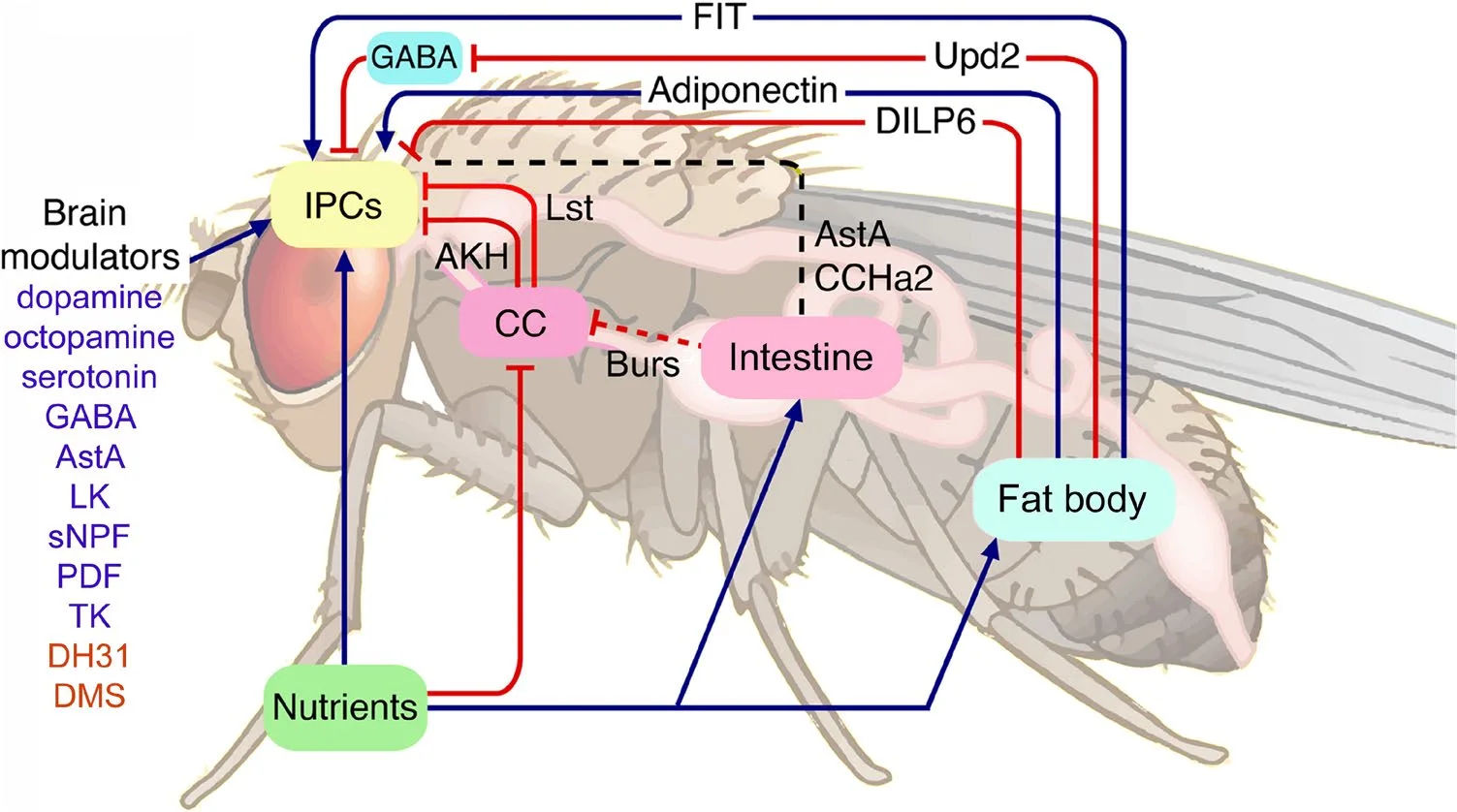
The first breakthroughs centered on molting and metamorphosis, processes so dramatic that they provided clear entry points for experimentation. Classic studies identified the prothoracicotropic hormone (PTTH) as a brain-derived signal that stimulates ecdysteroid production in the prothoracic glands. Soon after, other pivotal factors were uncovered, including ecdysis-triggering hormones and the allatostatins, which regulate juvenile hormone biosynthesis. Each discovery expanded the catalog of insect peptides and highlighted their precision in orchestrating developmental timing.
Progress during this pioneering era was slowed by technical challenges. Insects produce only minute amounts of peptide hormones, making chemical isolation extraordinarily difficult. Yet with ingenuity—combining bioassays, histological methods, and early chromatography—researchers gradually succeeded in purifying and characterizing active molecules.
These early efforts not only established insect neuroendocrinology as a serious scientific discipline but also set the stage for the explosive growth of the field. By demonstrating that small peptides could regulate fundamental physiological processes, pioneers created the framework on which modern molecular and genomic approaches continue to build.
Mapping the Peptide Universe: From a Handful to Hundreds
As analytical methods advanced in the late 20th century, the landscape of insect neuropeptide research rapidly broadened. Early studies had identified only a handful of key hormones, but improvements in chromatography, sequencing, and immunocytochemistry soon revealed a remarkable diversity of peptides across insect species. This expansion transformed the field from a narrow focus on developmental hormones to a panoramic view of regulatory systems touching nearly every physiological process.
One major breakthrough was the identification of FMRFamide-related peptides (FaRPs), among the first to demonstrate that insects produce complex families of neuromodulators comparable to those in vertebrates. Subsequent work uncovered other influential groups, such as the FXPRLa peptides, allatostatins, allatotropins, pyrokinins, and diuretic hormones. Each family brought new insights into how insects coordinate metabolism, reproduction, water balance, and behavior.
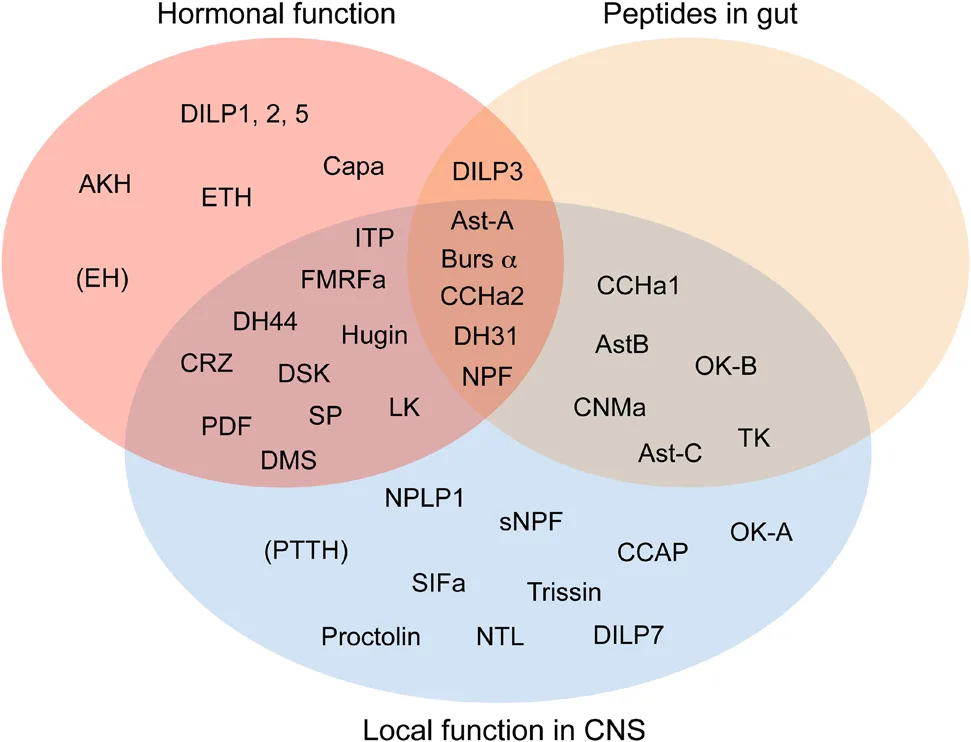
The rise of molecular cloning and cDNA libraries in the 1980s and 1990s further accelerated progress. Researchers could now deduce peptide precursors and predict the existence of multiple isoforms from a single gene, highlighting the efficiency and versatility of neuropeptide signaling. More recently, mass spectrometry and peptidomics have allowed precise mapping of peptide repertoires, even in non-model insects.
This explosion of knowledge also illuminated evolutionary patterns. Comparative studies showed that many insect peptides have counterparts—or at least distant relatives—in other animals, suggesting deep conservation of signaling strategies. At the same time, lineage-specific innovations underscored how neuropeptide diversity supports the ecological and behavioral diversity of insects themselves.
Master Regulators of Growth, Behavior, and Survival
With the catalog of insect neuropeptides steadily expanding, attention turned to understanding their physiological roles. What emerged is a picture of remarkable versatility: neuropeptides act as local neuromodulators in the nervous system and as systemic hormones circulating in the hemolymph, orchestrating nearly every stage of insect life.
One of the most studied systems involves the regulation of development and metamorphosis. The interplay between allatostatins and allatotropins finely tunes the production of juvenile hormone, ensuring proper timing of molts and transitions to adulthood. Similarly, ecdysis-triggering hormones coordinate the precisely choreographed behaviors of shedding the old cuticle, a process essential for growth and survival.
Energy balance and metabolism are also tightly controlled by peptides. The adipokinetic hormone (AKH) mobilizes stored lipids and carbohydrates during flight or stress, functioning analogously to vertebrate glucagon. Neuropeptide F (NPF), on the other hand, regulates feeding behavior and appetite, providing a direct link between nutritional state and behavior.
Other peptides integrate physiology with environmental and social cues. Diuretic hormones manage water and ion balance, critical for survival in diverse habitats. Neuropeptides also shape circadian rhythms, reproductive maturation, and stress adaptation, allowing insects to adjust their biology to changing conditions.
Importantly, these systems rarely act in isolation. Neuropeptides form interconnected networks, interacting with biogenic amines, classical hormones, and sensory inputs. This layered regulation ensures both robustness and flexibility, enabling insects to thrive in environments ranging from deserts to rainforests.
By revealing the breadth of peptide functions, researchers have highlighted the centrality of neuropeptides in insect biology. Far from being minor messengers, they are master regulators that link molecular signals to behavior, ecology, and survival strategies.
From Lab Bench to Field: Applications and New Frontiers
The study of insect neuropeptides is not just a story of basic biology—it also carries profound applied and translational potential. Because these peptides regulate vital processes such as development, feeding, and reproduction, they have emerged as promising targets for next-generation pest control strategies. Synthetic analogs or antagonists of key peptides, for example, can disrupt hormonal communication with exquisite specificity, offering alternatives to broad-spectrum chemical insecticides. Such approaches hold promise for improving agricultural sustainability while reducing environmental impact.
Beyond pest management, insect neuropeptides provide a valuable comparative framework for understanding neuroendocrine systems across the animal kingdom. Many peptide motifs discovered in insects share similarities with those found in vertebrates, highlighting evolutionary conservation of signaling strategies. This cross-species perspective enriches our knowledge of how small peptide messengers shape physiology and behavior.
The field also continues to benefit from the rapid pace of technological innovation. Genomics and transcriptomics are uncovering previously unknown peptide genes across diverse insect lineages. CRISPR-based tools now allow functional dissection of peptide signaling pathways with unprecedented precision. Meanwhile, structural biology and computational modeling are shedding light on the receptor–ligand interactions that drive signaling specificity. Together, these advances are propelling insect peptide research into a new era where detailed molecular insights can be directly linked to ecological and evolutionary questions.
Looking ahead, the challenge lies in weaving these molecular discoveries into broader biological narratives. By integrating neuropeptide research with fields such as behavioral ecology, evolutionary biology, and biotechnology, scientists are poised to unlock both fundamental insights and practical applications. What began as curiosity about mysterious “hormonal factors” has evolved into a discipline that continues to illuminate not only the biology of insects, but the universal principles of life itself.
Reference
Nässel, D. R. (2025). A brief history of insect neuropeptide and peptide hormone research. Cell and Tissue Research, 399(2), 129-159.
https://doi.org/10.1007/s00441-024-03936-0
Adams, M. E., & O’Shea, M. (1983). Peptide cotransmitter at a neuromuscular junction. Science, 221(4607), 286-289.
https://doi.org/10.1126/science.6134339
Elphick, M. R., Mirabeau, O., & Larhammar, D. (2018). Evolution of neuropeptide signalling systems. Journal of Experimental Biology, 221(3), jeb151092.
https://doi.org/10.1242/jeb.151092
Tsuji, M., Nishizuka, Y., & Emoto, K. (2023). Threat gates visual aversion via theta activity in Tachykinergic neurons. Nature Communications, 14(1), 3987.