 LinkPeptide
Amino Acid Derivatives for Peptide Synthesis
Blog 238
In modern peptide labs, amino acid derivatives are the quiet workhorses that make reliable sequences possible. They improve coupling efficiency, protect sensitive functional groups, and help chemists build complex peptides with clean, reproducible outcomes. Whether you’re working on discovery projects or scaling established sequences, the quality and selection of derivatives strongly influence peptide synthesis success, especially in solid-phase peptide synthesis workflows.
What are amino acid derivatives?
In peptide chemistry, an “amino acid derivative” usually means an amino acid that has been modified to make synthesis more controlled and predictable. Common derivative features include:
- N-terminal protecting groups (to control stepwise coupling)
- side-chain protecting groups (to prevent unwanted reactions)
- activated or modified forms that improve coupling performance
These design elements help chemists build sequences efficiently while keeping impurities and side reactions to a minimum.
Why derivatives matter in solid-phase peptide synthesis
Solid phase peptide synthesis (SPPS) builds a peptide one residue at a time on a resin. The process is reliable because it uses repeatable cycles:
- deprotect the N-terminus
- couple the next protected amino acid
- wash and repeat
In each cycle, amino acid derivatives influence:
- coupling yield and speed
- byproduct formation (deletions, racemization)
- solubility and resin swelling behavior
- The final impurity profile that purification must address
Better derivatives typically support smoother synthesis, higher crude quality, and easier purification.
Boc chemistry in peptide synthesis: where it fits today
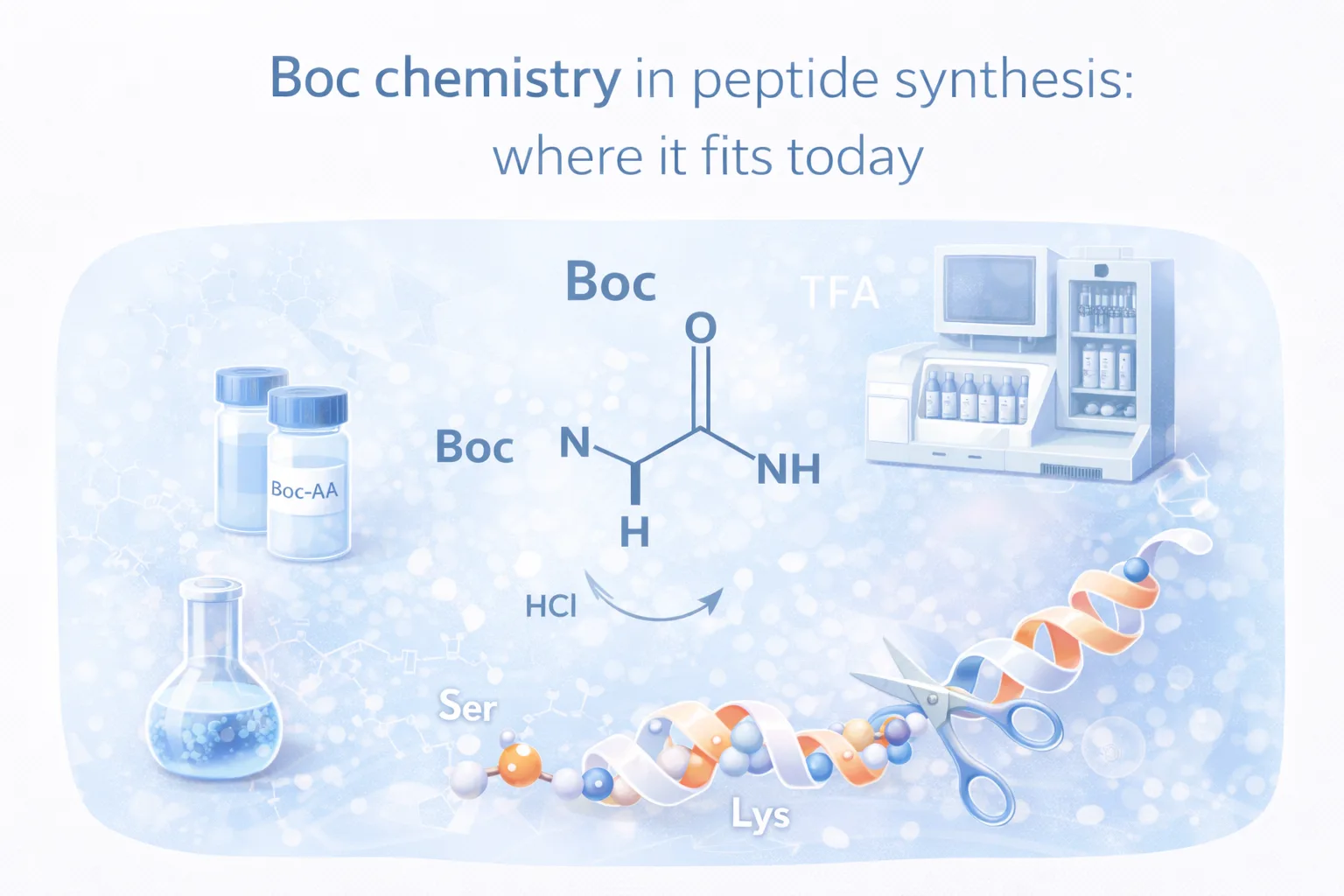
Boc chemistry is one of the classic strategies for protecting the N-terminus during peptide synthesis. While many modern workflows use alternative protection schemes, Boc remains an important part of peptide chemistry education and remains relevant in specialized contexts.
In simple terms, Boc chemistry involves:
- Boc protection for the N-terminus during chain assembly
- controlled deprotection cycles
- Final global deprotection during cleavage
Understanding Boc chemistry helps researchers interpret supplier specs and appreciate how protection strategy can shape crude composition and downstream processing.
Key types of amino acid derivatives used in peptide synthesis
1) N-protected amino acids (coupling control)
N-protection makes the stepwise assembly possible. The protecting group ensures that coupling happens at the correct reactive site in each cycle.
2) Side-chain protected amino acids (selective reactivity)
Side-chain protection prevents unwanted side reactions involving:
- hydroxyl groups
- amines
- carboxyl groups
- sulfur-containing residues
This is particularly important for sequences with multiple reactive side chains, where selectivity supports higher purity outcomes.
3) Special derivatives for challenging residues
Some residues are more prone to:
- racemization
- incomplete coupling
- aggregation on-resin
In these cases, choosing an optimized derivative (and appropriate coupling conditions) supports better crude quality and a cleaner pathway to the final peptide.
How derivative choices affect peptide cleavage and purification
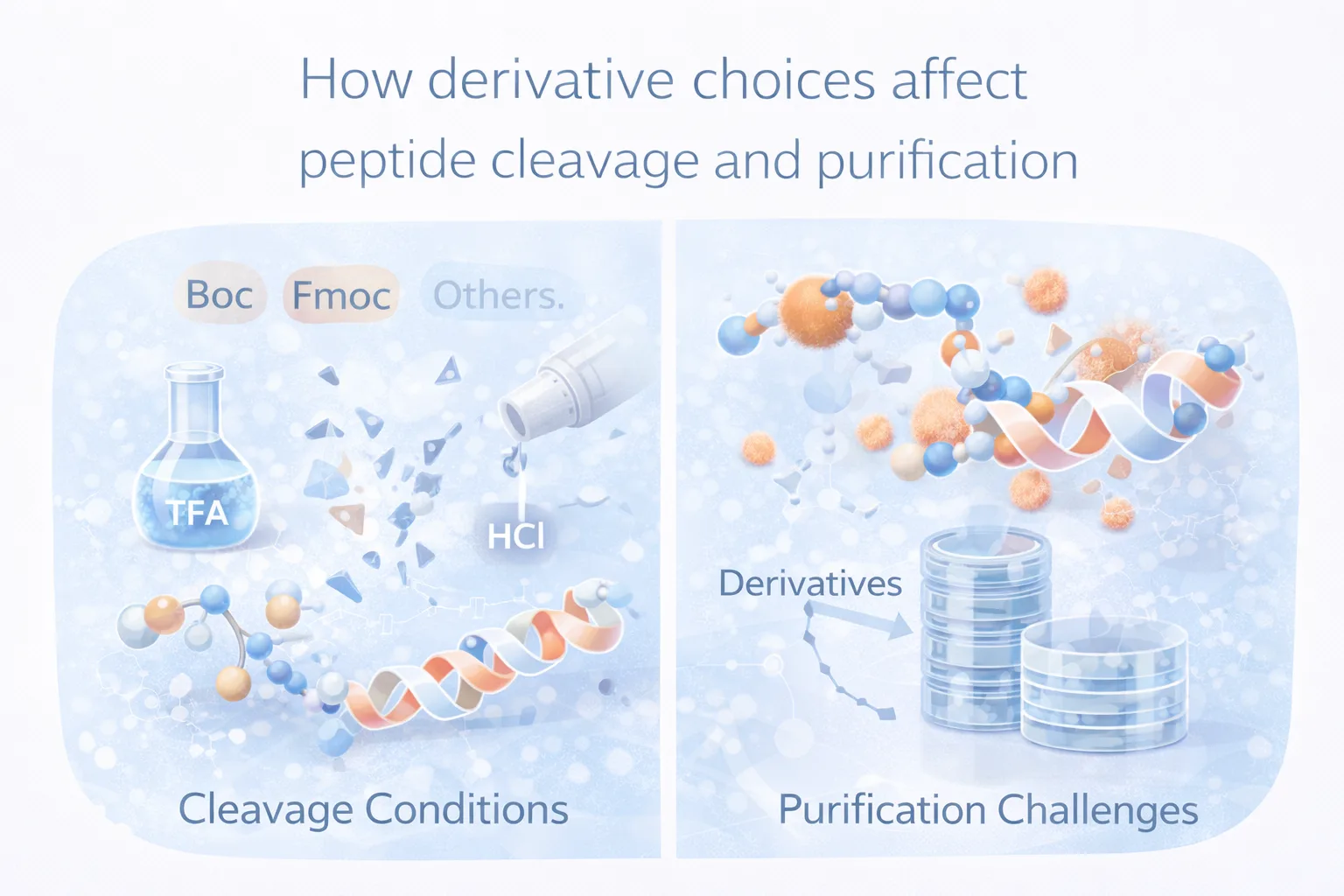
Peptide cleavage: the “release” step that must stay controlled
Peptide cleavage removes the peptide from the solid support and typically removes protecting groups in the same workflow. Cleavage conditions are designed to:
- Release the peptide efficiently
- remove protecting groups cleanly
- minimize side reactions
Because cleavage chemistry interacts with side-chain protection choices, thoughtful selection of derivatives supports more predictable cleavage outcomes.
Purification becomes easier when the crude material is of higher quality.
Better crude quality often means:
- fewer closely related impurities
- faster purification
- better yield after purification
That benefit can make the total workflow more efficient—not only in time, but also in cost and reproducibility.
Practical guidance: choosing amino acid derivatives for your project
AEO-style question: How do I choose amino acid derivatives for peptide synthesis?
A strong approach is to match derivatives to:
- sequence complexity (reactive side chains, challenging motifs)
- Your synthesis platform and resin system
- required purity and scale
- downstream application (screening, structural work, formulation)
If your sequence is unusually hydrophobic, aggregation-prone, or rich in reactive residues, it often benefits from a more deliberate derivative strategy.
From synthesis to storage: why handling still matters
Even with excellent synthesis, your peptide’s real-world performance depends on good handling.
Peptide storage for consistent lab results
Peptide storage is most effective when you:
- store peptides dry (lyophilized) for long-term needs
- Prepare small solution aliquots for active experiments
- label concentration, solvent, and date
- minimize repeated freeze–thaw handling
Peptide stability: what improves it most
Peptide stability is supported by:
- consistent storage temperatures
- reducing moisture exposure
- minimizing time in solution when not needed
- using a repeatable reconstitution routine
These habits keep peptide performance predictable across study timelines.
Conclusion
Amino acid derivatives are central to modern peptide synthesis because they make complex sequence assembly more controlled, efficient, and reproducible, especially in solid-phase peptide synthesis. Choices in protection strategy, including frameworks such as Boc chemistry, can shape crude quality, influence peptide cleavage outcomes, and simplify purification. When these chemistry decisions are paired with strong peptide storage practices and habits that support long-term peptide stability, researchers gain peptides that behave consistently at the bench.
How LinkPeptide supports amino acid derivatives and peptide synthesis
At LinkPeptide, we support peptide programs with a wide catalog of amino acids and peptide building blocks, as well as custom peptide services that help researchers move efficiently from design to data. Whether your work emphasizes solid phase peptide synthesis, method development, or larger peptide panels, consistent materials and clear specifications make experimental workflows smoother. If your project requires specialized amino acid derivatives, sequence-specific optimization, or custom synthesis support, our team focuses on practical quality and reproducibility so your experiments can scale with confidence.
FAQs
What are amino acid derivatives used for in peptide synthesis?
They improve control during synthesis by protecting reactive groups and supporting efficient, selective coupling cycles.
Why is solid-phase peptide synthesis so widely used?
SPPS enables repeatable, stepwise assembly on a resin, making purification between steps simple and allowing efficient production of many peptide sequences.
What is Boc chemistry?
Boc chemistry is a protection strategy used in peptide synthesis where the Boc group protects the N-terminus during chain assembly and is removed during deprotection/cleavage steps.
How do peptide storage practices affect peptide stability?
Storing peptides dry for long-term storage, using small solution aliquots, and minimizing freeze–thaw cycles typically support more consistent stability and performance.