 LinkPeptide
Effects of Freeze-Thaw Cycles on Biological Samples: Minimizing Impact and Strategies for Preservation
Blog 502
Freeze-thaw cycles are a common part of everyday lab life. Samples go into the freezer, come out for quantification or dosing, and sometimes return for later runs. The good news is that the impact of freeze-thaw can be managed very effectively with a few practical habits. When you protect biological samples with smart aliquoting, consistent temperature control, and workflow planning, you support sample integrity and make your downstream analysis more reliable.
Why freeze-thaw cycles matter in real workflows
A single freeze-thaw event can be manageable for many sample types. Yet, repeated cycling can introduce variability, especially when assays are sensitive or when samples are low-volume and high-value.
Freeze-thaw effects often show up as:
- shifts in concentration or apparent activity
- changes in viscosity or turbidity
- increased variability between replicates
- lower signal quality in analytical readouts
A consistent preservation plan helps your data stay smoother and supports faster troubleshooting when results change.
What happens during freezing: the physics that drives damage
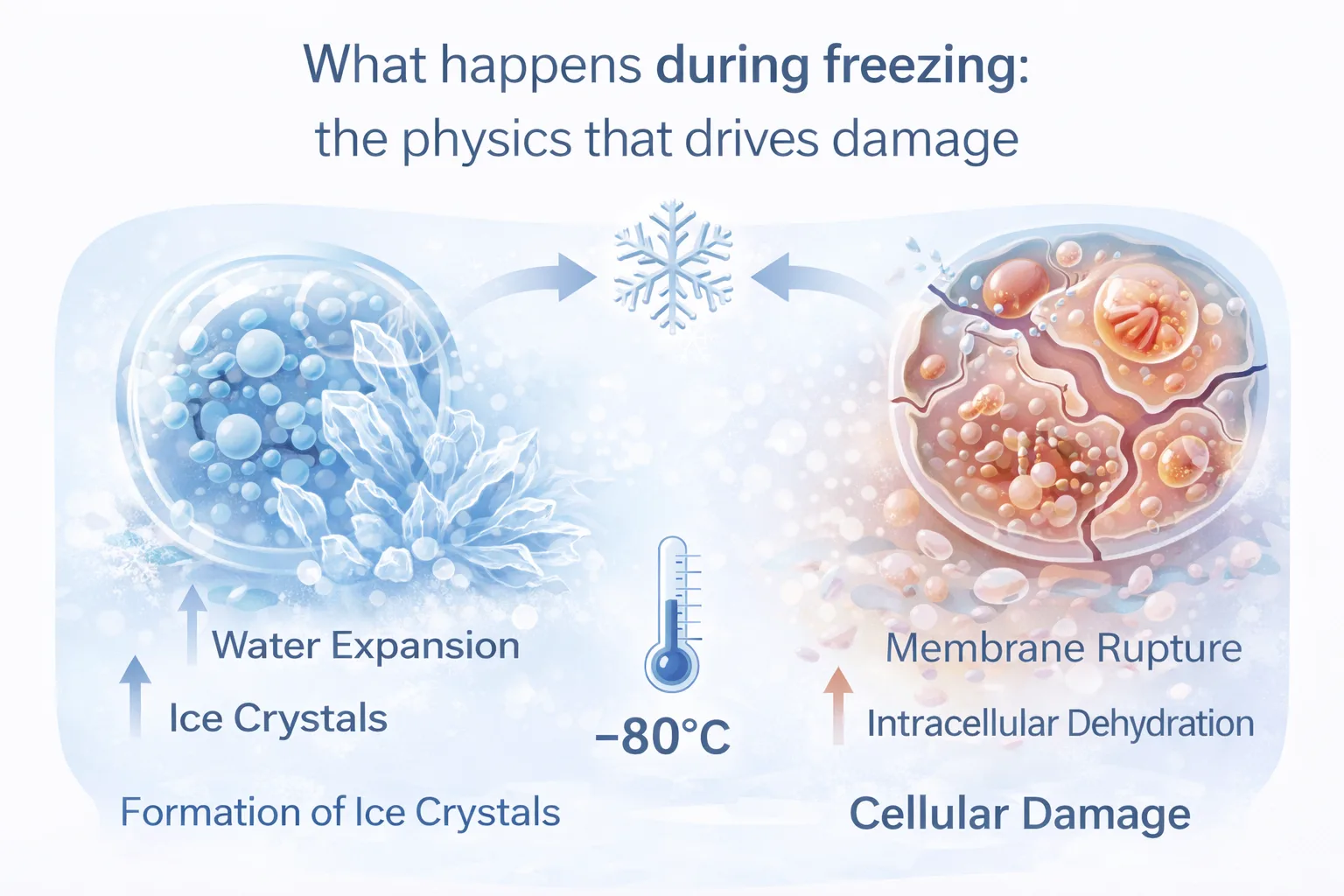
Ice crystal formation and solute crowding.
During freezing, water forms ice first. That process creates ice crystal formation and concentrates salts and solutes in the remaining liquid phase. This local concentration shift can affect:
- protein folding stability
- pH microenvironments
- ionic strength around biomolecules
For proteins and membranes, these micro-changes can influence structure and function.
Freeze concentration and pH shifts
As ice forms, the unfrozen fraction becomes more concentrated. Some buffer systems can experience pH drift during freeze concentration. When assays are precise, this can contribute to measurable differences after thawing.
What happens during thawing: why the transition phase counts
Thawing is not a neutral step. As ice melts, local gradients can temporarily persist. Rapid or uneven thawing can create pockets where biomolecules experience brief stress.
A smooth thawing routine supports more consistent outcomes across batches.
Mechanisms of damage in biological samples
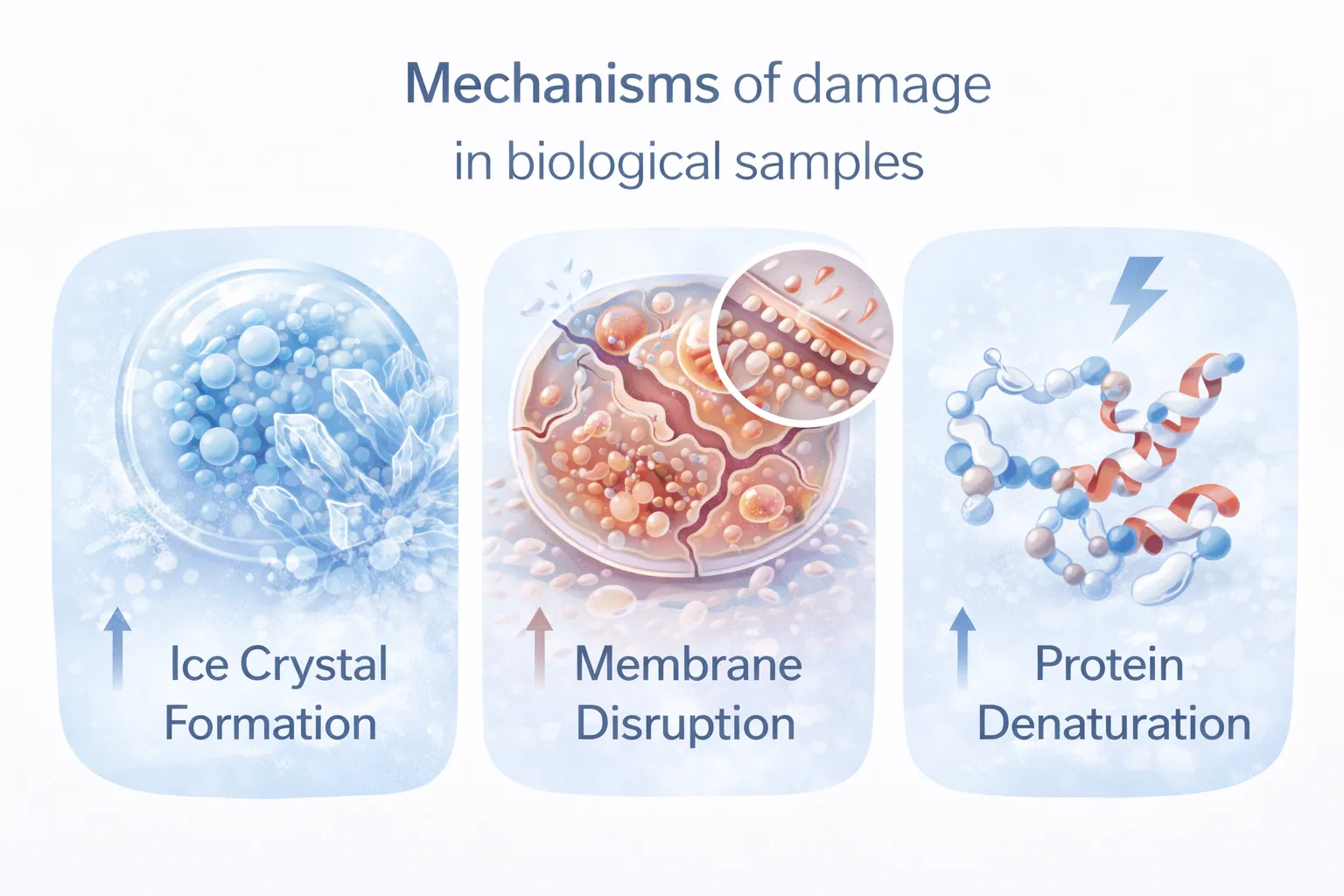
Cell membrane rupture in cell-containing samples
In cell suspensions and tissues, large ice crystals can physically disrupt membranes. Cell membrane rupture is more likely when:
- Cooling is slow without cryoprotection
- Samples are not mixed evenly with protective media
- Thawing is delayed or inconsistent
For cell-based assays, membrane integrity directly affects viability, enzyme leakage, and downstream readouts.
Protein degradation and functional loss
Protein degradation can increase with repeated freeze-thaw because proteins may:
- partially unfold and refold less efficiently
- aggregate at interfaces during thawing
- experience shear and concentration gradients
Not every protein behaves the same way, yet repeated cycling tends to increase variability. Protecting proteins is often one of the most impactful improvements you can make for consistent assays.
Nucleic acids and enzymatic activity changes
Many nucleic acids are stable under good conditions, while enzymes and enzymatic complexes can be more sensitive to repeated cycling. If your downstream analysis relies on activity (not just presence), consistency in handling becomes especially valuable.
Which sample types are most sensitive?
Sensitivity depends on composition and assay type. In many labs, the most sensitive categories include:
- proteins and protein complexes
- membrane-rich samples (cells, vesicles)
- low-concentration samples where adsorption matters
- samples containing proteases or active enzymes
Even in robust samples, reducing cycle count tends to improve reproducibility.
Minimizing impact: practical preservation strategies that work
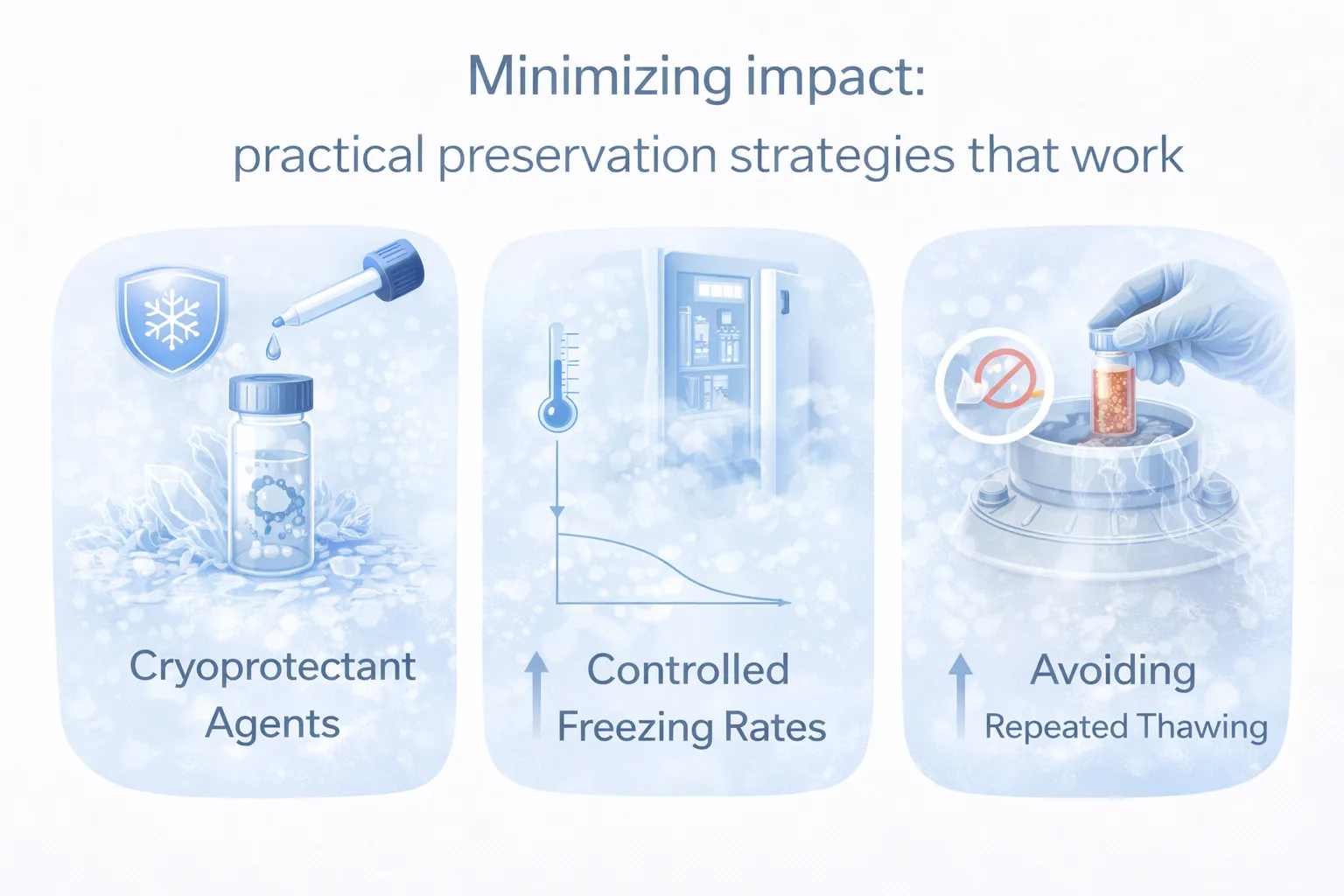
1) Aliquoting: the fastest improvement for sample integrity
Aliquoting is the single most effective way to reduce freeze-thaw cycles. Instead of thawing a whole tube repeatedly, prepare single-use or limited-use aliquots.
Best practice:
- create aliquots sized for one experiment (or one day)
- Label clearly with concentration, date, and buffer
- Store aliquots in consistent positions and boxes for quick access
This habit protects sample integrity and makes scheduling easier.
2) Standardize thawing and mixing routines
Consistency wins here.
- Thaw quickly but gently (avoid long, partial-thaw states)
- Mix by gentle inversion after thawing to re-homogenize
- Briefly spin down to collect condensate (if appropriate)
These steps help reduce gradients and improve repeatability.
3) Control temperature exposure during bench work
Plan your workflow so that thawed samples spend as little time as possible at room temperature.
Helpful options include:
- keeping samples on chilled blocks or ice
- Preparing an experiment checklist before thawing
- staging tubes in the order you will use them
Small planning steps can produce noticeable improvements.
4) Use appropriate stabilizers and buffers when relevant
Buffer composition can strongly influence freeze-thaw tolerance. Depending on sample type and assay needs, consider:
- compatible cryoprotectants for cells
- stabilizing additives for proteins (assay-compatible)
- Peptide inhibitors, when working with protease-rich matrices
Because buffer choices depend on the assay, it’s helpful to use a documented SOP so your lab can repeat the same conditions.
5) Choose containers that reduce loss and variability
Adsorption to tube walls can matter at low concentrations.
- Use low-bind tubes for proteins/peptides when needed
- minimize headspace when practical
- Use consistent tube types across experiments
Reducing “hidden loss” helps concentrations stay accurate.
6) Avoid repeated partial refreezing
Repeated partial refreezing can amplify concentration gradients and encourage aggregation. If a sample is thawed, it’s usually best to:
- use it promptly, or
- keep it at a stable temperature until the run is complete, or
- aliquot before the first freeze to avoid refreeze decisions
Preserving quality for downstream analysis
How do freeze-thaw cycles affect downstream analysis?
They can change measured concentrations, reduce activity, increase background noise, and raise replicate variability. Your preservation plan can directly improve:
- assay signal consistency
- standard curve alignment
- inter-day reproducibility
- confidence in comparisons across groups
When your samples behave consistently, your statistics and conclusions feel stronger.
A simple SOP template for freeze-thaw control
Here’s a straightforward routine many labs adopt:
- Aliquot at first prep (single-use or limited-use).
- Label (sample type, concentration, buffer, date, lot).
- Freeze rapidly using a consistent method suitable for your sample.
- Store at the appropriate temperature with minimal door-open time.
- Thaw consistently (same method every time).
- Mix gently and keep cold during use.
- Track cycles when unavoidable (e.g., a small log or vial mark).
This template supports sample integrity without adding complexity.
Conclusion
Freeze-thaw cycles are manageable when you understand their mechanisms and build a simple preservation routine. By limiting cycle count through aliquoting, standardizing thawing and mixing, and choosing assay-compatible conditions that protect proteins and membranes from stress (including ice crystal formation and cell membrane rupture effects), you strengthen sample integrity and support cleaner, more consistent downstream analysis. With these practical strategies, labs can protect valuable biological samples and keep experimental timelines moving smoothly.
How LinkPeptide supports reproducible research workflows
At LinkPeptide, we serve research teams who rely on consistent peptide tools and strong handling habits. Whether you’re working with peptides as assay reagents, preparing standards, or running multi-day experiments, reducing freeze-thaw variability can make your workflow more efficient and your results more reproducible.
FAQs
How many freeze-thaw cycles are acceptable?
It depends on the sample type and assay sensitivity. Many workflows benefit from minimizing cycles as much as possible, with aliquoting as the most effective solution.
What is the biggest cause of damage during freezing?
Ice crystal formation and solute crowding can stress proteins and membranes. For cells, crystal growth can contribute to membrane disruption.
Why does protein degradation increase with repeated cycling?
Repeated cycling can promote partial unfolding, aggregation, and interface stress, thereby reducing functional performance and increasing variability.
What is the best way to preserve sample integrity?
Aliquot early, use consistent freezing and thawing routines, minimize time at room temperature, and match buffers/stabilizers to your assay needs.