 LinkPeptide
Beyond Crude Protein: How Precision Amino Acid Nutrition Is Transforming Animal Health and Sustainable Production
Introduction
For decades, crude protein (CP) has been one of the most important nutritional parameters in animal feed formulation. However, modern nutritional science has demonstrated that animals do not actually require crude protein itself—they require specific amino acids that support growth, metabolism, immunity, tissue development, and physiological function.
Recent advances in amino acid nutrition are changing how researchers and feed formulators approach poultry and swine production. Instead of relying on high-protein diets that often provide excess nitrogen and unnecessary amino acids, precision nutrition strategies focus on delivering the exact amino acids required by the animal. This approach improves feed efficiency, supports animal health, reduces environmental impact, and lowers production costs.
As feed-grade amino acids become increasingly available and cost-effective, researchers are exploring how both essential and functional amino acids can optimize performance while enabling significant reductions in dietary crude protein.
Why Crude Protein Is No Longer the Whole Story
Crude protein is an indirect measurement based on nitrogen content. While useful as a general indicator of protein supply, it does not reflect the animal’s actual nutritional needs.
Historically, poultry and swine diets depended heavily on protein-rich ingredients such as soybean meal, rapeseed meal, sunflower meal, and animal by-products to provide essential amino acids. This often resulted in excessive dietary nitrogen and amino acid oversupply.
When animals consume more protein than necessary:
- Excess nitrogen must be excreted
- Water intake increases
- Ammonia production rises
- Gut fermentation can become unfavorable
- Environmental emissions increase
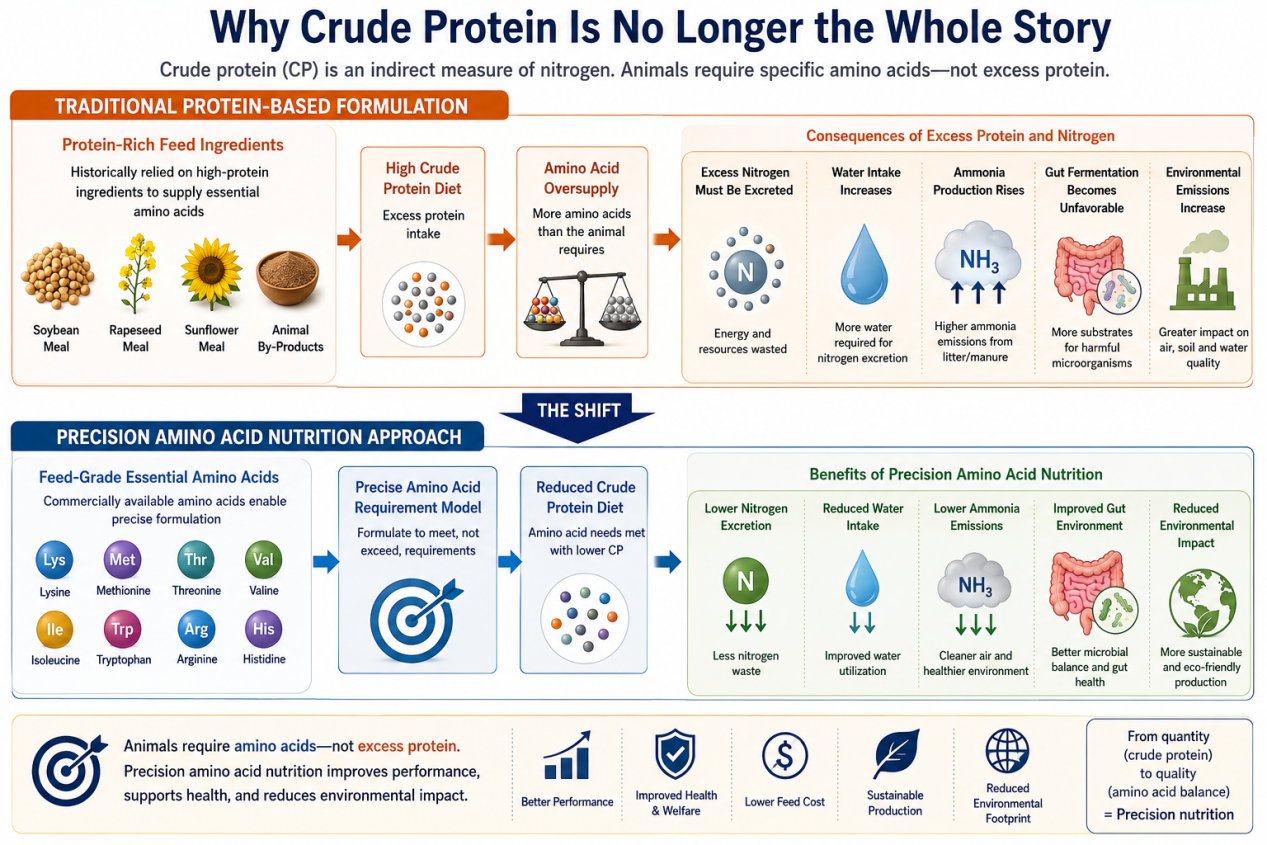
The development of commercially available feed-grade amino acids—including lysine, methionine, threonine, valine, isoleucine, tryptophan, arginine, and histidine—has enabled nutritionists to formulate diets that meet precise amino acid requirements without relying on excessive crude protein levels.
This shift has transformed protein nutrition from a quantity-focused approach into a precision nutrient management strategy.
Environmental Benefits of Reduced Crude Protein Diets
One of the strongest motivations for reducing dietary crude protein is sustainability.
Numerous studies have shown that lowering dietary crude protein while maintaining amino acid balance significantly reduces nitrogen excretion. Lower nitrogen output means:
- Reduced ammonia emissions
- Improved litter quality
- Lower manure-related pollution
- Reduced greenhouse gas impact
- Improved overall environmental sustainability
In Europe, these benefits align closely with the objectives of the European Green Deal and Farm-to-Fork Strategy, which seek to reduce agricultural emissions and improve resource efficiency.
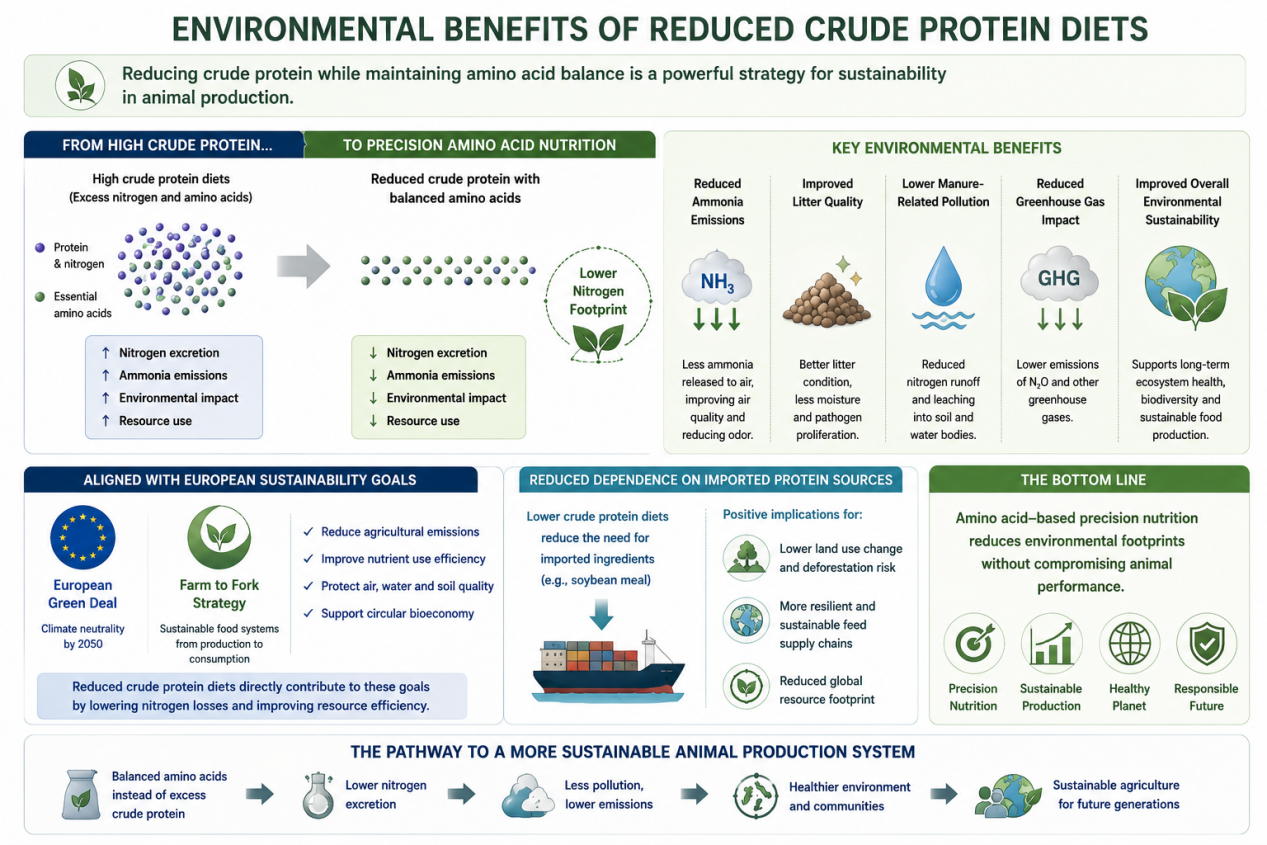
Reducing crude protein also decreases dependence on imported protein sources such as soybean meal. This has important implications for land use, deforestation, and global feed supply chains.
As sustainability becomes increasingly important across agriculture, amino acid-based precision nutrition offers a practical pathway to reduce environmental footprints without sacrificing productivity.
Functional Amino Acids: More Than Building Blocks
Modern amino acid research has revealed that many amino acids perform biological functions far beyond protein synthesis.
Arginine
Arginine has emerged as one of the most extensively studied functional amino acids in poultry and swine nutrition.
Arginine participates in the synthesis of:
- Nitric oxide (NO)
- Polyamines
- Creatine
- Ornithine
- Citrulline
These metabolic pathways influence:
- Immune function
- Vasodilation
- Wound healing
- Oxidative stress responses
- Intestinal integrity
- Heat stress tolerance
Research suggests that arginine supplementation may support birds exposed to heat stress, inflammatory challenges, coccidiosis, and necrotic enteritis. As feed-grade arginine becomes more accessible, targeted arginine nutrition may become an increasingly important management tool.
Threonine
Threonine plays a critical role in intestinal health and mucosal immunity.
A substantial portion of intestinal proteins consists of threonine-rich mucins that form protective barriers along the digestive tract. Adequate threonine supports:
- Intestinal epithelial turnover
- Mucin production
- Gut barrier integrity
- Antibody production
- Immune function
Research indicates that threonine requirements may increase during periods of disease challenge, environmental stress, or poor litter conditions.
Histidine
Histidine is gaining attention as an important amino acid in reduced-protein diets.
Beyond its role in protein synthesis, histidine contributes to the formation of bioactive dipeptides such as:
- Carnosine
- Anserine
These molecules provide antioxidant protection, pH buffering, and support muscular function. Emerging research suggests that maintaining adequate histidine levels may improve growth performance and breast meat yield in modern broilers.
Understanding Branched-Chain Amino Acid Balance
Branched-chain amino acids (BCAAs)—leucine, valine, and isoleucine—are essential regulators of protein synthesis and muscle development.
Unlike many amino acids, BCAAs share metabolic pathways. This means excessive levels of one amino acid can interfere with the utilization of the others.
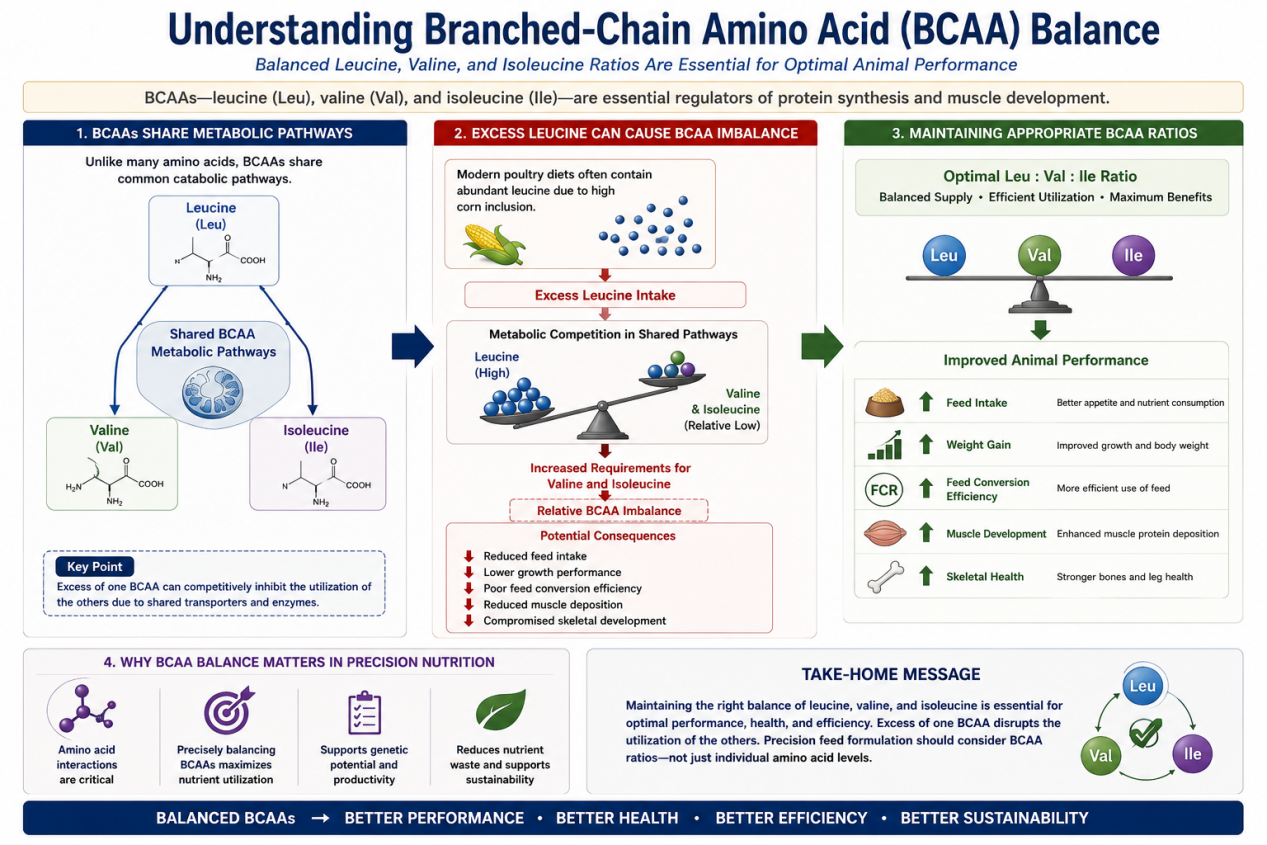
Modern poultry diets often contain abundant leucine due to high corn inclusion rates. Excess leucine may create metabolic imbalances that increase the requirements for valine and isoleucine.
Recent research demonstrates that maintaining appropriate BCAA ratios can improve:
- Feed intake
- Weight gain
- Feed conversion efficiency
- Muscle development
- Skeletal health
These findings highlight the growing importance of amino acid interactions in precision feed formulation.
The Emerging Role of Non-Essential Amino Acids
While essential amino acids receive most of the attention, reduced crude protein diets have increased interest in non-essential amino acids as potential limiting nutrients.
Researchers are now investigating the roles of:
- Glycine
- Serine
- Glutamic acid
- Alanine
- Proline
- Cysteine
As dietary protein levels decline, the supply of these amino acids may become insufficient for optimal growth and metabolism.
Studies suggest that glycine and serine are particularly important in young broilers and may support:
- Protein synthesis
- Nitrogen metabolism
- Intestinal development
- Growth performance
Future nutrition strategies will likely move beyond traditional essential amino acid formulations toward comprehensive amino acid profiling.
Precision Nutrition and Animal Welfare
Reducing dietary crude protein offers benefits beyond productivity and sustainability.
Lower protein diets have been associated with:
- Improved gut health
- Reduced post-weaning diarrhea
- Better litter quality
- Lower footpad dermatitis incidence
- Reduced hock burns
- Improved animal welfare
Excess undigested protein can promote the growth of undesirable microbial populations within the gastrointestinal tract. By minimizing excess nitrogen and balancing amino acid supply, nutritionists can create healthier intestinal environments.
These improvements contribute to both animal welfare and production efficiency.
Future Opportunities for Amino Acid Research
Despite significant progress, many questions remain unanswered.
Researchers continue to investigate:
- Optimal amino acid ratios under different production conditions
- Functional amino acid requirements during stress and disease
- Interactions among branched-chain amino acids
- Requirements for lower-limiting amino acids
- Roles of non-essential amino acids in low-protein diets
- Precision feeding strategies for sustainability goals
As analytical tools, digestibility databases, and feed formulation software continue to improve, amino acid nutrition is expected to become increasingly individualized and data-driven.
Conclusion
The future of animal nutrition lies in precision amino acid management rather than simply increasing crude protein levels.
Advances in feed-grade amino acids now allow nutritionists to formulate diets that support growth, health, welfare, and sustainability while reducing environmental impact. Functional amino acids such as arginine, threonine, and histidine are expanding our understanding of how nutrition influences immunity, intestinal health, stress responses, and overall physiological performance.
For researchers, these developments highlight the growing importance of amino acid science in both agricultural and biomedical applications. As our understanding of amino acid functionality continues to evolve, precision nutrition will play a central role in improving productivity, animal welfare, and environmental sustainability.
About LinkPeptide
LinkPeptide provides high-quality amino acids, peptide building blocks, custom peptide synthesis services, and peptide-related research materials that support investigations in metabolism, nutrition, immunology, drug discovery, and life science research. As amino acid science continues to advance, reliable peptide and amino acid tools remain essential for translating biological insights into practical applications.
Reference
Adhikari, R., Rochell, S. J., Kriseldi, R., Silva, M., Greiner, L., Williams, C., … & Lee, J. (2025). Recent advances in protein and amino acid nutritional dynamics in relation to performance, health, welfare, and cost of production. Poultry Science, 104(3), 104852.
https://doi.org/10.1016/j.psj.2025.104852
Aderibigbe, A. S., Wise, T. L., Davis, J. D., Naranjo, V. D., Hess, V., & Dozier III, W. A. (2024). Effects of reduced crude protein diets while maintaining essential amino acid concentrations on growth performance, nitrogen output, ammonia production, and meat yield. Poultry Science, 103(5), 103572.
https://doi.org/10.1016/j.psj.2024.103572
Dorigam, J. C. P., Sakomura, N. K., de Lima, M. B., Sarcinelli, M. F., & Suzuki, R. M. (2016). Establishing an essential amino acid profile for maintenance in poultry using deletion method. Journal of animal physiology and animal nutrition, 100(5), 884-892.
https://doi.org/10.1111/jpn.12403
Witte, M. B., & Barbul, A. (2003). Arginine physiology and its implication for wound healing. Wound Repair and Regeneration, 11(6), 419-423.