 LinkPeptide
Custom Peptide Synthesis: What Researchers Need to Know
Custom peptide synthesis allows researchers to order synthetic peptides designed around a specific amino acid sequence, Modification, purity level, and research application. Instead of using only catalog peptides, scientists can request custom peptides for receptor-ligand studies, enzyme assays, peptide inhibitors, cell-penetrating peptide systems, antibody generation support, biomarker research, peptide design studies, and drug discovery research.
What Is Custom Peptide Synthesis in Research?
Custom peptide synthesis is a service that produces a peptide according to a researcher’s requested sequence and specifications. Peptides are short chains of amino acids connected by peptide bonds. In research, synthetic peptides can act as ligands, substrates, inhibitors, epitopes, standards, tags, delivery tools, or model molecules.
Custom peptide synthesis is useful when a researcher needs:
- A sequence not available in a catalog
- A species-specific peptide fragment
- A modified peptide
- A labeled peptide for detection or imaging
- A peptide inhibitor or antagonist candidate
- A peptide substrate for enzyme assays
- A peptide library for screening
- A cell-penetrating peptide conjugate
- A peptide for receptor binding research
- A defined purity or scale for repeated studies
The process commonly involves peptide design, synthesis, cleavage, purification, analytical validation, lyophilization, COA generation, and shipment. For research use only workflows, the peptide should be selected and handled according to laboratory protocols and documented quality standards.
How Custom Peptide Synthesis Works
Most custom peptides are produced through solid-phase peptide synthesis, often abbreviated as SPPS. In this approach, amino acids are added step by step to a growing peptide chain attached to a solid resin. After the sequence is assembled, the peptide is cleaved from the resin, purified, analyzed, and lyophilized.
A typical custom peptide synthesis workflow includes:
- Sequence submission and feasibility review
- Selection of scale, purity, and modifications
- Solid-phase peptide synthesis
- Cleavage and deprotection
- Crude peptide assessment
- Purification, commonly by HPLC
- Identity confirmation by mass spectrometry
- COA preparation
- Lyophilization and packaging
- Delivery with documentation
For complex peptides, the supplier may review hydrophobicity, charge, length, aggregation risk, cysteine placement, disulfide bonds, and modification compatibility before synthesis begins.
Why Researchers Use Custom Peptides
Custom peptides support many research areas because they give scientists sequence-level control. This makes them valuable for molecular biology, pharmacology, neuroscience, cancer biology, immunology, endocrinology, cosmetic science, biomaterials research, and drug discovery research.
Common research applications include:
- Protein-protein interaction studies
- Receptor-ligand binding assays
- Enzyme substrate and inhibition assays
- Kinase and phosphatase research
- Antibody epitope mapping
- Cell signaling pathway studies
- Cell-penetrating peptide uptake research
- Peptide inhibitor screening
- Peptide library screening
- Structural biology support
- Biomarker assay development
- Mass spectrometry standards
- Fluorescent peptide localization studies
Custom peptides help researchers test precise sequence changes, compare analogs, add labels, study post-translational modifications, and evaluate structure-function relationships.
How to Order Custom Peptides Correctly
Ordering custom peptides correctly starts before the quote request. Clear specifications reduce revision cycles, synthesis delays, and mismatches between the peptide delivered and the peptide needed for the experiment.
Step 1: Confirm the Peptide Sequence
Write the sequence using standard one-letter or three-letter amino acid codes. Confirm the direction from N-terminus to C-terminus. Check for ambiguous residues, unusual amino acids, D-amino acids, cysteine residues, and expected disulfide bonds.
Before ordering, ask:
- Is the sequence written N-to-C?
- Is the species or isoform correct?
- Are any residues non-natural or D-form?
- Are cysteine residues free, protected, or paired?
- Are terminal groups specified?
Step 2: Define the Research Application
The application guides purity, scale, and modification choices. A peptide for exploratory screening may have different requirements from one used in receptor binding, enzyme kinetics, analytical standards, or preclinical research models.
Examples:
- Antibody generation support may use lower purity than quantitative assays.
- Receptor binding often benefits from higher purity.
- Enzyme substrates may require sequence and modification accuracy.
- Labeled peptides require confirmation of label placement.
- Cell-penetrating peptides need attention to charge, solubility, and cargo design.
Step 3: Choose the Right Purity
Peptide purity should match the sensitivity and purpose of the experiment. Higher purity can support cleaner interpretation, but it may also increase cost and turnaround.
| Purity level | Common research fit |
|---|---|
| Crude | Initial feasibility, internal screening, or purification by the researcher |
| >70% | Exploratory work and some antibody-related applications |
| >80% | Early screening and non-quantitative workflows |
| >90% | General research peptides and many routine assays |
| >95% | Receptor binding, enzyme assays, bioactive peptides, and signaling studies |
| >98% | High-sensitivity assays, analytical studies, and demanding research models |
Purity should be evaluated together with HPLC data, mass spectrometry, sequence identity, and COA documentation.
Step 4: Specify Modifications Clearly
Peptide modifications can change function, solubility, detection, stability, and assay compatibility. Common modification requests include:
- N-terminal acetylation
- C-terminal amidation
- Biotinylation
- Fluorescent labeling
- Phosphorylation
- Methylation
- Glycosylation
- Cyclization
- Disulfide bridge formation
- PEGylation
- Lipidation
- Stable isotope labeling
- Linker or spacer addition
- Carrier protein conjugation
Specify the exact modification site. For example, a fluorescent label can be placed at the N-terminus, C-terminus, or on a side-chain depending on design needs.
Step 5: Select the Synthesis Scale
Scale depends on the number of experiments, concentration, assay volume, repeat needs, and expected losses during handling. Small milligram quantities may be enough for early studies, while larger projects may require repeated lots or scale-up planning.
Researchers should estimate:
- Number of experiments
- Peptide concentration per assay
- Replicates and controls
- Solubility testing needs
- Aliquot loss
- Future validation needs
Step 6: Review Solubility and Handling
Custom peptides vary in solubility based on sequence, hydrophobicity, net charge, length, and modifications. Hydrophobic peptides, long peptides, cyclic peptides, and labeled peptides may need special preparation.
Ask whether the peptide needs:
- Water or buffer reconstitution
- Mild acid or base
- DMSO, DMF, or another co-solvent
- Lower stock concentration
- Light protection
- Reduced freeze-thaw exposure
- Special storage conditions
Peptide Design Considerations Before Ordering
Good peptide design improves the chance that a custom peptide can be synthesized, purified, dissolved, and used successfully.
Length
Short peptides are often easier to synthesize and purify. Longer peptides can be more complex and may have lower yields or more impurity species. Very long peptides may require additional feasibility review.
Hydrophobicity
Hydrophobic sequences can be difficult to dissolve and purify. If a peptide contains many leucine, isoleucine, valine, phenylalanine, tryptophan, or other hydrophobic residues, researchers should plan solubility and purification carefully.
Charge
Net charge affects solubility and receptor interaction. Highly basic or highly acidic peptides may dissolve differently depending on pH and buffer system.
Cysteine and Disulfide Bonds
Cysteine-containing peptides require clarity. Free cysteines may form unintended disulfide species, while designed disulfide bonds need correct pairing and analytical confirmation.
Terminal Groups
N-terminal acetylation and C-terminal amidation can make synthetic peptides closer to native or intended analog forms in research models. Terminal groups should be specified during ordering.
Modifications and Labels
Labels and modifications can improve detection or alter biological behavior. They can also change solubility, mass, purification behavior, and assay interpretation. Modified custom peptides should include HPLC and MS confirmation.
HPLC Peptides, MS, COA, and Quality Control
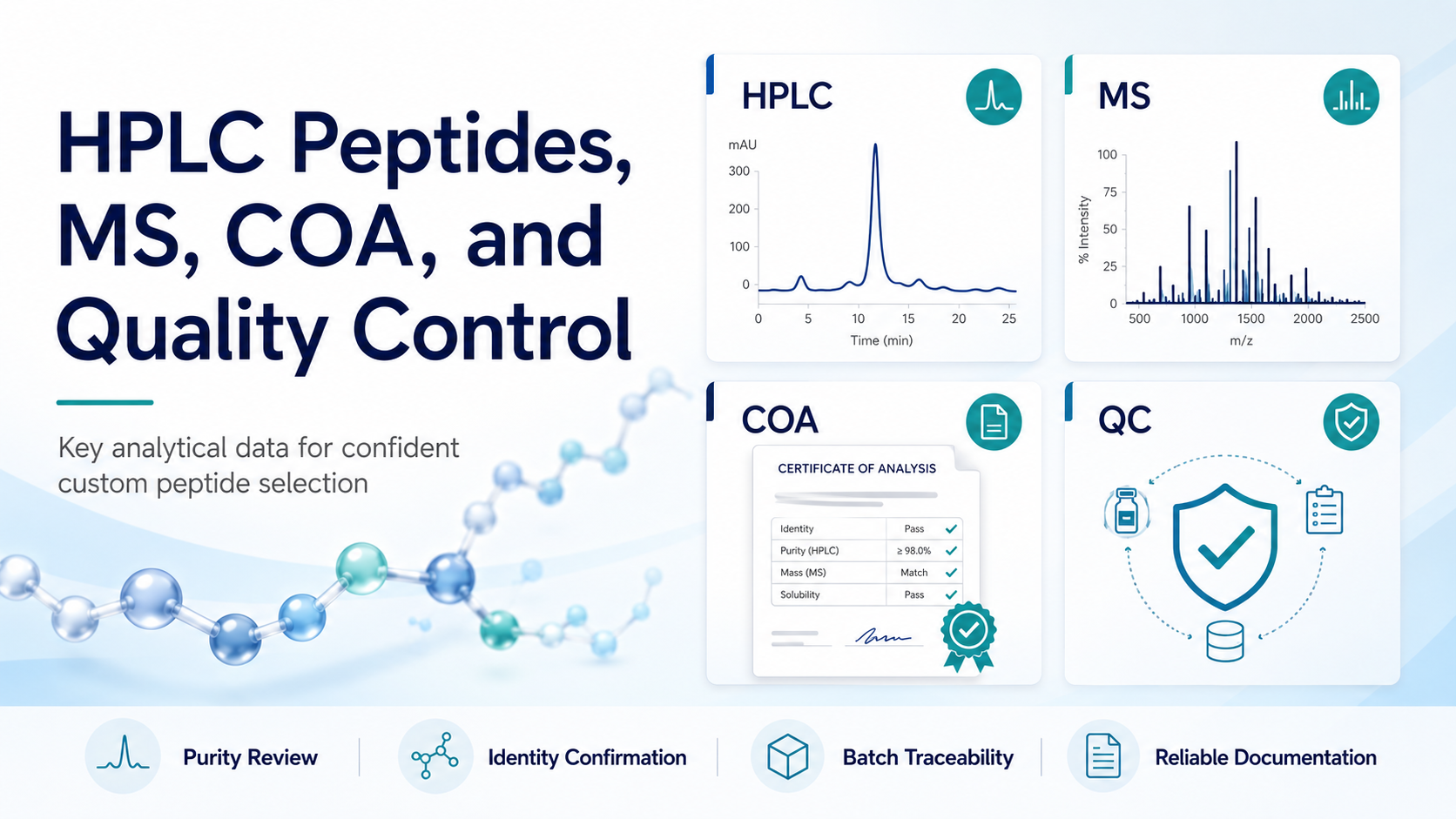
Quality-control data is central to custom peptide ordering. Researchers should compare suppliers not only by price but also by analytical documentation and batch traceability.
Why HPLC Matters
HPLC is commonly used to assess peptide purity. It separates the target peptide from related impurities and provides a chromatogram or purity percentage. For HPLC peptides, researchers should review whether the main peak is clear and whether the purity level matches the ordered specification.
Why Mass Spectrometry Matters
Mass spectrometry confirms the expected molecular weight of the peptide. This supports sequence identity and is especially important for custom peptides, modified peptides, labeled peptides, cyclic peptides, and peptide inhibitors.
What a COA Should Include
A strong certificate of analysis may include:
- Peptide name
- Sequence
- Molecular weight
- Lot or batch number
- Purity percentage
- HPLC result or chromatogram
- Mass spectrometry result
- Modification details
- Quantity supplied
- Appearance
- Storage guidance
- Date of analysis or release when available
Why Batch Consistency Matters
Batch consistency supports repeatable experiments. If a research program depends on long-term peptide use, researchers should document lot numbers, QC files, storage conditions, and any changes in synthesis scale or purity.
Custom Peptide Synthesis for Different Research Applications
| Research application | Peptide design need | QC priority |
|---|---|---|
| Receptor binding | Native ligand, analog, or labeled ligand | High purity, HPLC, MS, COA |
| Enzyme assay | Substrate or inhibitor sequence | Sequence identity, modification confirmation |
| Cell signaling | Bioactive peptide or pathway probe | Purity, solubility, batch consistency |
| Cellular uptake | Cell-penetrating peptide or conjugate | Label placement, charge, solubility |
| Antibody support | Epitope peptide and carrier strategy | Sequence accuracy and conjugation details |
| Peptide library | Variant sequences or positional scans | Format consistency and documentation |
| Analytical standard | Defined sequence and high purity | HPLC, MS, traceability |
| Drug discovery research | Hit validation or analog series | Purity, scale, reproducibility, support |
Common Mistakes in Peptide Ordering
Avoid these common ordering issues:
- Submitting a sequence without confirming N-to-C direction
- Forgetting terminal modifications
- Not specifying D-amino acids or non-natural residues
- Leaving cysteine pairing unclear
- Ordering purity that does not match the assay
- Requesting a label without specifying placement
- Ignoring solubility before ordering hydrophobic peptides
- Comparing suppliers only by price
- Not requesting HPLC/MS and COA documentation
- Ordering too little material for repeat experiments
- Changing lots without documenting batch differences
Clear peptide ordering improves research planning and helps prevent avoidable delays.
When to Request Custom Peptide Design Support
Researchers should request design or technical support when the peptide has features that may affect synthesis, purification, solubility, or assay performance.
Support is useful for:
- Long peptide sequences
- Hydrophobic regions
- Multiple cysteine residues
- Cyclic peptide designs
- Fluorescent or biotin labels
- Phosphorylated peptides
- Cell-penetrating peptide conjugates
- Peptide inhibitor optimization
- Peptide libraries
- Scale-up planning
- Difficult solubility predictions
Early design review can help align the sequence, purity, Modification, and handling plan with the intended research application.
Conclusion
Custom peptide synthesis gives researchers control over sequence, purity, scale, modifications, and analytical documentation. For research peptides, custom peptides, peptide inhibitors, cell-penetrating peptides, bioactive peptides, and peptide design studies, success begins with clear ordering specifications. It continues through HPLC, mass spectrometry, COA review, solubility planning, and batch documentation.
Researchers ordering custom peptide synthesis should define the application, confirm the exact sequence, choose an appropriate purity, specify modifications carefully, review HPLC peptides data, check MS confirmation, and keep lot-specific COA records. For research-use-only peptide workflows, LinkPeptide can support custom peptide synthesis, peptide modification, peptide analysis, and related peptide research materials with a practical focus on laboratory needs.
FAQ
What is custom peptide synthesis in research?
Custom peptide synthesis is the production of a researcher-specified peptide sequence with selected purity, scale, terminal groups, and optional modifications for laboratory research applications.
How do you order custom peptides correctly?
To place a custom peptide order, please confirm the sequence, N-to-C direction, species, terminal groups, modifications, purity, scale, solubility needs, HPLC/MS requirements, and COA documentation before submission.
What purity should custom peptides have?
Purity depends on the application. Exploratory studies may use moderate purity, while receptor binding, enzyme assays, analytical studies, and demanding research workflows often benefit from >95% or higher.
Why are HPLC and MS important for custom peptides?
HPLC helps assess peptide purity and impurity profile. Mass spectrometry confirms the expected molecular weight and supports sequence identity, especially for modified or complex custom peptides.
What modifications can be added to custom peptides?
Common peptide modifications include acetylation, amidation, biotinylation, fluorescent labeling, phosphorylation, methylation, glycosylation, cyclization, disulfide bonds, PEGylation, lipidation, and isotope labeling.