 LinkPeptide
Finding Your Way: Choosing the Right Peptide Purity for Every Application
Choosing the right peptide purity is one of the most important decisions in synthetic peptide research. A peptide that is suitable for early screening may not be the right choice for receptor binding, quantitative analysis, preclinical research models, or drug discovery research. The goal is not always to order the highest purity available. The goal is to match peptide purity, peptide quality, analytical documentation, and budget to the application.
For researchers working with bioactive peptides, peptide inhibitors, cell-penetrating peptides, custom peptides, and modified synthetic peptides, purity influences data clarity, reproducibility, assay interpretation, and procurement confidence. This guide explains how to choose peptide purity by research application, what HPLC and mass spectrometry data show, how to review a COA, and which quality-control factors matter most for laboratory research.
Peptide purity refers to the percentage of the target peptide in a synthetic peptide sample compared with related impurities. For routine research, moderate purity may be suitable. In contrast, receptor assays, quantitative studies, modified peptides, and preclinical research models often benefit from higher purity plus HPLC, MS, COA, and batch documentation.
What Does Peptide Purity Mean?
Peptide purity is a measure of how much of a peptide sample consists of the intended sequence. During peptide synthesis, side products can form through incomplete coupling, deletion sequences, truncation, oxidation, deprotection byproducts, or purification carryover. Purity testing helps researchers understand the composition of the final peptide material.
A peptide labeled 95% purity generally means the target peptide represents about 95% of the detected peptide-related material under the analytical method used. It does not automatically describe net peptide content, salt form, residual water, counterions, or biological activity. This is why peptide quality should be evaluated with more than a single percentage.
Why Peptide Purity Matters in Research
Peptide purity affects the confidence researchers can place in experimental results. Impurities may be inactive, weakly active, or occasionally able to interfere with receptor binding, enzyme assays, signaling studies, or analytical measurements. In early discovery work, small impurity levels may be acceptable. In sensitive assays, they can make data interpretation more complex.
Peptide purity is especially relevant in:
- Receptor-ligand binding studies
- Enzyme substrate and inhibitor assays
- Cell signaling experiments
- Cellular uptake studies using cell-penetrating peptides
- Quantitative analytical workflows
- Structure-function studies
- Modified peptide research
- Preclinical research models
- Drug discovery research and assay development
Common Peptide Purity Levels and Research Applications
Different applications call for different quality expectations. The table below offers general research-focused guidance.
| Peptide purity level | Common research fit | Practical notes |
|---|---|---|
| Crude peptide | Initial method development or internal feasibility checks | Usually needs further purification before sensitive studies |
| >70% purity | Antibody production support, some exploratory screening, non-quantitative testing | Useful when low cost and fast access matter more than precision |
| >80% purity | Early discovery, preliminary activity screening, simple functional checks | Review impurity profile before receptor or cell assays |
| >90% purity | General research peptides, pathway studies, many biochemical assays | Often suitable for routine laboratory research workflows |
| >95% purity | Receptor binding, enzyme assays, quantitative studies, bioactive peptides | Stronger choice when data clarity and reproducibility matter |
| >98% purity | High-sensitivity assays, reference-like materials, complex study designs | Often selected for demanding drug discovery research models |
| >99% purity | Analytical standards or highly controlled research applications | May increase cost and turnaround; confirm need before ordering |
Choosing Peptide Purity by Application
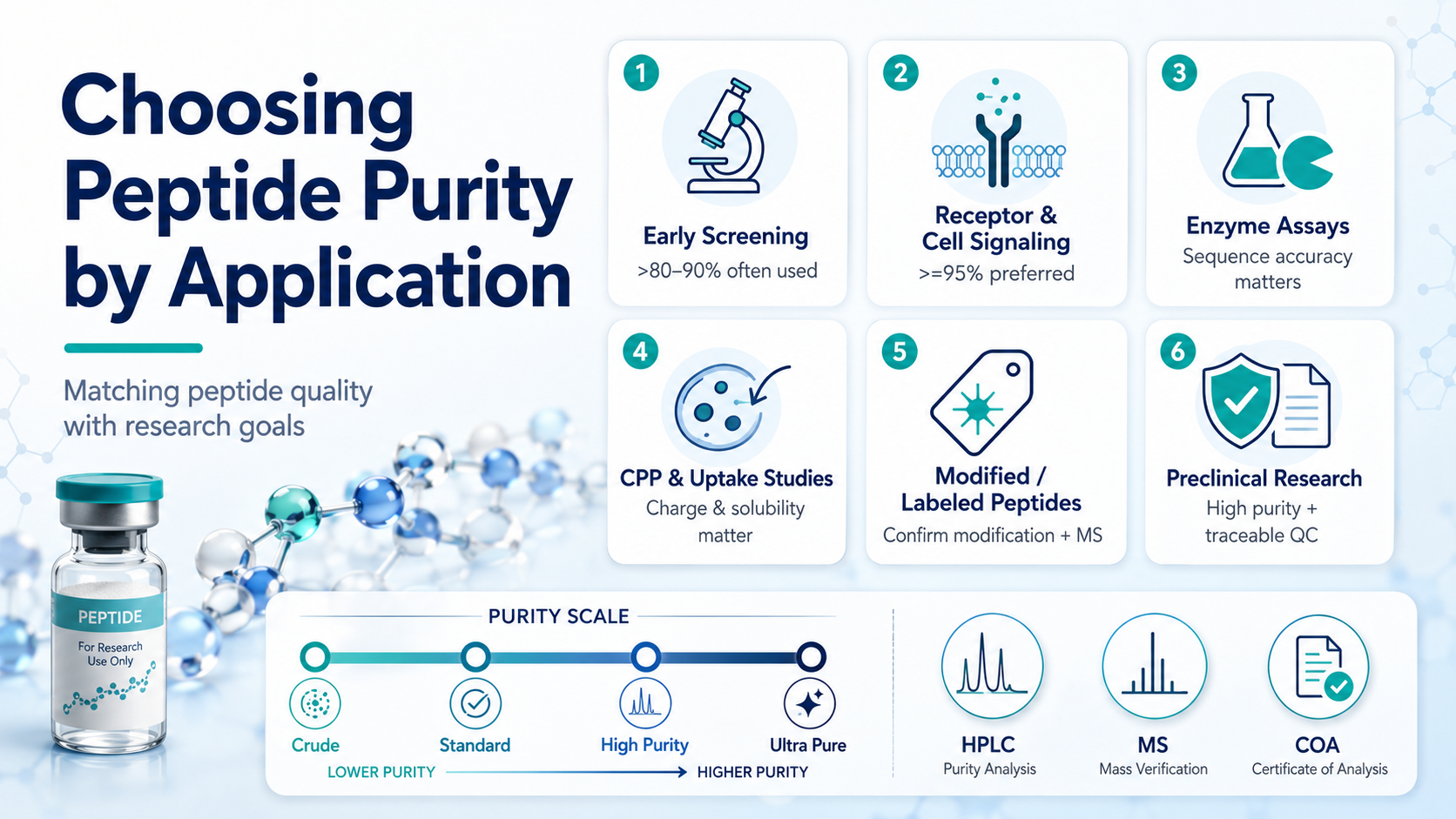
Early Screening and Exploratory Research
For early screening, researchers often evaluate many synthetic peptides across a target pathway, receptor family, or sequence library. In this phase, moderate purity may support efficient exploration, especially when the assay is qualitative or used for ranking candidates.
Useful considerations:
- Is the assay exploratory or quantitative?
- Will hits be resynthesized at higher purity later?
- Are impurities likely to affect the readout?
- Is speed or cost a major constraint?
For broad screening, researchers may start with >80% or >90% purity, then reorder promising candidates at >95% or higher for confirmation.
Receptor Binding and Cell Signaling Studies
Receptor-ligand binding assays and cell signaling studies often benefit from higher purity because small impurities may contribute to background activity or altered apparent potency. This is especially important for hormone receptors, GPCRs, kinase-linked pathways, cytokine receptors, and bioactive peptide systems.
For these applications, researchers commonly prioritize:
- 95% purity or higher
- HPLC chromatogram review
- Mass spectrometry identity confirmation
- Lot-specific COA
- Solubility and storage guidance
- Batch consistency for repeat experiments
Enzyme Assays and Peptide Substrates
Peptide substrates and peptide inhibitors are often used to measure enzyme activity, cleavage, phosphorylation, binding, or inhibition. Sequence accuracy and purity matter because truncated peptides or deletion sequences can change enzyme recognition.
For enzyme-related research, consider:
- Target sequence verification
- Modification site confirmation
- HPLC purity data
- MS molecular weight confirmation
- Compatibility with assay buffers and detection methods
Cell-Penetrating Peptides and Uptake Studies
Cell-penetrating peptides are used in intracellular delivery and cellular uptake research. Purity matters because sequence variants can affect uptake, localization, charge, solubility, and cargo interaction.
Researchers should pay attention to:
- Peptide length and charge
- Cargo conjugation strategy
- Fluorescent or biotin label position
- Hydrophobicity and solubility
- HPLC and MS data for modified peptides
Modified Peptides and Labeled Peptides
Modified peptides require additional quality review. A peptide may have high purity but still need confirmation that the intended modification is present at the correct site. Common modifications include acetylation, amidation, phosphorylation, methylation, cyclization, PEGylation, biotinylation, fluorescent labeling, and stable isotope labeling.
For modified peptides, mass spectrometry is especially useful because it helps confirm the expected molecular weight. HPLC helps evaluate purity, while COA documentation connects the analytical results to the batch received.
High Purity Peptides for Preclinical Research Models
In preclinical research models, peptide quality control becomes more important because experiments may require repeatability, clean analytical documentation, and traceable batch information. High-purity peptides can reduce uncertainty in receptor studies, pathway models, formulation research, pharmacology workflows, and translational research programs.
For these research contexts, procurement teams often look for:
- 95% or >98% purity where justified by assay design
- HPLC chromatogram
- Mass spectrometry confirmation
- COA with batch-specific details
- Clear sequence identity
- Modification confirmation
- Reproducible synthesis and purification workflow
- Technical support for custom peptide planning
HPLC Peptides: What HPLC Shows
High-performance liquid chromatography, or HPLC, is one of the most common methods for peptide purity analysis. It separates peptide-related components based on their interaction with the column and mobile phase. The resulting chromatogram shows peaks that represent the target peptide and detectable impurities.
HPLC helps answer one main question: how pure is the peptide under the tested analytical conditions?
When reviewing HPLC data, researchers should look for:
- A clear main peak
- Purity percentage
- Minor impurity peaks
- Detection wavelength
- Column and method details when available
- Batch or lot connection to the ordered peptide
HPLC does not fully confirm identity by itself. A strong main peak shows separation and estimated purity, but mass spectrometry is needed to support molecular identity.
Why Mass Spectrometry Matters
Mass spectrometry, often abbreviated as MS, helps confirm that the peptide has the expected molecular weight. This is critical for synthetic peptides, custom peptides, modified peptides, and peptide inhibitors, where sequence identity affects research interpretation.
MS helps answer a different question from HPLC: Is the target molecule what the researcher expected?
For peptide quality control, HPLC and MS work together. HPLC supports purity assessment, while MS supports identity confirmation. For custom peptide synthesis, both are valuable parts of analytical validation.
What Should a Peptide COA Include?
A certificate of analysis, or COA, connects the peptide batch to its quality-control data. Procurement teams and lab managers should review COA details before approving materials for sensitive workflows.
A useful peptide COA may include:
- Peptide name
- Sequence
- Molecular formula or molecular weight
- Lot or batch number
- Purity percentage
- HPLC result or chromatogram
- Mass spectrometry result
- Quantity
- Appearance
- Solubility or storage guidance
- Modification details, if applicable
- Release or analysis date when available
A COA should be specific to the batch, not a generic product page claim. Batch-specific documentation supports traceability and reproducibility.
How to Choose the Right Peptide Purity
Use this application-based checklist before ordering research peptides or requesting custom peptide synthesis:
- Define the assay type: screening, binding, signaling, uptake, enzyme activity, imaging, or analytical testing.
- Decide whether the result is qualitative, semi-quantitative, or quantitative.
- Match the peptide purity level to assay sensitivity.
- Please confirm the sequence, species, isoform, fragment position, and modification needs.
- Review whether the peptide requires labeling, cyclization, terminal modification, or conjugation.
- Ask whether HPLC, MS, and COA documentation are available.
- Please check the solubility, storage, and handling requirements.
- Please consider the synthesis scale and future repeat orders.
- Plan for batch consistency if the project will continue over time.
- Evaluate technical support, turnaround, global delivery, and documentation responsiveness.
LinkPeptide offers research peptides, bioactive peptides, peptide inhibitors, cell-penetrating peptides, custom peptide synthesis, peptide modification, and peptide analysis services for laboratory research applications.
Peptide Quality Control in Drug Development Research
Peptide quality control in drug development research requires a structured approach. Even in early-stage research, peptide identity, purity, impurity profile, and batch traceability influence confidence in assay results.
Important comparison points include:
| Quality factor | Why it matters for research |
|---|---|
| Purity | Helps reduce interference from related peptide impurities |
| HPLC | Quantifies purity and shows impurity peaks |
| Mass spectrometry | Confirms molecular weight and supports identity |
| COA | Links QC data to the received batch |
| Sequence identity | Confirms the intended amino acid chain |
| Modification confirmation | Verifies labels, conjugates, or terminal changes |
| Batch consistency | Supports repeat studies and longitudinal projects |
| Scale | Helps align discovery, validation, and larger research needs |
| Technical support | Helps resolve synthesis feasibility and assay-fit questions |
For pharmaceutical research and biotech R&D, purity standards should be selected according to study phase, assay sensitivity, and documentation needs rather than a single universal number.
Practical Lab Considerations Beyond Purity
Purity is important, but it is only one part of peptide quality. A peptide can meet a purity target and still require further review for solubility, handling, modification integrity, or sequence complexity.
Researchers should also evaluate:
- Net peptide content versus gross peptide weight
- Salt form and counterion considerations
- Water content and hygroscopic behavior
- Storage temperature and freeze-thaw planning
- Reconstitution solvent compatibility
- Adsorption to plastic or glass surfaces
- Oxidation-sensitive residues such as methionine or cysteine
- Disulfide bridge formation where relevant
- Hydrophobicity and aggregation tendency
These details are especially important for long peptides, hydrophobic peptides, cyclic peptides, fluorescent peptides, and peptides used in sensitive cell-based assays.
When Should Researchers Request Custom Peptide Support?
Custom peptide synthesis is useful when a catalog peptide does not match the exact research need. Researchers may request custom support for:
- Species-specific sequences
- Peptide fragments
- Alanine scanning studies
- Mutant peptide libraries
- Peptide inhibitors
- Cell-penetrating peptide conjugates
- Fluorescent-labeled peptides
- Biotinylated peptides
- Phosphorylated peptides
- Cyclic peptides
- Scale-up from screening to repeated studies
For custom peptides, it is helpful to discuss sequence complexity, modification feasibility, expected purity, purification method, analytical package, and delivery timeline before ordering.
Common Mistakes When Selecting Peptide Purity
Researchers can improve procurement decisions by avoiding common mismatches:
- Choosing the highest purity without considering assay requirements
- Using crude peptides in a sensitive quantitative assay
- Comparing suppliers by purity percentage alone
- Ignoring COA and lot-specific documentation
- Reviewing HPLC without checking MS identity data
- Ordering modified peptides without confirming the modification position
- Underestimating solubility challenges for hydrophobic sequences
- Changing peptide lots without documenting batch differences
A thoughtful selection process helps align peptide quality with experimental purpose.
Conclusion
Peptide purity plays a central role in research peptides, synthetic peptides, peptide analysis, and peptide quality control. The right purity level depends on the application: exploratory screening may allow moderate purity, while receptor binding, enzyme assays, modified peptides, cell signaling studies, preclinical research models, and drug discovery research often benefit from higher purity and stronger documentation.
Researchers should evaluate peptide purity together with HPLC data, mass spectrometry confirmation, COA details, sequence identity, peptide modification requirements, solubility, batch consistency, synthesis scale, and technical support. For research-use-only workflows, LinkPeptide can support peptide selection through catalog peptides, custom peptide synthesis, peptide modification, peptide analysis, and related peptide research materials.
FAQ
What is peptide purity?
Peptide purity is the percentage of the intended peptide sequence in a sample compared with detectable peptide-related impurities under the analytical method used, commonly HPLC.
What peptide purity is suitable for research use?
For many research peptides, >90% purity may support routine studies. Sensitive receptor assays, quantitative workflows, modified peptides, and preclinical research models often use >95% or higher.
Why are HPLC and MS both important for peptide quality control?
HPLC estimates peptide purity by separating the main peak from impurity peaks. Mass spectrometry helps confirm the expected molecular weight and supports peptide identity verification.
What should researchers check on a peptide COA?
Researchers should check sequence, lot number, purity percentage, HPLC result, MS result, molecular weight, modification details, quantity, storage guidance, and batch-specific traceability.
Are higher purity peptides always necessary?
Higher purity is not always necessary. The best choice depends on assay sensitivity, research phase, peptide complexity, modification type, documentation needs, and budget.