 LinkPeptide
How to Store Peptides: Best Practices for Researchers
Peptide storage is a critical part of research peptide handling because storage conditions influence peptide integrity, solubility, concentration accuracy, and assay reproducibility. Lyophilized peptides are generally more stable than reconstituted peptides, but both forms require protection from moisture, repeated freeze-thaw cycles, light exposure, and unnecessary time at room temperature.
For researchers working with synthetic peptides, custom peptides, bioactive peptides, peptide inhibitors, cell-penetrating peptides, and modified peptides, Storage is not only a freezer decision. It is a workflow decision that connects peptide quality, peptide reconstitution, HPLC/MS documentation, COA review, batch consistency, and final experimental design. This guide explains how to store peptides for research-use-only applications and how to reduce avoidable peptide degradation during laboratory storage.
Why Peptide Storage Matters in Research
Peptides are chains of amino acids, and their chemical structure can be sensitive to environmental conditions. Temperature, moisture, oxygen, light, pH, solvent composition, and repeated freeze-thaw cycles can affect peptide stability. When Storage is not controlled, peptides may degrade, oxidize, hydrolyze, aggregate, or precipitate.
In laboratory research, peptide storage affects:
- Receptor-ligand binding assays
- Enzyme activity and inhibition studies
- Cell signaling experiments
- Peptide inhibitor screening
- Cell-penetrating peptide uptake research
- Fluorescent and labeled peptide studies
- Peptide solubility after reconstitution
- Quantitative peptide analysis
- Drug discovery research workflows
- Long-term batch-to-batch reproducibility
Good storage practice helps researchers preserve material integrity from receipt through reconstitution, aliquoting, assay setup, and repeat testing.
Lyophilized Peptides vs Reconstituted Peptides
Peptides are often supplied as lyophilized powders. Lyophilization, also called freeze-drying, removes water and creates a dry peptide form that is generally more stable than the same peptide in solution. Reconstituted peptides are peptides dissolved in water, buffer, or another solvent, and they typically require more careful short-term handling.
| Peptide form | Storage focus | Practical research note |
|---|---|---|
| Lyophilized peptides | Keep cold, dry, sealed, and protected from light | Usually preferred for longer-term storage before use |
| Reconstituted peptides | Aliquot, minimize freeze-thaw, protect from light, use compatible solvent | Better suited for planned short-term or controlled-use workflows |
| Modified peptides | Protect label or modification from degradation conditions | Fluorescent, biotinylated, phosphorylated, or cyclic peptides may need special handling |
| Hydrophobic peptides | Prevent precipitation after reconstitution | Solvent and stock concentration planning are essential |
| Cysteine-containing peptides | Reduce unwanted oxidation or disulfide changes | Confirm intended reduced, oxidized, or cyclic state |
How to Store Lyophilized Peptides at -20°C
For many research peptides, lyophilized Storage at -20°C is a practical long-term laboratory approach. The peptide should remain sealed and dry until use. Moisture exposure is one of the most important risks for lyophilized peptides, so vial handling matters as much as freezer temperature.
Best Practices for Lyophilized Peptide Storage
- Store unopened lyophilized peptide vials at -20°C unless product-specific instructions recommend another condition.
- Keep vials tightly sealed to reduce moisture exposure.
- Protect light-sensitive peptides from direct light.
- Avoid frequent freezer door exposure when possible.
- Let the vial reach room temperature before opening to reduce condensation.
- Open the vial only when ready to weigh or reconstitute.
- Record the lot number, storage date, and storage location.
- Return unused lyophilized material to cold, dry Storage promptly if the lab protocol allows.
Why Room-Temperature Equilibration Matters
When a cold vial is opened immediately after removal from the freezer, moisture from the air can condense inside the vial. That moisture can interact with lyophilized peptide powder and may support hydrolysis, aggregation, or handling variability. Allowing the vial to warm while still sealed helps reduce condensation risk.
Best Way to Store Reconstituted Peptides in the Laboratory
Alt Text (Reconstituted peptides)
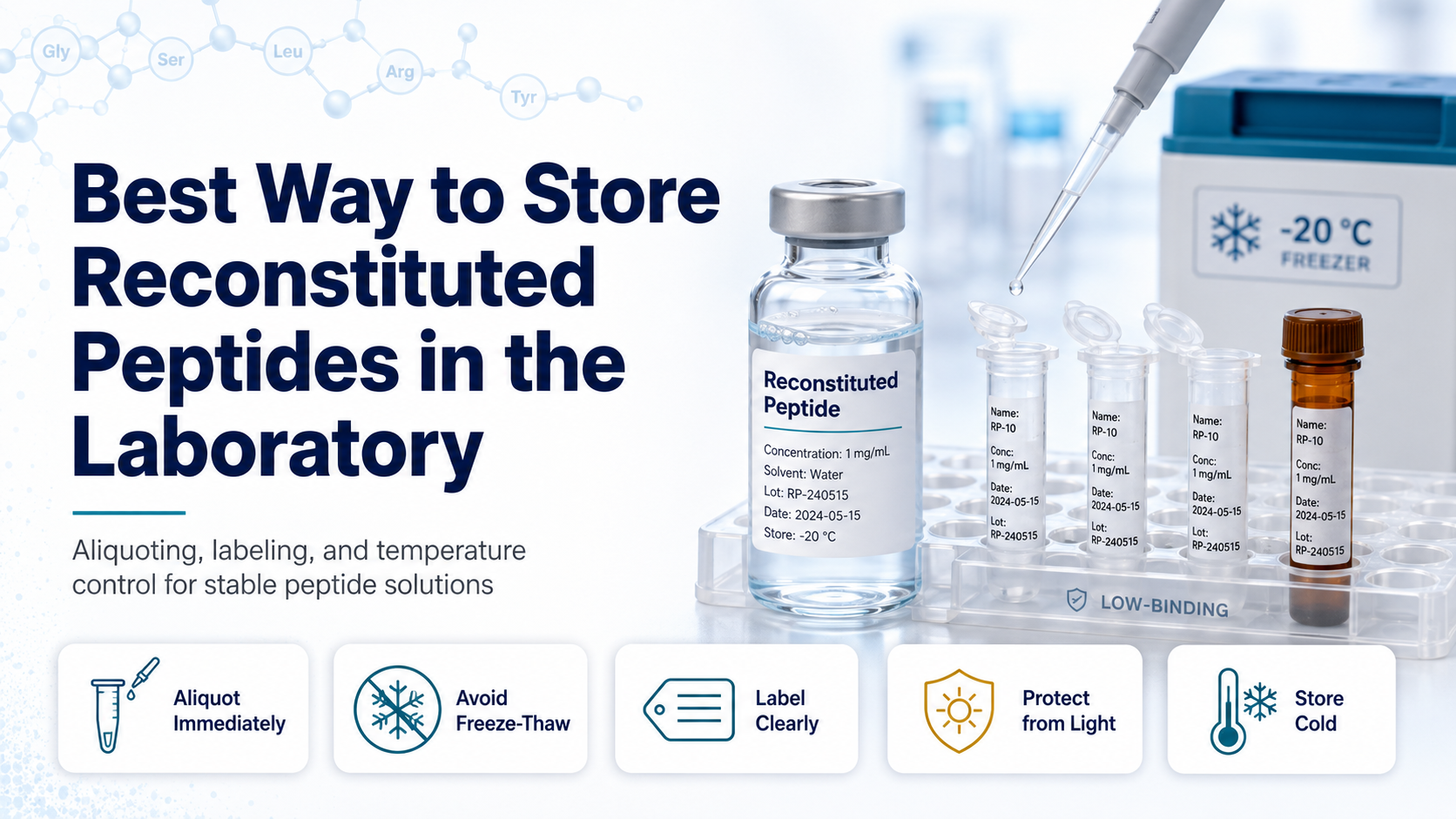
Reconstituted peptides are generally less stable than lyophilized peptides because they are exposed to solvent, pH, oxygen, and potential microbial or chemical degradation factors. After reconstitution, peptide handling should be planned around aliquoting, concentration, storage temperature, and expected use schedule.
Reconstituted Peptide Storage Best Practices
- Prepare stock solutions using a solvent compatible with the peptide and assay.
- Use small aliquots sized for single-use or limited-use experiments.
- Avoid repeated freeze-thaw cycles.
- Store light-sensitive peptides in amber tubes or protected containers.
- Use low-binding tubes when adsorption is a concern.
- Label each aliquot with peptide name, concentration, solvent, date, and lot number.
- Keep a preparation record with COA and HPLC/MS reference files.
- Follow peptide-specific storage guidance where available.
Short-Term vs Longer-Term Solution Storage
Some reconstituted peptides may be kept briefly at refrigerated temperatures for short-term use, while others may be stored frozen in aliquots. The best choice depends on sequence, solvent, concentration, assay timeline, and peptide sensitivity. Researchers should avoid assuming that all reconstituted peptides behave the same way.
For most laboratory workflows, aliquoting immediately after reconstitution supports better repeatability because each experiment uses a defined preparation history.
Peptide Reconstitution and Storage Planning
Peptide reconstitution and peptide storage should be planned together. A peptide that dissolves well in one solvent may precipitate after dilution into buffer or media. A peptide that is stable as a dry powder may degrade more quickly in solution.
Peptide Reconstitution Planning Questions
Before reconstitution, ask:
- What is the target stock concentration?
- Will the peptide dissolve in water, buffer, or a cosolvent?
- Is the peptide acidic, basic, hydrophobic, long, cyclic, or modified?
- Does the peptide contain oxidation-sensitive residues?
- Will the final solvent percentage affect the assay?
- How many aliquots are needed?
- How soon will the peptide be used after reconstitution?
- What storage condition is recommended on the COA or datasheet?
How Peptide Solubility Affects Storage
Peptide solubility can change during Storage. A clear stock solution may become cloudy after freezing, thawing, dilution, or pH change. Hydrophobic peptides, long peptides, cyclic peptides, and modified peptides may be more likely to aggregate or precipitate.
For difficult peptides, researchers should consider:
- Lower stock concentrations
- Compatible organic cosolvents
- Gentle mixing rather than harsh agitation
- Testing small-volume dilution before full assay setup
- Recording visual appearance after reconstitution and thawing
How to Prevent Peptide Degradation During Storage
Peptide degradation can occur through several chemical and physical pathways. Storage practices should reduce the conditions that support these changes.
Common Peptide Degradation Pathways
| Degradation pathway | What can contribute to it | Storage control strategy |
|---|---|---|
| Hydrolysis | Water exposure, unsuitable pH, prolonged solution storage | Keep lyophilized peptides dry; avoid unnecessary solution time |
| Oxidation | Oxygen, light, oxidizing conditions, sensitive residues | Minimize air exposure; protect light-sensitive peptides |
| Deamidation | pH, temperature, sequence context | Use suitable pH and temperature controls |
| Aggregation | Hydrophobicity, high concentration, freeze-thaw stress | Use appropriate solvent, concentration, and aliquots |
| Photodegradation | Light-sensitive labels or residues | Store protected from light |
| Microbial contamination | Non-sterile handling or prolonged aqueous storage | Use good lab technique and suitable storage plans |
Residues and Features That May Need Extra Attention
Some peptide sequences are more sensitive than others. Researchers should review sequence composition and modification type before deciding on storage conditions.
Potentially sensitive features include:
- Methionine and tryptophan residues, which may be oxidation-sensitive
- Asparagine and glutamine residues, which may be relevant to deamidation risk
- Cysteine residues and disulfide bonds
- Long hydrophobic segments
- Fluorescent labels
- Phosphorylated residues
- Lipidated or PEGylated peptides
- Cyclic structures
- Cell-penetrating peptide conjugates
Peptide Handling Checklist for Research Labs
A simple handling checklist can improve reproducibility across lab members and timepoints.
Upon Receipt
- Please confirm the peptide name, sequence, and quantity.
- Check the lot number and COA.
- Please review the purity, HPLC, and mass spectrometry data.
- Confirm storage conditions in the documentation.
- Store lyophilized peptides at the recommended temperature.
- Protect light-sensitive peptides as needed.
Before Opening the Vial
- Allow sealed vial to reach room temperature.
- Prepare solvent, tubes, labels, and records before opening.
- Review target concentration and aliquot plan.
- Work efficiently to reduce moisture exposure.
After Reconstitution
- Mix gently and avoid foaming when possible.
- Confirm visual appearance and note any cloudiness.
- Aliquot into labeled tubes.
- Record solvent, concentration, date, and storage condition.
- Avoid repeated freeze-thaw cycles.
- Store according to peptide-specific guidance.
Quality-Control Review: HPLC, MS, COA, Purity, and Batch Consistency
Peptide storage decisions should be connected to peptide quality documentation. A peptide’s COA and analytical data help researchers understand what material they are storing and using.
Why HPLC Matters
HPLC helps evaluate peptide purity by separating the main peptide peak from related impurity peaks. If a peptide degrades during Storage, HPLC can sometimes reveal changes in impurity profile, new peaks, or reduced main peak area in analytical studies.
Why Mass Spectrometry Matters
Mass spectrometry supports sequence identity by confirming the expected molecular weight. For custom peptides, modified peptides, labeled peptides, and peptide inhibitors, MS data helps confirm that the supplied material matches the intended research design.
Why COA Review Matters
A certificate of analysis connects the peptide batch to its purity, sequence, HPLC, MS, and lot information. For lab managers and procurement teams, COA review helps maintain traceability from ordering to Storage to experimental use.
Why Batch Consistency Matters
Batch consistency is important for repeat experiments and long-term projects. Storage logs should include lot numbers, storage locations, reconstitution dates, aliquot use, and freeze-thaw history. This documentation helps researchers interpret differences between experiments and peptide lots.
How to Choose the Right Peptide or Service for Storage-Sensitive Work
Some peptide projects need extra planning before ordering. Storage-sensitive peptides may require custom design input, specific purity, special modifications, analytical validation, or solubility review.
How to Choose Checklist
- Confirm whether the peptide is catalog, custom, modified, labeled, cyclic, or conjugated.
- Review sequence features linked with oxidation, hydrolysis, aggregation, or poor solubility.
- Choose purity based on assay sensitivity and repeatability needs.
- Please request or review the HPLC and mass spectrometry data.
- Confirm COA availability and lot-specific documentation.
- Ask about solubility and reconstitution guidance for difficult sequences.
- Consider aliquot size, stock concentration, and expected use schedule.
- Select technical support when working with long, hydrophobic, or modified peptides.
- Plan repeat orders if the project requires batch continuity.
- Align shipping, Storage, and delivery timing with lab availability.
LinkPeptide offers research peptides, custom peptides, bioactive peptides, peptide inhibitors, cell-penetrating peptides, peptide modification, peptide analysis, and peptide synthesis materials for laboratory research workflows.
Storage Considerations by Peptide Type
| Peptide type | Storage consideration | Practical note |
|---|---|---|
| Bioactive peptides | Activity-related assays may be sensitive to degradation | Use documented storage and avoid repeated freeze-thaw |
| Peptide inhibitors | Assay interpretation depends on intact inhibitor sequence | Track lot, purity, and aliquot history |
| Cell-penetrating peptides | Charge and conjugation can affect solubility | Monitor precipitation after thawing or dilution |
| Labeled peptides | Fluorophores can be light-sensitive | Protect from light during storage and handling |
| Phosphorylated peptides | Modification integrity matters | Confirm MS data and avoid unsuitable conditions |
| Cyclic peptides | Structure and solubility vary by design | Follow supplier-specific handling notes |
| Hydrophobic peptides | Higher aggregation risk | Use compatible solvent and avoid high stock concentration |
| Custom peptides | Requirements depend on sequence and modification | Discuss storage and reconstitution before ordering |
Peptide Storage Record Template
Researchers can use a simple storage record to support reproducibility.
| Field | Example entry |
|---|---|
| Peptide name | Project-specific peptide ID |
| Sequence | N-to-C amino acid sequence |
| Supplier | LinkPeptide or supplier name |
| Lot number | Batch-specific number |
| Purity | HPLC purity percentage |
| MS confirmation | Expected molecular weight confirmed |
| COA location | Lab folder or LIMS reference |
| Storage form | Lyophilized or reconstituted |
| Storage temperature | -20°C, -80°C, 2–8°C, or product-specific condition |
| Reconstitution solvent | Water, buffer, DMSO, or other solvent |
| Stock concentration | Research-defined concentration |
| Aliquot size | Single-use or planned-use volume |
| Freeze-thaw count | Number per aliquot |
| Light protection | Yes or no |
| Notes | Solubility, cloudiness, precipitation, or handling observations |
This documentation helps teams keep peptide handling consistent across molecular biology, pharmacology, cancer biology, immunology, endocrinology, cosmetic science, biomaterials, and drug discovery research.
Common Peptide Storage Mistakes to Avoid
Researchers can improve storage outcomes by avoiding common workflow errors:
- Opening a cold lyophilized vial before it reaches room temperature
- Storing lyophilized peptides with repeated moisture exposure
- Reconstituting the full vial when only small aliquots are needed
- Repeatedly freezing and thawing the same peptide stock
- Using a solvent without checking peptide solubility or assay compatibility
- Leaving light-sensitive peptides exposed on the bench
- Forgetting to record the lot number, solvent, concentration, and storage date
- Assuming all peptides share the same storage stability
- Ignoring HPLC/MS and COA documentation
- Changing peptide batches without updating records
Conclusion
Peptide storage guidelines are essential for protecting research peptides from avoidable degradation and supporting consistent experimental workflows. Lyophilized peptides are generally best kept sealed, dry, protected from light, and commonly stored at -20°C for longer-term laboratory use. Reconstituted peptides require careful aliquoting, compatible solvents, freeze-thaw control, light protection when needed, and complete preparation records.
For research-use-only peptide experiments, storage planning should include peptide sequence review, solubility assessment, peptide reconstitution strategy, HPLC/MS data, COA documentation, purity, batch consistency, and handling records. Researchers planning storage-sensitive peptide studies can explore LinkPeptide resources for research peptides, custom peptide synthesis, peptide modification, peptide analysis, and peptide-related materials that support laboratory research workflows.
FAQ
How should lyophilized peptides be stored?
Lyophilized peptides should usually be stored sealed, dry, protected from light, and commonly at -20°C for longer-term laboratory storage unless product-specific guidance recommends another condition.
What is the best way to store reconstituted peptides?
Reconstituted peptides should be aliquoted into small volumes, labeled clearly, protected from light when needed, stored under peptide-specific conditions, and handled to minimize repeated freeze-thaw cycles.
Why should peptide vials be warmed before opening?
A sealed cold vial should reach room temperature before opening to reduce condensation inside the vial. Moisture exposure can affect lyophilized peptide handling and may contribute to degradation.
How can researchers prevent peptide degradation during Storage?
Researchers can reduce degradation by controlling temperature, moisture, light, oxygen exposure, pH, solvent compatibility, freeze-thaw cycles, and by documenting storage conditions for each peptide lot.
What QC data supports peptide storage planning?
Useful QC data includes HPLC purity, mass spectrometry confirmation, COA documentation, sequence identity, modification details, lot number, storage guidance, solubility notes, and batch consistency records.