 LinkPeptide
Metabolic Peptide Hormones and Regulators Research
Metabolic peptide hormones are peptide or protein-based signaling molecules involved in metabolic research, including insulin, glucagon, growth hormone, somatostatin, GLP-1, GIP, leptin, ghrelin, PYY, and melanocortin-related peptides. Researchers study them through hormone receptors such as receptor tyrosine kinases, GPCRs, cytokine-family receptors, and related signaling systems.
For academic groups, biotech R&D teams, and drug discovery researchers, the main search intent is clear: understand which peptide hormones are involved in metabolism, how their receptors work, and how to choose research-grade peptides with suitable Purity, documentation, and analytical validation. This guide explains the biology, research applications, selection criteria, and quality-control factors that support reproducible peptide-based experiments.
What Are Metabolic Peptide Hormones?
Metabolic peptide hormones are chains of amino acids that act as biological messengers in endocrine and paracrine signaling models. Unlike steroid hormones, many peptide hormones interact with receptors on the cell surface because their structure supports receptor-mediated signaling rather than direct membrane diffusion.
Metabolic peptide hormone research spans molecular biology, endocrinology, pharmacology, neuroscience, immunology, cancer biology, and drug discovery research. Because these peptides are often pathway-specific, they are frequently used as reference ligands, pathway modulators, receptor probes, assay controls, or starting points for custom peptide design.
Metabolic Peptide Hormones and Their Receptors
Most metabolic peptide hormones signal through membrane-associated hormone receptors. The receptor class determines the downstream pathway, assay design, and type of peptide needed.
Receptor Tyrosine Kinase Pathways
Insulin is the most familiar metabolic peptide hormone associated with receptor tyrosine kinase signaling. In research models, insulin receptor activation is commonly studied through phosphorylation events, PI3K/AKT signaling, glucose transporter regulation, glycogen metabolism, and downstream transcriptional effects.
Researchers studying insulin signaling often evaluate:
- Ligand-receptor binding
- Insulin receptor phosphorylation
- IRS protein recruitment
- PI3K/AKT pathway activation
- MAPK pathway crosstalk
- Cellular nutrient-response models
Insulin and related peptide tools can support pathway mapping, receptor activation assays, and comparative studies of metabolic signaling networks.
GPCR-Mediated Peptide Hormone Signaling
Many peptide hormones involved in metabolism act through G protein-coupled receptors, also known as GPCRs. Glucagon, GLP-1, GIP, somatostatin, ghrelin, melanocortin peptides, and several gut-derived peptides are associated with GPCR-linked research models.
GPCR studies may track second messengers such as cAMP, calcium flux, IP3/DAG signaling, beta-arrestin recruitment, receptor internalization, and downstream kinase activation. For metabolic pathway studies, GPCR-linked peptide hormones are especially useful because they provide clear receptor-ligand relationships and measurable signaling outputs.
Cytokine-Family and JAK/STAT-Linked Receptors
Growth hormone is a peptide/protein hormone studied through growth hormone receptor signaling. Its receptor is associated with JAK/STAT pathway activation and broader signaling crosstalk. In metabolic research, growth hormone-related studies may focus on receptor activation, transcriptional regulation, cell growth models, lipid metabolism models, and endocrine pathway interactions.
Leptin is another metabolic peptide/protein hormone commonly studied through cytokine-family receptor signaling. Researchers often use leptin-related systems to explore nutrient sensing, energy balance models, and hypothalamic signaling research.
List of Peptide Hormones Involved in Metabolism
The following list highlights commonly studied peptide hormones and related regulators in metabolism-focused research.
| Peptide hormone or regulator | Common research focus | Typical receptor/pathway context |
|---|---|---|
| Insulin | Nutrient response, glucose signaling, PI3K/AKT | Insulin receptor, RTK signaling |
| Glucagon | Fasting-response models, hepatic signaling | Glucagon receptor, GPCR/cAMP |
| GLP-1 | Incretin signaling, receptor activation assays | GLP-1 receptor, GPCR/cAMP |
| GIP | Incretin research, metabolic pathway crosstalk | GIP receptor, GPCR/cAMP |
| Somatostatin | Hormone release regulation, receptor selectivity | SSTR family, GPCR signaling |
| Growth hormone | JAK/STAT signaling, endocrine pathway studies | Growth hormone receptor |
| Ghrelin | Appetite and nutrient-sensing models | Ghrelin receptor, GPCR signaling |
| Leptin | Energy-balance signaling models | Leptin receptor, JAK/STAT |
| PYY | Gut-brain axis and receptor studies | Neuropeptide Y receptors |
| Melanocortin peptides | Energy homeostasis and receptor research | MC receptor family, GPCR signaling |
| Amylin | Pancreatic hormone research models | Calcitonin receptor complexes |
| Orexin peptides | Neuroendocrine and metabolic regulation studies | Orexin receptors, GPCR signaling |
This type of comparison helps researchers match the peptide, receptor, and assay endpoint before ordering catalog peptides or requesting custom peptide synthesis.
Insulin and Glucagon Signaling Pathways and Receptors
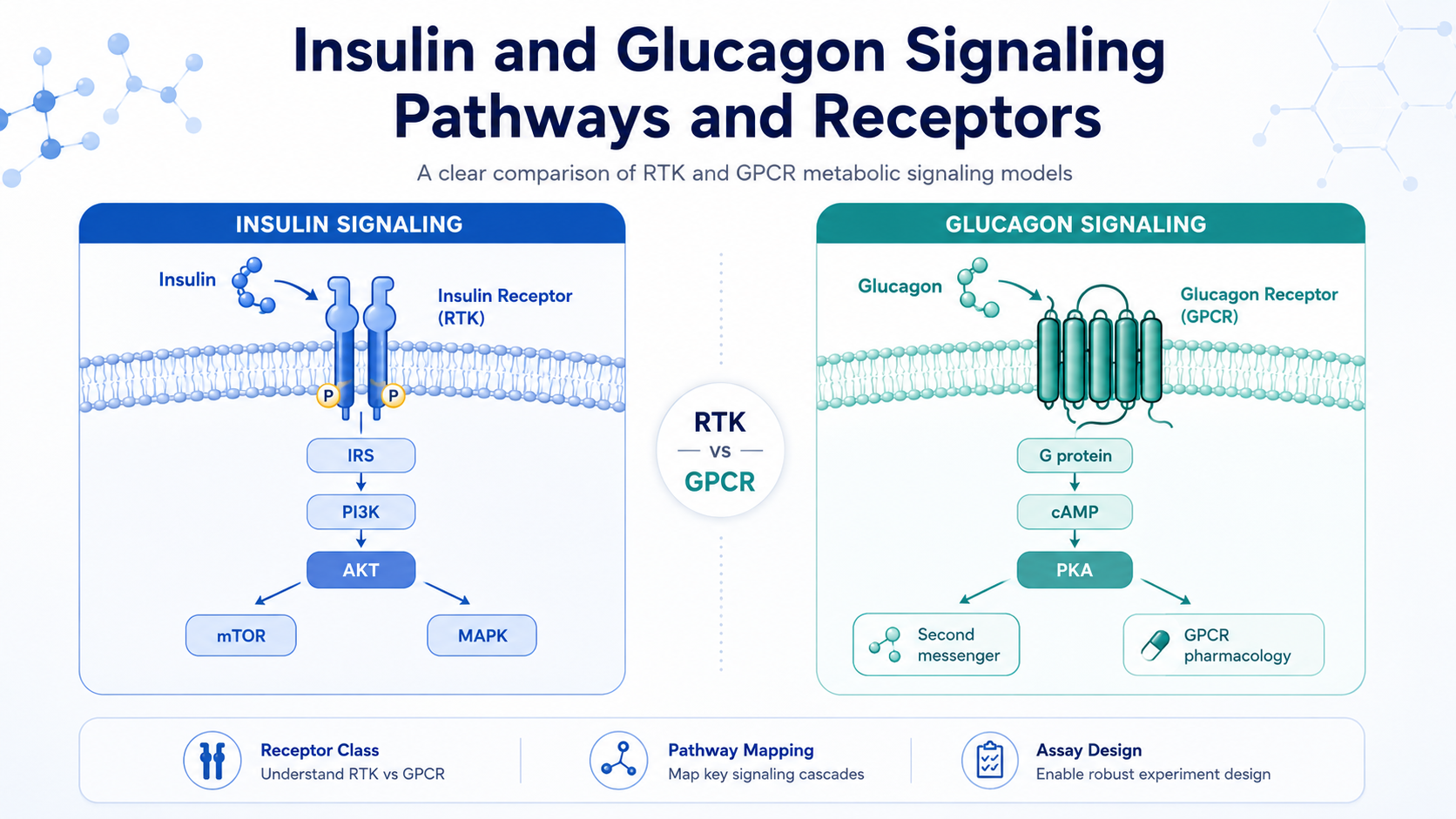
Insulin and glucagon are often studied together because they provide a useful contrast between anabolic and catabolic pathway models. In laboratory research, this pair supports studies of receptor type, second-messenger signaling, phosphorylation cascades, and pathway feedback.
How Does Insulin Signaling Work in Research Models?
Insulin binds to the insulin receptor, a receptor tyrosine kinase. This activates phosphorylation-dependent signaling events involving IRS proteins, PI3K, AKT, and downstream metabolic regulators. Researchers use this pathway to study receptor activation, kinase signaling, glucose-response models, and pathway crosstalk with MAPK and mTOR-related systems.
How Does Glucagon Signaling Work in Research Models?
Glucagon binds the glucagon receptor, a GPCR. In many research systems, glucagon receptor activation is linked with cAMP generation and PKA-related signaling. This makes glucagon useful for studying fasting-response models, hepatic metabolic signaling, second-messenger assays, and GPCR pharmacology.
Why Compare Insulin and Glucagon Pathways?
Comparing these pathways helps researchers examine how different receptor classes coordinate metabolic signaling. Insulin receptor studies emphasize RTK phosphorylation networks, while glucagon receptor studies emphasize GPCR-driven cAMP signaling. Together, they provide a strong framework for pathway mapping and receptor-ligand assay design.
Growth Hormone, Somatostatin, and Melanocortin Receptors in Metabolic Research
Growth Hormone Research Context
Growth hormone is widely searched because it appears across endocrinology, cell signaling, and metabolic regulation topics. In laboratory research, growth hormone and related peptide/protein systems are often used to study receptor activation, JAK/STAT signaling, transcriptional effects, and endocrine pathway crosstalk.
Researchers may focus on:
- Growth hormone receptor binding
- STAT phosphorylation
- Signal duration and feedback regulation
- Metabolic pathway interactions
- Comparative receptor signaling models
Somatostatin Research Context
Somatostatin is a peptide hormone regulator that interacts with somatostatin receptor subtypes, often abbreviated as SSTRs. These receptors are GPCRs and are relevant in studies of hormone release regulation, receptor subtype selectivity, intracellular signaling, and peptide analog research.
Somatostatin-related research can involve native sequences, modified peptides, receptor-selective analogs, labeled peptides, or peptide inhibitors, depending on the experiment.
Melanocortin Receptors Research Context
Melanocortin receptors are GPCRs involved in research areas such as energy balance, feeding behavior models, pigmentation biology, inflammation-related signaling, and neuroendocrine regulation. Melanocortin-related peptides, including ACTH-derived and alpha-MSH-related sequences, are frequently studied in receptor-ligand binding and signaling assays.
Because melanocortin receptor assays can be sensitive to peptide sequence and modifications, researchers often evaluate sequence identity, Purity, solubility, and receptor selectivity before selecting peptides.
How Researchers Can Choose the Right Peptide or Service
Choosing metabolic peptide hormones for research is not only a matter of finding the correct name. The peptide must match the receptor model, assay format, purity requirement, modification need, and documentation standard.
How to Choose Checklist
Use this checklist before selecting a catalog peptide or custom peptide service:
- Confirm the exact peptide sequence, species, and isoform.
- Match the peptide to the target hormone receptor or receptor subtype.
- Identify whether the assay measures binding, activation, inhibition, uptake, localization, or pathway response.
- Decide whether a native peptide, an analog, an antagonist, an inhibitor, or a labeled peptide is needed.
- Select a suitable purity level based on assay sensitivity.
- Review solubility and storage requirements.
- Check whether terminal modification, fluorescent labeling, biotinylation, cyclization, PEGylation, or phosphorylation is needed.
- Request or review HPLC, mass spectrometry, COA, and batch documentation.
- Consider synthesis scale, expected turnaround, shipping needs, and technical support.
For researchers comparing peptide suppliers, LinkPeptide offers catalog research peptides as well as custom peptide synthesis, peptide modification, and peptide analysis services that can support metabolism-focused laboratory studies.
Practical Lab Considerations for Metabolic Peptide Hormone Studies
Sequence and Species Matching
Peptide hormones can differ across species, fragments, and analog formats. A small sequence difference may influence receptor binding, assay performance, or pathway readout. Researchers should verify whether the study requires a human, mouse, rat, or another species-specific sequence.
Purity Requirements
Purity expectations vary by application. Screening assays, receptor binding studies, cell signaling experiments, and analytical standards may require different purity thresholds. For sensitive receptor or functional assays, higher Purity and strong analytical documentation can support clearer interpretation.
Solubility and Handling
Peptides may require specific solvents, buffers, pH ranges, or preparation conditions. Hydrophobic sequences, long peptides, cyclic peptides, and modified peptides may need additional planning. Solubility notes should be reviewed before the experimental setup.
Peptide Modifications
Peptide modification can improve assay fit or enable specialized detection. Common research modifications include:
- N-terminal acetylation
- C-terminal amidation
- Fluorescent labeling
- Biotinylation
- Cyclization
- PEGylation
- Phosphorylation
- Stable isotope labeling
- Disulfide bridge formation
These modifications may support binding studies, imaging, pull-down assays, stability studies, uptake assays, or receptor selectivity research.
Quality-Control Checklist: HPLC, MS, COA, and Batch Consistency
Quality control is a major differentiator when selecting research peptides for metabolic peptide hormone studies. Researchers and procurement teams should evaluate documentation as carefully as price or availability.
What Should a Research Peptide COA Include?
A useful certificate of analysis may include:
- Peptide name and sequence
- Lot or batch number
- Molecular weight
- Purity percentage
- HPLC chromatogram or purity result
- Mass spectrometry confirmation
- Appearance and quantity
- Storage guidance
- Manufacturing or release date when available
Why HPLC Matters
High-performance liquid chromatography helps assess peptide purity by separating the target peptide from impurities, deletion sequences, or synthesis byproducts. For receptor assays and signaling experiments, HPLC data can help researchers understand the composition of the peptide material used in the study.
Why Mass Spectrometry Matters
Mass spectrometry helps confirm molecular weight and supports sequence identity verification. For metabolic peptide hormones and regulators, MS data is especially useful when working with modified peptides, labeled peptides, cyclic peptides, or custom sequences.
Why Batch Consistency Matters
Batch consistency supports reproducibility across experiments, timepoints, and collaborative studies. For long-term projects, researchers may need comparable lots, documentation traceability, or scale-up options to keep peptide materials aligned across assay phases.
Comparison-Style Insights for Peptide Selection
| Research need | Useful peptide type or service | Key QC consideration |
|---|---|---|
| Receptor activation assay | Native peptide hormone or agonist analog | Sequence identity, purity, MS |
| Receptor subtype study | Selective analog or modified peptide | Selectivity data, sequence design |
| Pathway inhibition study | Peptide inhibitor or antagonist | Purity, functional context, solubility |
| Cellular uptake study | Cell-penetrating peptide or labeled peptide | Label position, purity, uptake compatibility |
| Imaging or localization | Fluorescent-labeled peptide | Label identity, MS, photostability notes |
| Pull-down or binding assay | Biotinylated peptide | Biotin placement, linker design, COA |
| Custom metabolic target | Custom peptide synthesis | Sequence feasibility, scale, QC package |
| Structure-function study | Peptide modification service | Modification site, HPLC/MS validation |
This comparison gives procurement teams and researchers a practical way to connect research goals with peptide format and quality-control documentation.
Conclusion
Metabolic peptide hormones are essential tools for studying hormone receptors, receptor-ligand binding, insulin and glucagon signaling pathways, growth hormone receptor biology, somatostatin receptors, melanocortin receptors, and broader endocrine signaling networks. A strong research workflow begins with the right peptide sequence, receptor match, purity level, analytical validation, and documentation.
For metabolism-focused laboratory research, peptide selection should include clear attention to HPLC purity, mass spectrometry confirmation, COA availability, sequence identity, modification options, solubility, synthesis scale, and batch consistency. Researchers planning peptide-based assays can explore LinkPeptide research peptides, bioactive peptides, peptide inhibitors, custom peptide synthesis, peptide modification, and peptide analysis support for research-use-only applications.
FAQ
What are metabolic peptide hormones?
Metabolic peptide hormones are amino-acid-based signaling molecules involved in metabolic research. Examples include insulin, glucagon, growth hormone, somatostatin, GLP-1, GIP, leptin, ghrelin, PYY, and melanocortin-related peptides.
Which peptide hormones are involved in metabolism?
Common peptide hormones involved in metabolism include insulin, glucagon, GLP-1, GIP, growth hormone, somatostatin, leptin, ghrelin, amylin, PYY, orexin peptides, and melanocortin-related peptides.
What receptors do metabolic peptide hormones use?
Metabolic peptide hormones commonly signal through receptor tyrosine kinases, GPCRs, cytokine-family receptors, and related receptor complexes. The receptor class affects downstream signaling and assay design.
How are insulin and glucagon signaling pathways different?
Insulin signals mainly through the insulin receptor, a receptor tyrosine kinase linked with PI3K/AKT and phosphorylation pathways. Glucagon signals through a GPCR linked with cAMP and PKA-related signaling.
What QC data should researchers check before ordering peptides?
Researchers should review peptide purity, HPLC data, mass spectrometry confirmation, sequence identity, COA documentation, lot number, storage notes, solubility guidance, and batch consistency information where available.