 LinkPeptide
Peptide Solubility Guidelines for Research Use
Peptide solubility guidelines help researchers prepare synthetic peptides in a way that supports clear, repeatable laboratory results. Whether a lab is working with research peptides, custom peptides, bioactive peptides, peptide inhibitors, cell-penetrating peptides, or modified peptides, solubility affects concentration accuracy, assay performance, handling, and downstream interpretation.
The central question is practical: how should researchers dissolve peptides in water or another solvent for a specific research application? The answer depends on peptide sequence, amino acid composition, charge, hydrophobicity, length, purity, modification type, and assay compatibility. This guide explains peptide reconstitution, peptide solubilization, solvent selection, step-by-step preparation, troubleshooting, quality-control review, and supplier selection points for research-use-only workflows.
What Is Peptide Solubility?
Peptide solubility describes how well a peptide dissolves into a selected solvent to form a usable solution. A soluble peptide creates a clear or appropriately prepared stock solution at the target concentration. A poorly soluble peptide may remain as visible particles, form cloudiness, aggregate, gel, or precipitate after dilution.
For laboratory research, peptide solubility matters because the peptide must be available in solution for receptor binding, enzyme assays, cell signaling, cellular uptake, peptide analysis, drug discovery research, or molecular biology workflows. If a peptide is only partly dissolved, the actual concentration in the assay may differ from the intended concentration.
Solubility is not one fixed property. It changes with:
- Peptide sequence
- Net charge
- Hydrophobic amino acid content
- Peptide length
- pI value
- Terminal groups
- Disulfide bonds
- Fluorescent labels or biotin tags
- Salt form or counterion
- Purity and impurity profile
- Stock concentration
- Solvent, pH, ionic strength, and temperature
What Is Peptide Reconstitution?
Peptide reconstitution is the process of dissolving a lyophilized, or freeze-dried, peptide into a liquid solvent to create a stock solution. Reconstitution is one of the most important steps in peptide preparation because it connects the supplied dry material to the experimental concentration used in the lab.
Why Peptide Solubility Matters in Research
Peptide solubility affects experimental clarity. A peptide that dissolves fully and remains stable in the selected solvent can support a more consistent assay setup. A peptide that precipitates or aggregates may produce variable results, concentration drift, or inconsistent biological readouts.
Solubility is especially important for:
- Receptor-ligand binding assays
- Enzyme substrate studies
- Peptide inhibitor screening
- Cell signaling assays
- Cell-penetrating peptide uptake research
- Fluorescent-labeled peptide localization
- Bioactive peptide research
- Quantitative peptide analysis
- Custom peptide validation
- Drug discovery research workflows
In each case, peptide preparation should be matched to the research goal rather than treated as a one-size-fits-all step.
How to Dissolve Peptides in Water
Many peptides dissolve well in water, especially shorter peptides with several charged or polar residues. For water-soluble peptides, sterile water or lab-grade water may be used to prepare a stock solution, depending on laboratory protocols and assay needs.
A practical water-first approach includes:
- Review the peptide sequence and COA.
- Let the lyophilized peptide reach room temperature before opening the vial.
- Add a small amount of water first rather than the full volume.
- Mix gently by pipetting or slow swirling.
- Avoid vigorous shaking or foaming.
- Confirm that the solution is clear or suitable for the planned assay.
- Bring to the final volume after dissolution is complete.
- Aliquot to reduce repeated freeze-thaw cycles.
Water is a useful first option for many peptides, but not every peptide dissolves well in water. Hydrophobic peptides, long peptides, cyclic peptides, and modified peptides may require pH adjustment or cosolvent strategies.
Peptide Reconstitution Protocol Step by Step
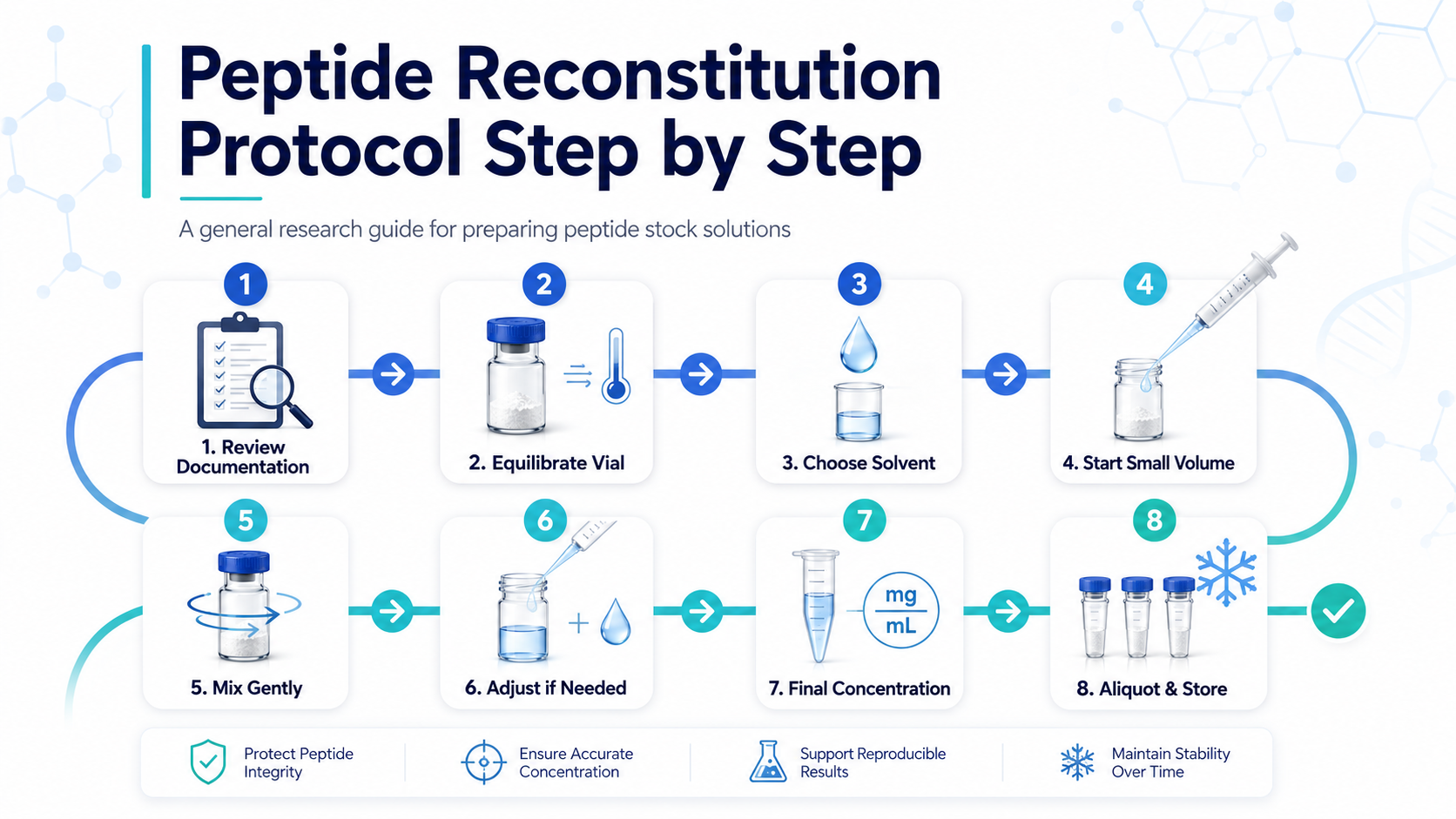
The following step-by-step peptide reconstitution protocol is a general research guide. Researchers should adapt it to product-specific documentation, internal SOPs, and assay requirements.
Step 1: Review Documentation
Before opening the vial, check the peptide name, sequence, lot number, COA, purity, HPLC result, mass spectrometry confirmation, storage guidance, and any supplier notes about solubility. If the peptide is custom-synthesized or modified, confirm the modification site and expected molecular weight.
Step 2: Equilibrate the Vial
Allow the lyophilized peptide vial to reach room temperature before opening. This helps reduce moisture condensation on the peptide powder, which can affect long-term handling and stability.
Step 3: Choose a Starting Solvent
Select a solvent based on sequence and application. Water or aqueous buffer may be suitable for many charged peptides. Acidic peptides may dissolve more readily with basic adjustment, while basic peptides may dissolve more readily with mild acidic adjustment. Hydrophobic peptides may require a small amount of DMSO, DMF, acetonitrile, or another compatible organic cosolvent.
Step 4: Start With a Small Volume
Add a small volume of solvent first to wet the peptide and create a concentrated stock. This makes it easier to evaluate whether the peptide is dissolving before committing the full final volume.
Step 5: Mix Gently
Use gentle pipetting, slow swirling, or brief low-energy mixing. Avoid harsh vortexing unless validated for the specific peptide and assay. Foam formation can complicate handling, especially for longer or aggregation-prone peptides.
Step 6: Adjust Strategy if Needed
If the peptide remains cloudy, forms particles, or creates a gel-like solution, pause before adding more solvent. Review the sequence, charge, hydrophobicity, and supplier notes. Consider pH adjustment, small organic cosolvent addition, sonication, or a lower stock concentration if compatible with the research protocol.
Step 7: Bring to Final Concentration
Once the peptide is dissolved, dilute to the desired stock concentration using a compatible solvent or buffer. Record the final concentration, solvent composition, pH if relevant, and preparation date.
Step 8: Aliquot and Store
Aliquot the stock solution into research-use volumes to minimize repeated freeze-thaw cycles. Store according to peptide-specific guidance and laboratory SOPs.
Peptide Solubilization by Peptide Type
Different peptide classes often require different preparation strategies.
| Peptide type | Solubility considerations | Practical preparation approach |
|---|---|---|
| Short polar peptides | Often dissolve readily in water | Start with water or aqueous buffer |
| Basic peptides | Positive charge may support aqueous solubility | Mild acidic solvent can help when needed |
| Acidic peptides | Negative charge can support aqueous solubility | Mild basic adjustment can help when needed |
| Hydrophobic peptides | May aggregate or resist water dissolution | Use limited organic co-solvent, then dilute |
| Long peptides | Higher aggregation risk | Use lower stock concentration and gentle handling |
| Cyclic peptides | Solubility depends on ring structure and hydrophobicity | Review supplier-specific notes closely |
| Disulfide peptides | Sensitive to redox and aggregation conditions | Avoid incompatible reducing or oxidizing environments |
| Fluorescent peptides | Label may increase hydrophobicity | Protect from light and consider co-solvent compatibility |
| Biotinylated peptides | Linker and biotin placement affect behavior | Confirm final assay compatibility |
| Cell-penetrating peptides | Often charged but sequence-dependent | Check uptake assay compatibility and dilution behavior |
Solvent Selection for Synthetic Peptides
Solvent selection should be guided by peptide chemistry and final assay compatibility. The goal is to create a concentrated stock solution that can be diluted into the experimental system without precipitation or unwanted solvent effects.
Water and Aqueous Buffers
Water is often suitable for polar or charged peptides. Buffers may be useful when the assay requires a controlled pH or ionic environment. However, some peptides that dissolve in water may precipitate when added to salt-containing buffers, so dilution testing is useful.
Mild Acidic Solutions
Basic peptides can sometimes dissolve more readily in mild acidic conditions. Dilute acetic acid is commonly discussed in peptide handling guidance for certain basic or difficult sequences. Researchers should confirm compatibility with downstream assays before use.
Mild Basic Solutions
Acidic peptides can sometimes dissolve more readily after mild basic adjustment. Ammonium hydroxide or other basic conditions may be considered in some research workflows, depending on peptide chemistry and protocol compatibility.
Organic Cosolvents
Hydrophobic peptides may require DMSO, DMF, acetonitrile, or another organic cosolvent. These should usually be kept as low as practical in the final assay, especially in cell-based studies, because solvent concentration can affect cell behavior or assay readouts.
Chaotropic Agents
For strongly aggregating peptides, chaotropic agents such as urea or guanidine hydrochloride may support solubilization in some analytical or biochemical workflows. These conditions may not be compatible with every assay and should be selected carefully.
How to Choose the Right Peptide, Product, or Service
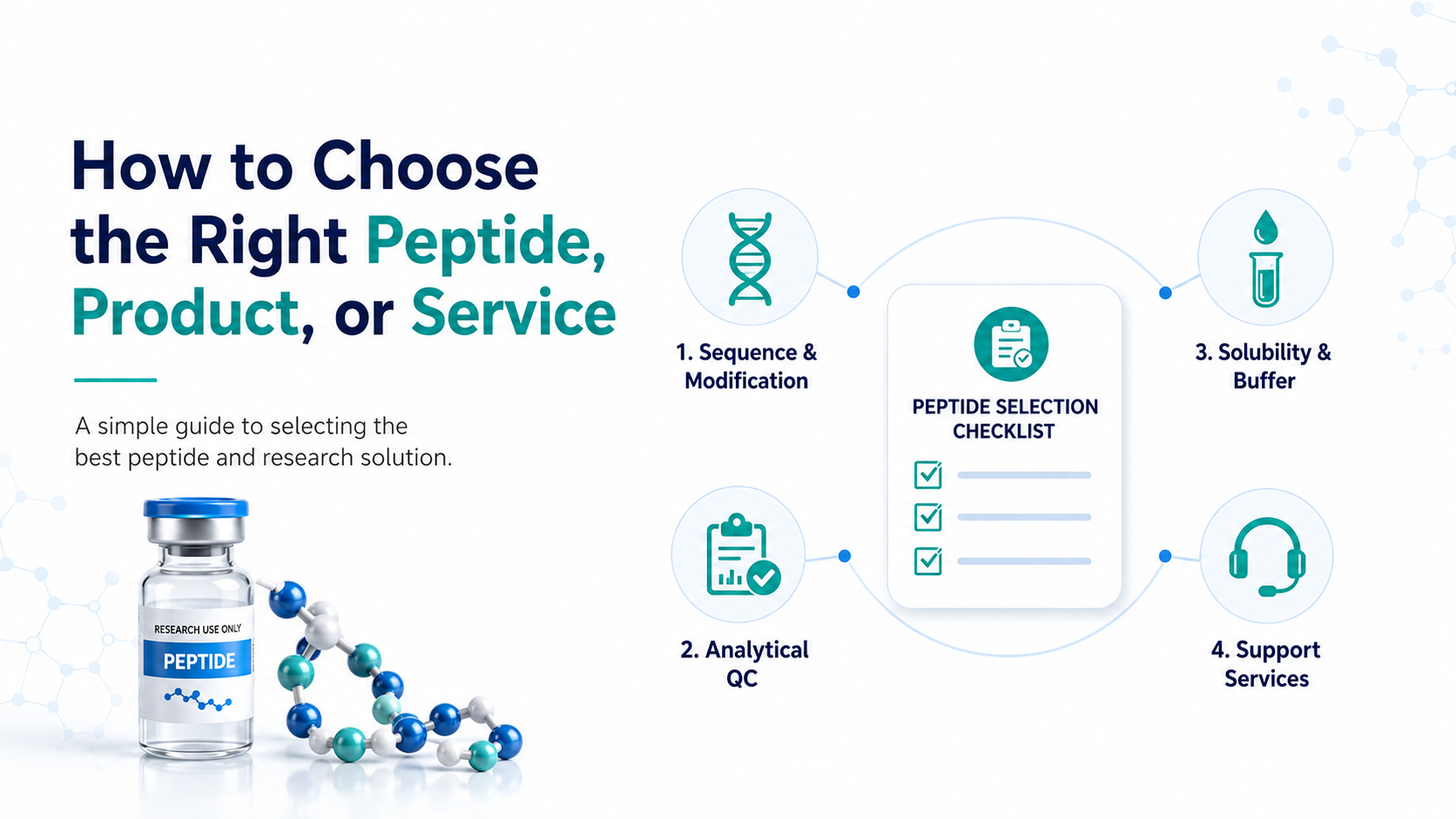
Researchers should choose peptide products and services based on the application, not only the peptide name.
How to Choose Checklist
- Confirm the exact sequence, species, fragment, and modification.
- Review amino acid composition for charged, hydrophobic, cysteine, methionine, or aromatic residues.
- Decide whether the study uses a bioactive peptide, peptide inhibitor, cell-penetrating peptide, substrate, labeled peptide, or custom peptide.
- Select a purity level that matches assay sensitivity.
- Review HPLC data for purity and impurity profile.
- Review mass spectrometry data for molecular identity.
- Check the COA for lot-specific documentation.
- Ask about peptide solubility guidance before ordering difficult sequences.
- Plan stock concentration, final solvent percentage, and buffer compatibility.
- Consider peptide modification, peptide analysis, and custom peptide synthesis support for specialized studies.
LinkPeptide offers research peptides, custom peptides, peptide synthesis, peptide modification, peptide analysis, and related building blocks for laboratory research applications.
Quality-Control Checklist: HPLC, MS, COA, Purity, and Batch Consistency
Peptide solubility is connected to peptide quality. Impurities, deletion sequences, incomplete deprotection products, oxidation products, or incorrect modifications can affect apparent solubility and assay performance.
A strong QC review should include:
- Purity percentage
- HPLC chromatogram or HPLC summary
- Mass spectrometry confirmation
- Sequence identity
- Modification of identity and position
- Lot or batch number
- COA availability
- Solubility notes were available
- Storage and handling recommendations
- Batch consistency for repeat studies
Why HPLC Matters
HPLC peptides data help researchers understand the purity profile of the supplied material. A clear main peak and documented purity result support confidence in the peptide preparation.
Why Mass Spectrometry Matters
Mass spectrometry confirms that the expected peptide mass is present. This is especially important for custom peptides, modified peptides, labeled peptides, cyclic peptides, peptide inhibitors, and cell-penetrating peptides.
Why COA Review Matters
A COA connects the material received in the lab to its analytical validation. For procurement teams and lab managers, COA review supports traceability and repeatable purchasing decisions.
Conclusion
Peptide solubility guidelines help researchers connect peptide chemistry with reliable laboratory preparation. Successful peptide reconstitution begins with sequence review, solvent selection, gentle handling, concentration planning, and assay compatibility. For synthetic peptides, custom peptides, bioactive peptides, peptide inhibitors, cell-penetrating peptides, and modified peptides, solubility planning should be paired with HPLC, mass spectrometry, COA review, purity assessment, sequence identity, and batch consistency.
For research-use-only workflows, labs can improve peptide preparation by documenting each step, testing small volumes before full-scale preparation, and selecting peptide products or services that provide clear quality-control support. Researchers planning specialized peptide work can explore LinkPeptide resources for catalog research peptides, custom peptide synthesis, peptide modification, peptide analysis, and related peptide synthesis materials.
FAQ
What is peptide solubility?
Peptide solubility is the ability of a peptide to dissolve in a selected solvent at the desired concentration. It depends on sequence, charge, hydrophobicity, length, purity, modifications, solvent, pH, and assay conditions.
How do you dissolve peptides in water?
Review the COA and sequence first, equilibrate the vial to room temperature, add a small volume of water, mix gently, confirm dissolution, then dilute to the target stock concentration if water is compatible.
What solvent should be used for peptide reconstitution?
Many peptides can start with water or an aqueous buffer. Basic peptides may need mild acid, acidic peptides may need mild base, and hydrophobic peptides may need limited organic cosolvent such as DMSO or DMF.
Why does a peptide become cloudy after reconstitution?
Cloudiness may indicate incomplete dissolution, aggregation, precipitation, or solvent incompatibility. Researchers should review sequence chemistry, pH, solvent choice, stock concentration, and buffer compatibility before proceeding.
What QC data helps with peptide solubility planning?
Helpful QC data includes purity, HPLC results, mass spectrometry confirmation, COA documentation, sequence identity, modification details, lot number, storage guidance, and batch consistency information.