 LinkPeptide
Virtual Screening of Peptide Libraries: The Search for Peptide-Based Therapeutics Using Computational Tools
Virtual screening of peptide libraries helps researchers prioritize peptide sequences before synthesis and laboratory testing. Instead of preparing every possible sequence at the bench, scientists can use computational tools to screen peptide libraries, predict target binding, rank bioactive peptides, and select candidates for downstream research validation.
For academic teams, biotech R&D groups, pharmaceutical discovery researchers, and lab managers, this workflow creates a practical bridge between computational peptide design and experimental peptide research. The strongest projects do not stop at silico prediction. They connect virtual screening with custom peptide synthesis, peptide purity selection, HPLC/MS validation, COA review, solubility planning, and reproducible laboratory assays.
What Is Virtual Screening of Peptide Libraries?
Virtual screening is an in silico method for evaluating large sets of molecules against a target of interest. In peptide research, the screened molecules are peptide sequences or peptidomimetics. The target may be a receptor, enzyme, protein-protein interaction site, transporter, viral protein, signaling protein, or another research-relevant biomolecular structure.
A peptide library is a collection of peptide sequences designed or assembled for screening. Libraries may be random, motif-based, target-focused, derived from known bioactive peptides, generated from protein fragments, or created by computational design tools.
Why Peptide Libraries Matter in Drug Discovery Research
Peptide libraries allow researchers to explore sequence diversity in a structured way. A library may contain dozens, hundreds, thousands, or millions of sequences, depending on the design strategy and screening method.
Peptide libraries are used in research areas such as:
- Bioactive peptide discovery
- Peptide inhibitor screening
- Receptor-ligand binding research
- Protein-protein interaction mapping
- Enzyme substrate and inhibitor studies
- Antimicrobial peptide research
- Cancer biology research models
- Immunology and inflammation research
- Cell-penetrating peptide design
- Biomaterials and cosmetic science research
- Drug discovery peptide workflows
Computational screening helps narrow a large library into a smaller list of high-priority candidates for synthesis and laboratory testing.
How Virtual Screening Works: From Library to Candidate Peptides
A typical virtual screening workflow includes several stages. Each stage improves the quality of the candidate list before researchers invest in peptide synthesis and experimental assays.
1. Define the Biological Target
The target may be a protein structure, receptor pocket, enzyme active site, protein interaction surface, or known binding motif. Structure-based virtual screening requires a target structure from experimental data or a reliable computational model.
2. Build or Select the Peptide Library
The peptide library should match the project goal. Researchers may create libraries based on natural bioactive peptides, known motifs, alanine scanning, sequence variants, random sequences, predicted epitopes, or AI-generated candidates.
Library design factors include:
- Peptide length
- Amino acid diversity
- Net charge
- Hydrophobicity
- Motifs or conserved residues
- Cyclization potential
- Modification options
- Solubility expectations
- Synthesis feasibility
3. Prepare Peptide and Target Structures
Peptide conformations are flexible, so structure preparation is important. Researchers may generate multiple conformers, use predicted structures, prepare target protonation states, define the binding site, and remove unsuitable library entries before screening.
4. Run Computational Screening
Depending on the method, researchers may use peptide docking, molecular dynamics, pharmacophore matching, QSAR models, machine learning classifiers, or deep learning tools. Many projects combine multiple methods to reduce false positives.
5. Rank and Filter Hits
After scoring, researchers filter candidates by predicted binding, target interaction pattern, sequence feasibility, solubility, charge, stability, novelty, and synthesis practicality.
6. Synthesize and Validate Selected Peptides
Computational hits should be validated experimentally. Selected peptides can be synthesized, purified, confirmed by HPLC and mass spectrometry, documented with a COA, and tested in research assays.
Structure-Based Virtual Screening of Bioactive Peptides
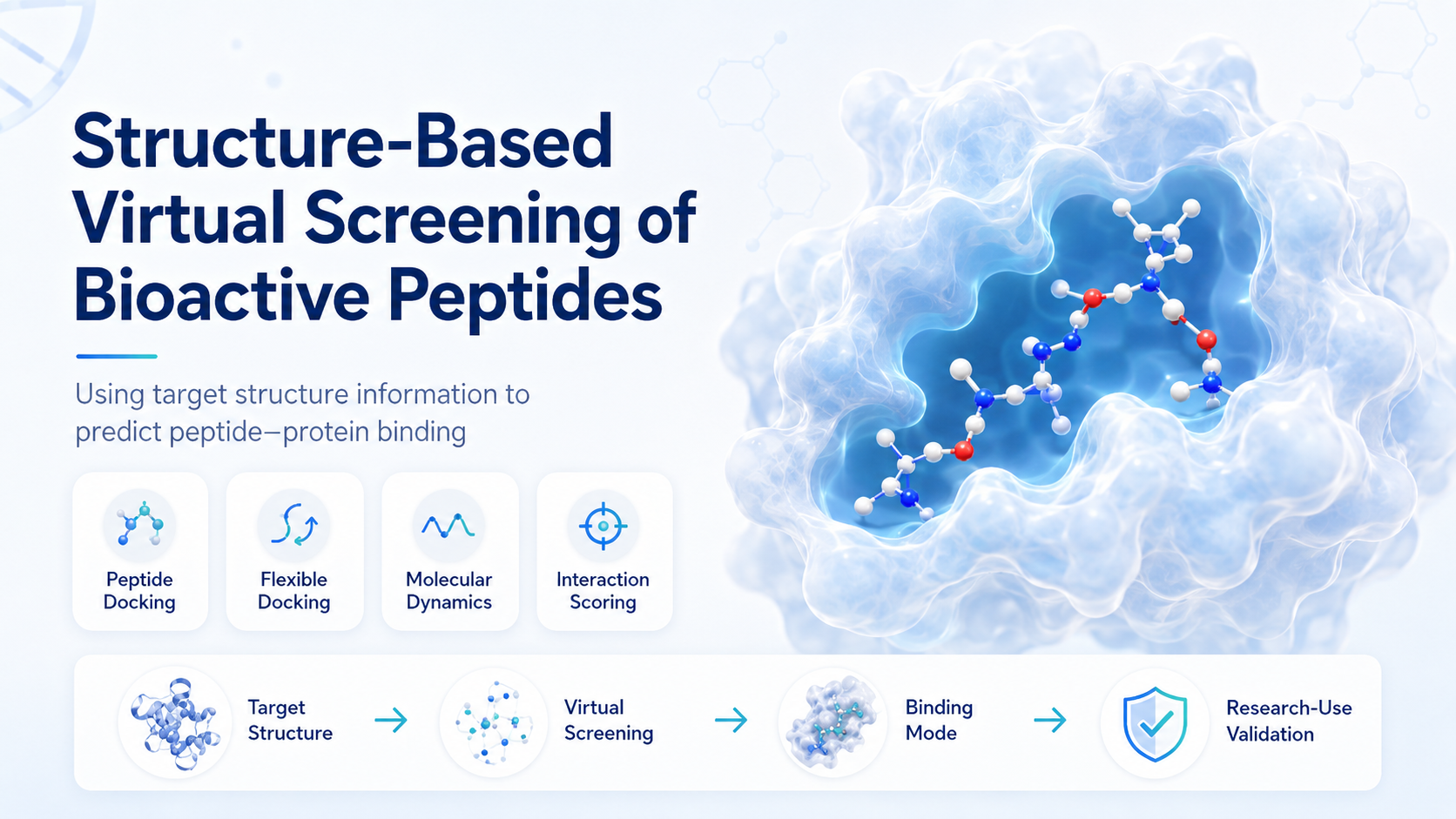
Structure-based virtual screening uses target structure information to predict how peptides may bind to a protein. This method is valuable when researchers have a defined receptor, enzyme, or interaction interface.
Common Structure-Based Methods
- Peptide docking
- Flexible docking
- Ensemble docking
- Molecular dynamics simulations
- Binding free energy estimation
- Interface residue analysis
- Pharmacophore modeling
- Protein-peptide interaction scoring
Structure-based screening is useful for studying peptide inhibitors, receptor ligands, protein-protein interaction blockers, enzyme substrates, and bioactive peptides. A major challenge is peptide flexibility. Unlike many small molecules, peptides can adopt many conformations, and this makes docking and scoring more complex.
Practical Strengths
Structure-based screening can help researchers identify candidate binding modes, key residues, hydrogen bond networks, hydrophobic contacts, electrostatic interactions, and possible sequence optimization points.
Practical Limitations
Predicted binding scores are not final proof of activity. Peptides may behave differently in solution, cellular systems, or experimental assay conditions. This is why computational screening should be followed by synthesis and research-use validation.
Ligand-Based and Sequence-Based Screening
Ligand-based virtual screening is useful when researchers have known active peptides but limited target structural information. These methods compare new candidates to known sequences or activity patterns.
Common ligand-based approaches include:
- QSAR modeling
- Similarity searching
- Motif enrichment
- Physicochemical descriptor analysis
- Machine learning classification
- Activity prediction from peptide datasets
Sequence-based screening can identify patterns linked with charge, hydrophobicity, amphipathicity, residue composition, or known bioactivity classes. These approaches can be especially useful for antimicrobial peptide research, cell-penetrating peptide research, and peptide inhibitor discovery.
AI and Machine Learning in Peptide Screening
AI and machine learning are increasingly used to analyze peptide libraries, predict activity, design new sequences, and prioritize candidates. These methods can process large datasets and identify sequence-property relationships that may be difficult to detect manually.
Common computational tools and methods include:
- Supervised machine learning models
- Deep learning models
- Generative peptide design
- Reinforcement learning
- Protein language models
- QSAR models
- Molecular dynamics-assisted scoring
- Multi-parameter optimization
AI-supported screening can help researchers explore large sequence spaces more efficiently. However, model quality depends on training data, target relevance, validation strategy, and experimental follow-up. A predicted hit still needs synthesis, analytical validation, and laboratory testing.
In Silico Methods for Identifying Therapeutic Peptide Candidates
In silico methods can support peptide-based therapeutic design research by prioritizing candidates for experimental study. In a research-use-only context, these methods help scientists identify sequences for receptor binding, enzyme inhibition, cellular uptake, selectivity exploration, or structure-function studies.
A practical in silico workflow may include:
- Target selection and structure preparation
- Peptide library construction
- Initial filtering for length, charge, hydrophobicity, and synthesis feasibility
- Docking or sequence-based prediction
- Molecular dynamics refinement for top hits
- Solubility and stability prediction
- Removal of difficult or low-confidence candidates
- Custom peptide synthesis of selected hits
- HPLC/MS and COA review
- Laboratory research validation
This sequence helps researchers move from large computational libraries to smaller, testable peptide sets.
How to Choose Peptides After Virtual Screening
A ranked computational output is only the starting point. Researchers should choose peptides for synthesis by balancing predicted performance with practical laboratory criteria.
Hit Selection Checklist
- Does the peptide interact with the intended target site?
- Are key binding residues plausible?
- Does the sequence match the project’s mechanism hypothesis?
- Is the peptide length practical for synthesis?
- Is the sequence highly hydrophobic or aggregation-prone?
- Are cysteine residues and disulfide bonds clearly defined?
- Is the predicted peptide compatible with the assay solvent and buffer?
- Does the peptide require modification, labeling, cyclization, or conjugation?
- What purity level is needed for validation?
- Can the peptide be synthesized with HPLC/MS and COA documentation?
This checklist helps bridge computational prioritization and experimental peptide ordering.
Custom Peptide Synthesis After Virtual Screening
Once peptide hits are prioritized, researchers often need custom peptide synthesis to generate the selected sequences. This is where virtual screening connects to practical peptide procurement.
Custom synthesis may be used for:
- Top-ranked peptide hits
- Sequence variants
- Alanine scanning peptides
- Truncated peptide series
- Peptide inhibitors
- Labeled peptides
- Cell-penetrating peptide conjugates
- Cyclic peptides
- Phosphorylated peptides
- Biotinylated peptides
- Peptide libraries for secondary screening
LinkPeptide offers research peptides, bioactive peptides, peptide inhibitors, cell-penetrating peptides, custom peptide synthesis, peptide modification, peptide analysis, and synthesis materials that can support research-use-only validation after computational screening.
Quality-Control Checklist for Screening Hits
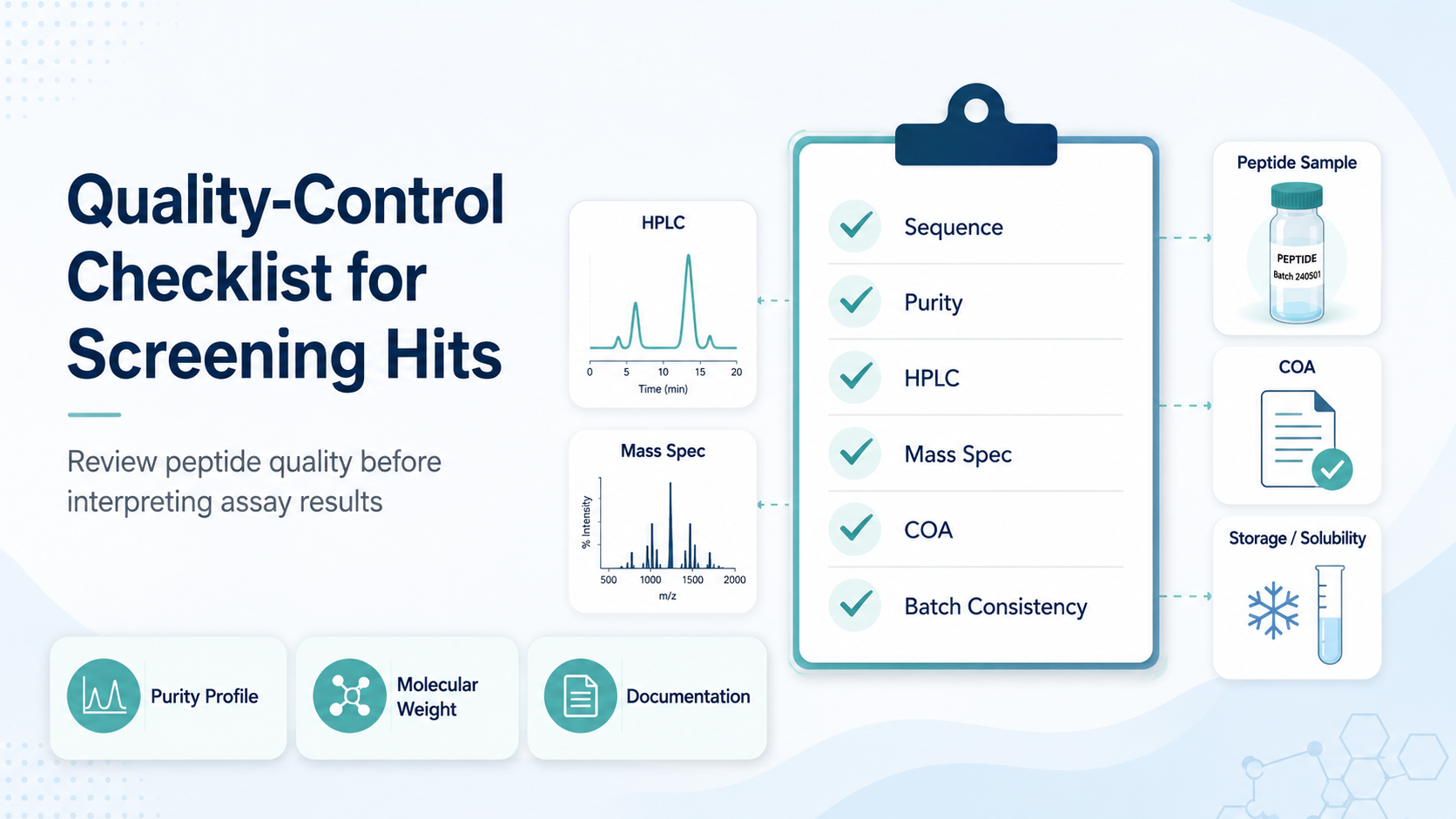
Quality control matters because a computational hit only becomes useful when the synthesized peptide is correctly made, purified, and documented. Researchers should evaluate peptide quality before interpreting assay results.
What QC Data Should Researchers Review?
- Peptide sequence
- Purity level
- HPLC chromatogram or summary
- Mass spectrometry confirmation
- Molecular weight
- Modification details
- Lot or batch number
- COA documentation
- Solubility and storage notes
- Batch consistency for repeat testing
Why HPLC Matters
HPLC helps assess peptide purity and impurity profile. For binding, inhibition, signaling, or uptake assays, a clear purity profile supports more confident interpretation of experimental data.
Why Mass Spectrometry Matters
Mass spectrometry confirms that the peptide has the expected molecular weight. This is essential for custom peptides, modified peptides, cyclic peptides, and labeled peptides generated after virtual screening.
Why COA and Batch Consistency Matter
A COA links the synthesized peptide to its analytical documentation. Batch consistency helps research teams repeat validation studies and compare results across projects, timepoints, and collaborators.
Practical Comparison: Computational Prediction vs Lab Validation
| Stage | Main goal | Key output | Research limitation |
|---|---|---|---|
| Virtual screening | Prioritize peptide candidates | Ranked peptide list | Scores may not reflect real assay behavior |
| Docking | Predict binding mode | Binding poses and scores | Peptide flexibility can affect accuracy |
| Molecular dynamics | Explore conformational stability | Dynamic interaction data | Computationally intensive |
| ML prediction | Predict activity or properties | Probability or activity ranking | Depends on dataset quality |
| Custom synthesis | Produce selected peptides | Physical research peptide | Sequence complexity may affect yield |
| HPLC/MS QC | Confirm purity and identity | Analytical documentation | Does not replace functional testing |
| Lab validation | Test research hypothesis | Assay results | Requires assay-specific controls |
Common Mistakes in Virtual Screening of Peptide Libraries
Researchers can improve project quality by avoiding common mistakes:
- Treating docking score as proof of activity
- Screening libraries without considering synthesis feasibility
- Ignoring peptide solubility before ordering hits
- Selecting highly hydrophobic sequences without preparation planning
- Forgetting terminal groups or modifications during peptide ordering
- Synthesizing too many low-confidence hits instead of a balanced validation set
- Skipping HPLC/MS and COA review
- Using one purity level for every application without assay-based reasoning
- Not including control peptides
- Failing to track lot numbers and batch differences
A stronger workflow combines computational prioritization with careful peptide design, synthesis planning, and experimental validation.
Conclusion
Virtual screening of peptide libraries helps researchers search large peptide spaces, prioritize bioactive peptides, and design more focused experimental validation workflows. Computational tools such as docking, molecular dynamics, QSAR, machine learning, and AI-supported peptide design can identify promising candidates for peptide-based therapeutic design research, receptor studies, inhibitor screening, and drug discovery peptide workflows.
The strongest research programs connect in silico methods with practical laboratory execution. That means selecting synthesizable peptides, planning solubility and purity, ordering custom peptides with clear specifications, reviewing HPLC and mass spectrometry data, keeping COA documentation, and validating peptide activity in research-use-only assays. Researchers moving from computational hits to lab testing can use LinkPeptide resources for custom peptide synthesis, peptide modification, peptide analysis, bioactive peptides, peptide inhibitors, and peptide library support.
FAQ
What is virtual screening of peptide libraries?
Virtual screening of peptide libraries is an in silico workflow that evaluates many peptide sequences against a target to prioritize candidates for synthesis and research-use laboratory validation.
What computational tools are used for peptide screening?
Common tools and methods include peptide docking, molecular dynamics, QSAR, pharmacophore modeling, machine learning, deep learning, generative design, and sequence-based prediction models.
Why is experimental validation needed after virtual screening?
Virtual screening predicts likely candidates, but it does not prove activity. Synthesized peptides need HPLC/MS confirmation, COA documentation, and laboratory assays to support research conclusions.
How are bioactive peptides selected from virtual screening results?
Researchers select candidates by reviewing predicted binding, target-site interactions, sequence feasibility, solubility, charge, hydrophobicity, modification needs, synthesis practicality, and assay fit.
What QC data should be checked for synthesized screening hits?
Researchers should review peptide purity, HPLC data, mass spectrometry confirmation, sequence identity, molecular weight, modification details, lot number, COA documentation, and storage guidance.