 LinkPeptide
Breaking Barriers: How SNAC Enables the Next Generation of Oral Peptide Drugs
Blog 332
Abstract
For decades, scientists have sought a way to make peptide drugs as easy to take as a pill. Peptides offer unmatched therapeutic precision, but their fragility and inability to cross cell membranes have kept most confined to injections. A recent Nature Communications study has finally revealed how the permeation enhancer salcaprozate sodium (SNAC) helps peptides like semaglutide overcome these barriers. Using advanced molecular simulations and NMR experiments, researchers discovered that SNAC forms dynamic clusters that create temporary, fluid-like defects in membranes—allowing peptides to pass through safely, in a process resembling “molecular quicksand.” This finding marks a breakthrough in oral peptide delivery, paving the way for rationally designed enhancer systems and more effective formulations. At LinkPeptide, we celebrate and support such innovation by providing high-quality custom peptides and reagents that empower researchers to explore the next frontier of peptide-based therapeutics.
The Long Quest for Oral Peptide Drugs
For decades, scientists have pursued a deceptively simple goal: to develop peptide drugs that can be taken as easily as a pill. Peptides—short chains of amino acids—are among the most promising therapeutic agents in modern medicine. They can mimic natural hormones, regulate metabolism, and block disease pathways with a precision that few small molecules can match. Yet despite their biological power, peptides share one critical weakness: they struggle to survive the journey through the human digestive system.
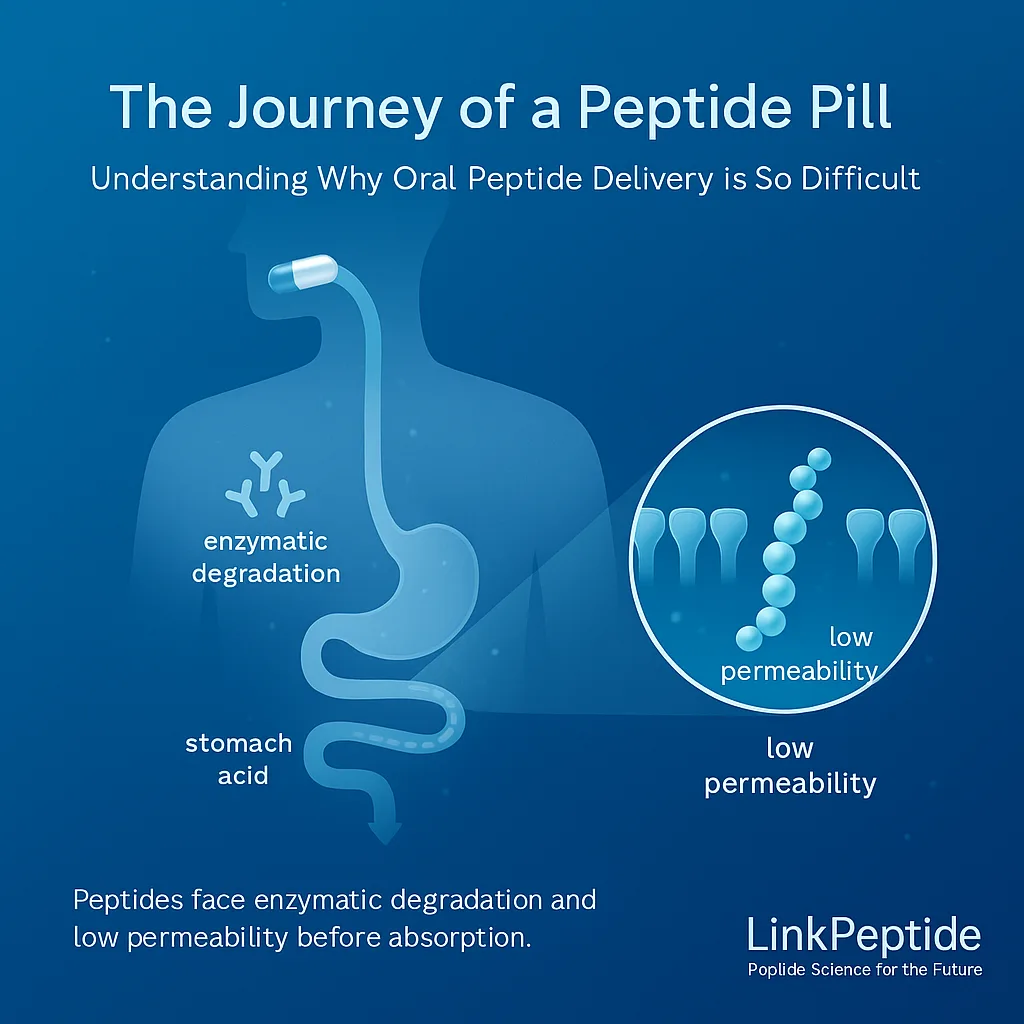
When swallowed, most peptides face two major barriers. The first is enzymatic degradation. In the stomach and intestine, powerful digestive enzymes rapidly cleave peptide bonds, breaking complex molecules into inactive fragments long before they can reach their target. The second barrier is membrane permeability. Even if a peptide escapes digestion, it still must cross the tightly packed lipid membranes of intestinal epithelial cells to enter the bloodstream. Unlike small, lipophilic drugs that can easily diffuse through these membranes, peptides are typically large, polar, and water-soluble, making passive absorption nearly impossible.
These challenges have kept peptide therapies almost entirely confined to injections. From the first use of insulin in the 1920s to today’s GLP-1 receptor agonists used to treat diabetes and obesity, patients have depended on needles to deliver lifesaving treatments. For researchers and formulators, the holy grail has long been an effective oral peptide drug—a pill that could combine the specificity of biologics with the convenience of traditional tablets. Such a breakthrough would not only transform patient compliance and comfort but also open the door to a new generation of peptide-based therapeutics that are safer, smarter, and more accessible than ever before.
That vision is now coming into focus, thanks to recent advances in membrane permeation enhancers—innovative small molecules that help peptides cross biological barriers once thought to be impassable.
Meet SNAC — The Smart Helper Behind Oral Semaglutide
Among the many strategies developed to make oral peptide drugs possible, one compound has quietly transformed the field: salcaprozate sodium, better known as SNAC. This small molecule acts as a permeation enhancer, helping peptides slip past the body’s natural barriers to absorption. SNAC is the key ingredient behind Rybelsus®, the first oral formulation of the GLP-1 receptor agonist semaglutide, developed by Novo Nordisk. Its success has turned SNAC into a cornerstone of modern oral peptide delivery research.
But what exactly does SNAC do? Its role is surprisingly multifaceted. First, SNAC creates a protective microenvironment around the peptide as it dissolves in the stomach. By locally raising the pH near the drug tablet, SNAC neutralizes stomach acid and temporarily inactivates digestive enzymes such as pepsin. This helps the peptide survive long enough to reach the intestinal wall—an essential first step toward absorption.
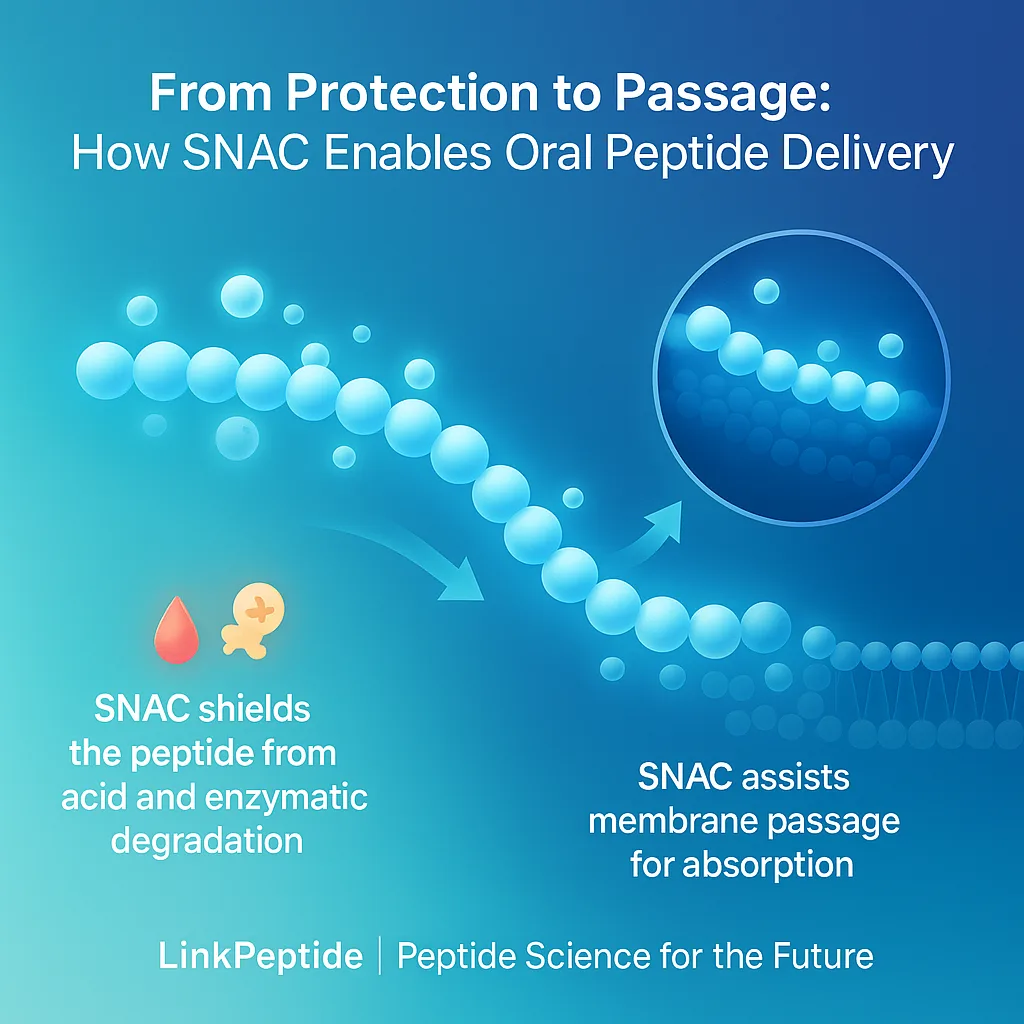
The second, and more mysterious, role of SNAC lies in how it facilitates peptide passage through cell membranes. Semaglutide and most other therapeutic peptides are large, polar molecules that cannot easily cross the lipid bilayer that separates gut cells from the bloodstream. For years, researchers have debated how SNAC overcomes this obstacle without damaging the epithelial layer. Traditional explanations focused on its ability to “fluidize” the membrane, making it temporarily more permeable. However, that description was always incomplete—a biochemical shorthand for a process scientists could not yet see in detail.
Recently, new molecular-level research has begun to reveal what truly happens when SNAC meets semaglutide. Far from being a simple solvent effect, SNAC appears to form dynamic molecular structures that interact directly with both the peptide and the membrane itself—offering a far more elegant and controlled mechanism than previously imagined.
The Discovery — Watching Semaglutide Sink Like Quicksand
A recent study published in Nature Communications (Colston, Faivre, & Schneebeli, 2025) has finally unveiled what happens at the molecular level when SNAC helps a peptide like semaglutide cross a biological membrane. Using a powerful technique called constant pH molecular dynamics (CpHMD) simulation, combined with NMR spectroscopy and dynamic light scattering (DLS) experiments, the researchers were able to observe this interaction in unprecedented detail. What they found challenges long-held assumptions—and paints a far more dynamic picture of peptide absorption.
The team discovered that SNAC molecules do not work alone. Instead, they tend to aggregate around semaglutide, forming clusters that behave almost like molecular “rafts.” These SNAC–semaglutide complexes approach the cell membrane together, and rather than breaking it apart, SNAC molecules subtly weave themselves into the lipid layer. Inside the membrane, they form tiny, fluid-filled defects—temporary zones where the lipid molecules loosen just enough to let the peptide move through.
Here’s where the process becomes fascinating. The simulations showed semaglutide’s fatty acid tail acting as an anchor, allowing the peptide to attach to the membrane and gradually “sink” into the SNAC-rich region. As more SNAC molecules rearrange around it, the peptide slowly passes through the membrane, almost like sinking into soft, molecular quicksand. Importantly, the membrane remains intact throughout the process, ensuring that cellular integrity is never compromised.
This discovery reframes how scientists understand transcellular peptide absorption. Instead of brute-force disruption, SNAC enables a cooperative, self-assembling process—one where chemistry and structure work hand in hand to guide large peptides across one of biology’s most selective barriers.
What It Means for Peptide Science
The implications of this discovery reach far beyond semaglutide alone. For the first time, researchers can see how a permeation enhancer operates at atomic resolution, revealing a process that is both precise and adaptable. The SNAC–semaglutide system shows that peptide absorption can occur without damaging the cell membrane, a crucial requirement for safety in oral drug delivery. This new understanding opens the door to designing smarter, more predictable enhancer systems for a wide range of peptide therapeutics.
Traditionally, formulation scientists have relied on trial and error when developing oral peptides — testing various surfactants, lipids, or co-solvents to find combinations that might work. Now, with insights from constant pH molecular dynamics (CpHMD) and complementary experimental data, it becomes possible to rationally design permeation enhancers that match the charge, hydrophobicity, and structure of a specific peptide. This marks a turning point in how oral peptide delivery can be approached — not as a black box, but as an engineered, tunable system.
Beyond its pharmaceutical significance, the SNAC mechanism highlights the power of multidisciplinary science. Chemistry, biophysics, and computational modeling converge to reveal how molecular interactions guide drug behavior in living systems. For academic researchers, this is an invitation to explore new enhancer–peptide pairs and to extend the same approach to macrocyclic and bioactive peptides that once seemed impossible to deliver orally.
For industry innovators, the findings provide a foundation for next-generation oral peptide formulations—ones that combine potency, stability, and ease of use. What was once an elusive goal now looks increasingly achievable: peptide medicines that move seamlessly from the lab bench to the pill bottle.
LinkPeptide’s Perspective — Enabling the Next Generation of Peptide Therapies
The story of SNAC and semaglutide illustrates a profound shift in how peptide drugs are designed and understood. It shows that innovation in therapeutics doesn’t always come from new molecules—it can emerge from reimagining how existing peptides interact with their environment. By combining experimental and computational insight, researchers have uncovered a molecular choreography that turns a fragile peptide into a viable oral medicine.
At LinkPeptide, we view breakthroughs like this as milestones in a much larger journey: the ongoing effort to make peptide-based therapeutics more accessible, efficient, and adaptable. Our mission is to support that journey by providing high-quality custom peptides, inhibitors, and labeling tools that enable scientists to study peptide behavior with precision and creativity. Whether researchers are investigating membrane dynamics, designing new delivery systems, or engineering next-generation analogs, LinkPeptide offers the building blocks that make such discoveries possible.
As the field moves toward rationally engineered peptide delivery, understanding mechanisms like SNAC’s “quicksand effect” becomes essential. It’s not just about getting peptides into the bloodstream—it’s about learning how to do so safely, predictably, and reproducibly. The future of peptide therapeutics will belong to those who can merge molecular understanding with innovative formulation design.
At LinkPeptide, we’re proud to help our partners take that next step—transforming complex peptide science into practical biomedical solutions that advance human health.
Reference
Schneebeli, S. T., Colston, K. J., & Faivre, K. T. (2025). Permeation Enhancer-Induced Membrane Defects Assist the Oral Absorption of Peptide Drugs.
https://doi.org/10.1038/s41467-025-64891-0
Chen, G., Kang, W., Li, W., Chen, S., & Gao, Y. (2022). Oral delivery of protein and peptide drugs: From non-specific formulation approaches to intestinal cell targeting strategies. Theranostics, 12(3), 1419.
https://doi.org/10.7150/thno.61747
Solis-Herrera, C., Kane, M. P., & Triplitt, C. (2024). Current understanding of sodium n-(8-[2-hydroxylbenzoyl] amino) caprylate (SNAC) as an absorption enhancer: The oral semaglutide experience. Clinical Diabetes, 42(1), 74-86.
https://doi.org/10.2337/cd22-0118
Twarog, C., Fattah, S., Heade, J., Maher, S., Fattal, E., & Brayden, D. J. (2019). Intestinal permeation enhancers for oral delivery of macromolecules: a comparison between salcaprozate sodium (SNAC) and sodium caprate (C10). Pharmaceutics, 11(2), 78.