 LinkPeptide
From Analytical HPLC to Preparative FPLC: Optimizing Peptide Purification for Reliable Scale-Up
Blog 531
Abstract
Peptide purification remains one of the most critical and technically demanding steps in solid-phase peptide synthesis (SPPS). Although reversed-phase high-performance liquid chromatography (RP-HPLC) provides reliable analytical resolution of closely related impurities such as deamidation variants, isoaspartate rearrangements, and isomeric substitutions, transferring these conditions to preparative flash liquid chromatography (FPLC) often results in significant retention shifts and loss of resolution. System-dependent differences in column geometry, particle size, dwell volume, and gradient formation can generate elution deviations of up to 15–20%, leading to repeated purification cycles, material loss, and increased solvent consumption. Recent systematic investigations demonstrate that optimizing gradient steepness, flow rate, and mobile-phase modifiers—combined with a correction model that accounts for system delay and column volume—can reduce transfer error to below 5%. By integrating analytical rigor with predictive transfer strategies, peptide manufacturers can improve first-pass purification success, enhance scalability, and achieve more sustainable and efficient production workflows.
Keywords: Peptide purification, HPLC-to-FPLC transfer, SPPS impurities, Reversed-phase chromatography, Preparative chromatography optimization
Why Peptide Purification Remains the Bottleneck in SPPS
Solid-phase peptide synthesis (SPPS) has transformed modern biomedical research and therapeutic development. It enables the precise assembly of custom peptide sequences for applications ranging from receptor agonists and enzyme inhibitors to bioactive peptides and cosmetic ingredients. Today, complex sequences can be synthesized efficiently and reproducibly. However, while synthesis technology has matured significantly, purification remains one of the most technically demanding and critical stages of peptide production.
Each iterative coupling and Fmoc deprotection step in SPPS introduces the possibility of side reactions. Over multiple cycles, structurally similar impurities accumulate, including deamidated variants, isoaspartate rearrangements, amino acid misincorporations, leucine/isoleucine isomers, and truncated deletion sequences. These impurities often differ from the target peptide by only a single functional group, a subtle backbone rearrangement, or minor stereochemical variation.
The challenge becomes even greater because many of these species are isobaric—they share nearly identical molecular weights. As a result, mass spectrometry alone is insufficient for definitive purity evaluation. Reliable impurity profiling depends on high-resolution chromatographic separation, which is why reversed-phase high-performance liquid chromatography (RP-HPLC) remains the gold standard for peptide purity analysis.
Yet achieving clean analytical separation is only part of the story. When purification is scaled from analytical HPLC to preparative flash liquid chromatography (FPLC), unexpected discrepancies frequently arise. Elution behavior may shift significantly, closely related impurities can co-elute, and target compounds may overlap with the injection front. The result is often repeated purification cycles, increased solvent consumption, material loss, and extended development timelines.
For peptide manufacturers and research laboratories alike, the disconnect between analytical validation and preparative execution represents a significant operational bottleneck. Understanding—and ultimately closing—this gap is essential for improving yield, purity, and overall process efficiency.
Why HPLC Success Doesn’t Guarantee Preparative Performance
At first glance, analytical HPLC and preparative FPLC appear conceptually similar. Both frequently use reversed-phase C18 stationary phases and comparable mobile-phase compositions. However, important physical and hydrodynamic differences between these systems fundamentally affect retention behavior.
Analytical HPLC systems typically employ small internal diameter columns packed with fine particles (3–5 μm). These configurations provide high separation efficiency, strong resolving power, and excellent peak shape control. In contrast, preparative FPLC systems are designed for higher loading capacity and scalability. They commonly use larger columns packed with larger particles (10–25 μm) and operate under different flow and pressure regimes.
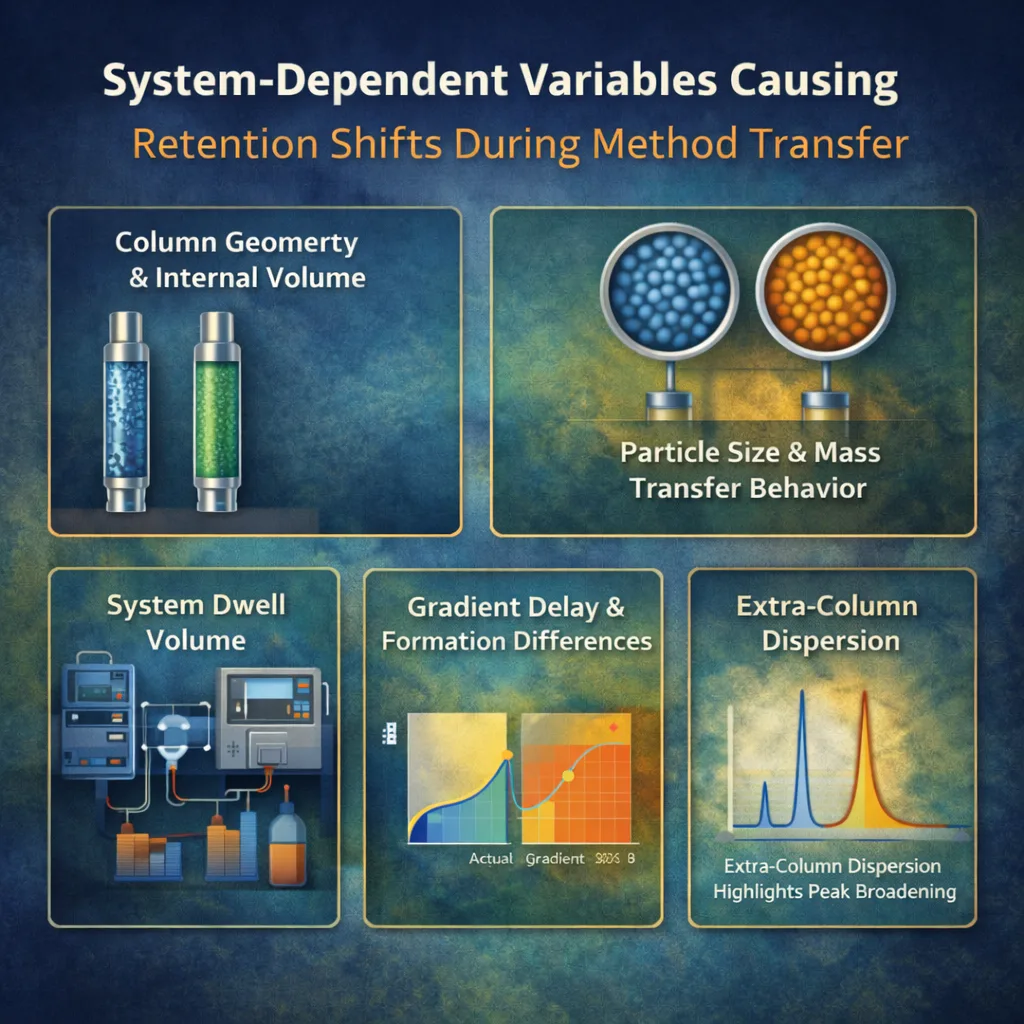
Several system-dependent variables contribute to retention shifts during method transfer:
- Column geometry and internal volume
- Particle size and mass-transfer behavior
- System dwell volume
- Gradient delay and formation differences
- Extra-column dispersion
Because of these factors, directly transferring the percentage of acetonitrile (%ACN) at which a peptide elutes under analytical conditions often results in significant prediction errors. In practice, deviations of 15–20% ACN are not uncommon.
For peptide impurity separations—where critical resolution windows may span only a few percentage points of organic solvent—such errors are unacceptable. Even a 3–5% ACN shift can collapse separation between closely related species, forcing laboratories into empirical trial-and-error optimization.
Repeated gradient adjustments, additional analytical runs, and re-purification cycles increase solvent use, reduce recovery, and delay project timelines. Moving from empirical adjustment toward systematic transfer strategies is therefore essential for modern peptide manufacturing.
Key Chromatographic Parameters That Determine Peptide Resolution
A systematic evaluation of chromatographic parameters reveals which variables genuinely influence peptide resolution and transferability.
Column Particle Size: Rethinking Conventional Assumptions
While smaller particles generally deliver higher theoretical plate numbers, modern 10 μm C18 columns have demonstrated surprisingly strong performance for peptide impurity profiling. Although slightly less efficient than 3–5 μm analytical columns, they provide sufficient resolution for reliable purity assessment.
Importantly, 10 μm columns more closely mimic preparative systems, making them valuable tools for method scouting when scalability is the ultimate goal. Using such columns during analytical development can improve transfer predictability without sacrificing meaningful impurity discrimination.
Gradient Steepness: A Critical Design Parameter
Among all tested variables, gradient steepness proved to be one of the most decisive. Increasing gradient slopes from moderate (e.g., 2% ACN/min) to steeper conditions (5–10% ACN/min) dramatically reduced resolution.
Closely related peptides require shallow gradients to allow sufficient interaction time with the stationary phase. Steeper gradients compress elution windows and force partially resolved species to co-elute. For impurity-rich peptide mixtures, maintaining relatively flat gradients is essential.
Interestingly, shortening overall run time by cropping the method—while preserving gradient slope—had minimal impact on retention behavior. This suggests that time efficiency can be improved without sacrificing separation quality.
Flow Rate: The Most Effective Kinetic Lever
Increasing flow rate significantly improved resolution, particularly on larger-particle columns. Higher linear velocity likely reduces mass-transfer limitations and improves separation performance under certain conditions.
Matching analytical flow rates more closely to preparative conditions also enhances transfer predictability, reinforcing the importance of considering hydrodynamics during method development.
Mobile-Phase Modifier: A Selectivity Switch
While trifluoroacetic acid (TFA) remains the standard ion-pairing additive in peptide chromatography, substituting it with formic acid (FA) can dramatically alter selectivity. In some cases, impurity groups that were unresolved under TFA became fully separable with FA.
However, this improvement is sequence-dependent. Certain hydrophilic peptides may experience retention loss under FA conditions. Modifier selection should therefore be deliberate and peptide-specific rather than purely conventional.
Together, these findings demonstrate that robust peptide separation depends on thoughtful control of gradient design, flow dynamics, and mobile-phase chemistry.
A Data-Driven Approach to Reliable HPLC-to-FPLC Transfer
Beyond optimizing chromatographic parameters, a major advance lies in quantitatively improving method transfer.
Direct transfer of analytical elution data to preparative systems frequently results in large prediction errors—often around 17% ACN deviation. Such discrepancies can prevent successful first-pass purification.
To address this, a correction model was introduced that incorporates system-dependent variables including:
- Column volume
- Dwell volume
- Flow rate
- Gradient slope
- Starting solvent composition
By correcting retention time for column and system delay contributions, the calculated elution percentage more accurately reflects the effective gradient experienced by the peptide.
The impact is significant. Applying this correction reduced transfer error from approximately 17% to less than 5%. Under optimized flow-rate conditions, deviations decreased further to around 3%.
In validation experiments, closely related peptide mixtures were purified successfully on the first attempt, achieving average purities above 90% and yields around 30% without iterative gradient adjustments.
For peptide manufacturers, this represents a shift from empirical purification to data-driven predictability. Fewer failed runs mean lower solvent consumption, improved material recovery, shorter timelines, and greater process sustainability.
Building More Efficient and Scalable Peptide Purification Workflows
As peptide therapeutics and functional biomolecules continue to grow in complexity, purification strategies must evolve alongside synthesis technologies.
This research highlights a crucial principle: analytical resolution can serve as a reliable predictor of preparative success—provided that system-specific variables are accounted for. When chromatographic development is approached strategically, scale-up becomes more predictable and efficient.
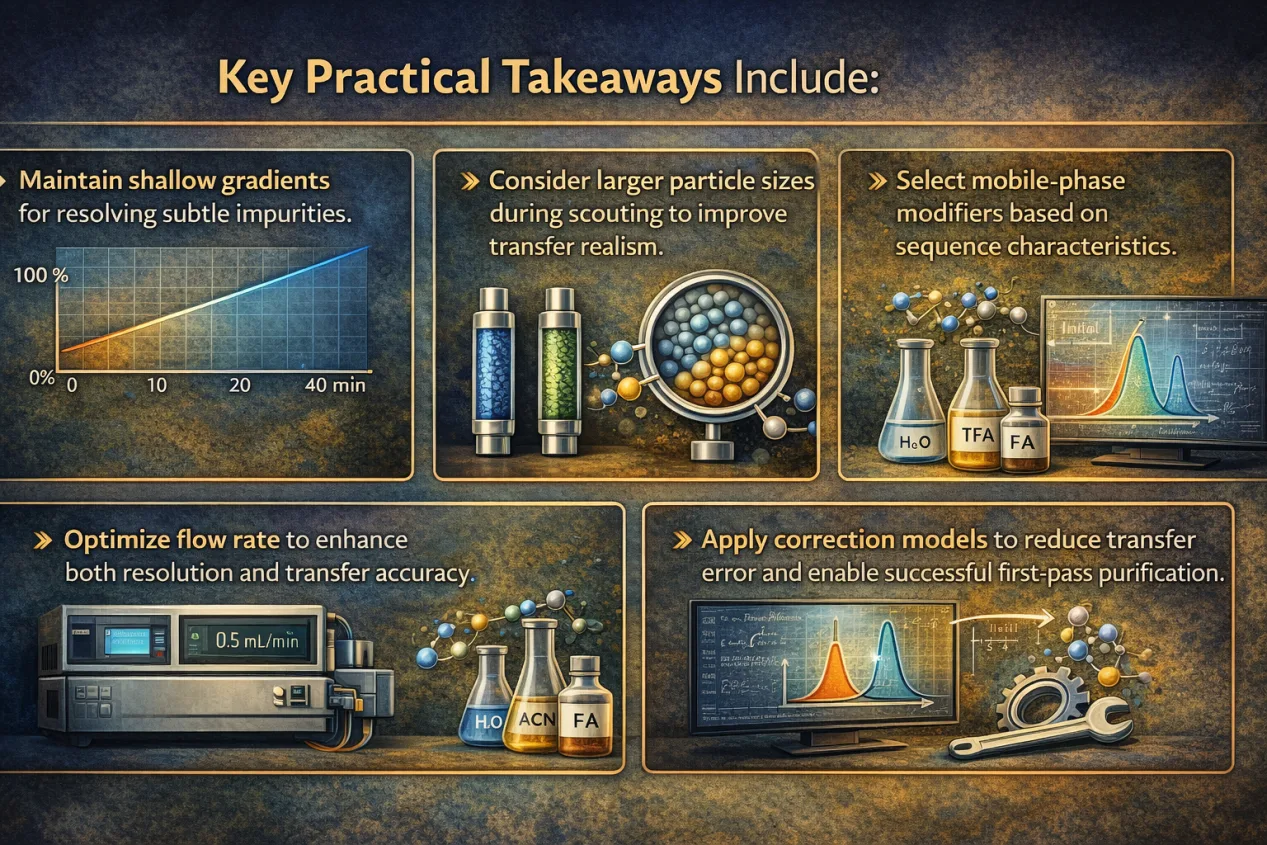
Key practical takeaways include:
- Maintain shallow gradients for resolving subtle impurities.
- Consider larger particle sizes during scouting to improve transfer realism.
- Optimize flow rate to enhance both resolution and transfer accuracy.
- Select mobile-phase modifiers based on sequence characteristics.
- Apply correction models to reduce transfer error and enable successful first-pass purification.
For peptide suppliers and research partners, improved purification efficiency translates directly into better reproducibility, reduced environmental impact, and faster delivery timelines.
At LinkPeptide, we understand that peptide purity is more than a numerical specification—it reflects the integrity of the entire workflow, from synthesis through scalable purification. By integrating optimized RP methodologies and data-driven transfer strategies, peptide production becomes not only more efficient but also more reliable and sustainable.
Bridging the gap between HPLC and FPLC is not merely a technical refinement—it is a strategic step toward smarter peptide manufacturing in an increasingly demanding scientific landscape.
Reference
Streuli, A., Erckes, V., Nardone, B., Bedard, V., Beland, F., & Steuer, C. (2026). Improvement of Analysis and Transferability in Peptide Purification: From HPLC to FPLC and Back Again. Journal of Peptide Science, 32(3), e70090.https://doi.org/10.1002/psc.70090
Fosgerau, K., & Hoffmann, T. (2015). Peptide therapeutics: current status and future directions. Drug discovery today, 20(1), 122-128.https://doi.org/10.1016/j.drudis.2014.10.003
D’Aloisio, V., Dognini, P., Hutcheon, G. A., & Coxon, C. R. (2021). PepTherDia: database and structural composition analysis of approved peptide therapeutics and diagnostics. Drug Discovery Today, 26(6), 1409-1419.https://doi.org/10.1016/j.drudis.2021.02.019
De Luca, C., Lievore, G., Bozza, D., Buratti, A., Cavazzini, A., Ricci, A., … & Catani, M. (2021). Downstream processing of therapeutic peptides by means of preparative liquid chromatography. Molecules, 26(15), 4688.https://doi.org/10.3390/molecules26154688