 LinkPeptide
Latex-Derived Peptides and Enzymes: Nature’s Answer to Antibiotic Resistance
Blog 203
Abstract
The rapid rise of antimicrobial resistance has intensified the global search for alternatives to conventional antibiotics. Among the most promising candidates are antimicrobial peptides (AMPs), naturally occurring molecules with broad-spectrum activity and unique mechanisms that limit resistance development. Recent research highlights latex from medicinal plants as a rich but underexplored reservoir of AMPs, enzymes, and proteins with significant therapeutic potential. Plant families such as Euphorbiaceae, Apocynaceae, Moraceae, Papaveraceae, and Caricaceae produce latex that not only protects plants from pathogens but also yields bioactive compounds effective against bacteria, fungi, and viruses. Beyond medicine, these molecules show applications in agriculture as natural pesticides and in industry as eco-friendly preservatives. However, challenges such as peptide instability, degradation, and production costs remain. Advances in biotechnology—including peptide synthesis, genetic engineering, and omics tools—offer pathways to overcome these barriers, ensuring sustainable use of latex-derived antimicrobials in a post-antibiotic era.
Introduction: Confronting the Antibiotic Resistance Era
Antibiotic resistance has become one of the most pressing health challenges of our time. Once hailed as miracle cures, conventional antibiotics are rapidly losing their power as bacteria, fungi, and viruses develop sophisticated resistance strategies. If unchecked, antimicrobial resistance is projected to cause millions of deaths annually by 2050, surpassing the toll of many major diseases. This alarming scenario has intensified the search for next-generation antimicrobial agents.
One of the most promising frontiers lies in antimicrobial peptides (AMPs)—small, naturally occurring molecules that serve as the first line of defense across plants, animals, and microorganisms. Unlike conventional antibiotics, which often strike a single target, AMPs typically disrupt microbial membranes or interfere with multiple essential processes, making it far more difficult for pathogens to adapt.
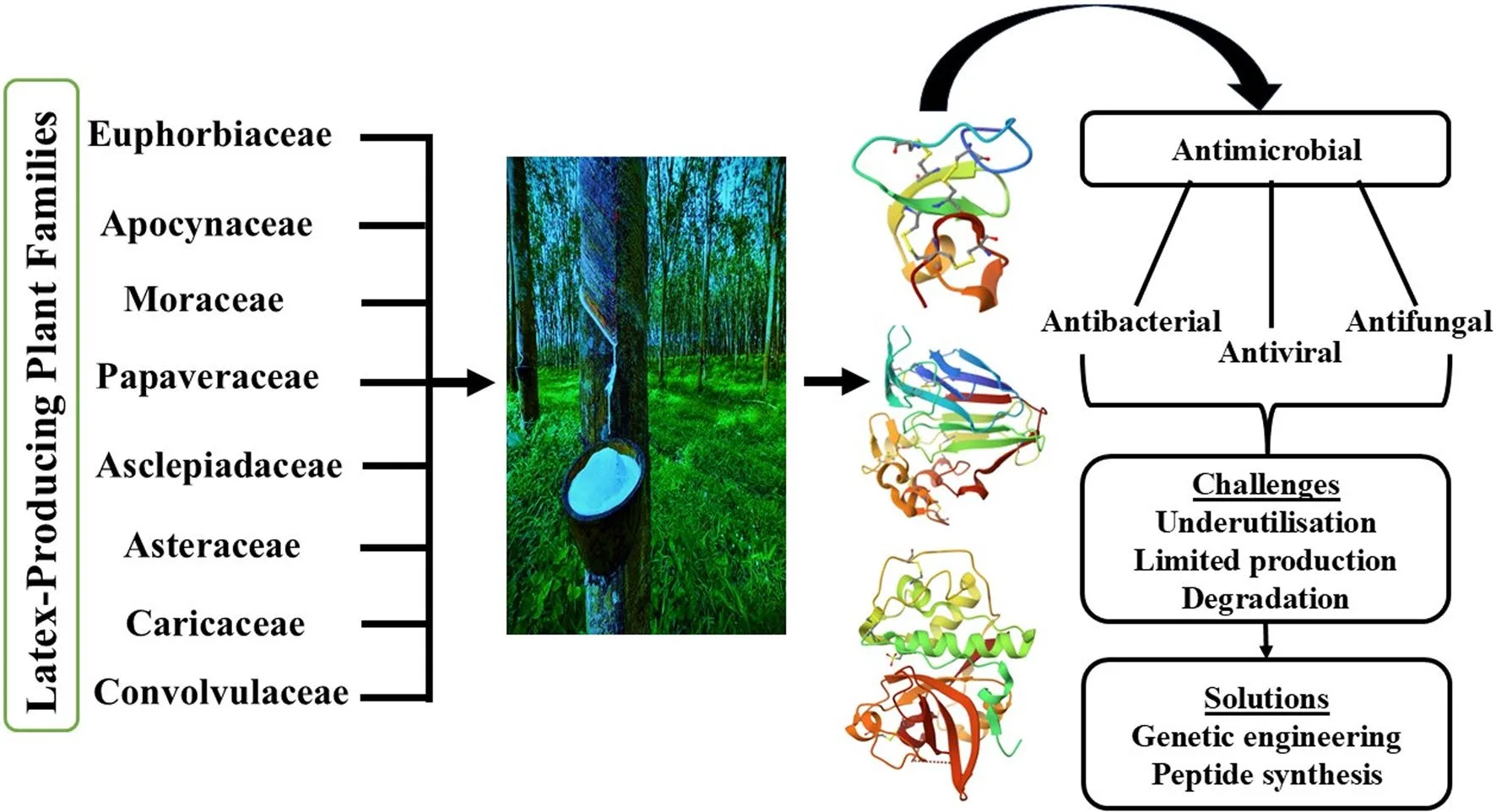
Within this context, the latex of medicinal plants has emerged as an underexplored yet powerful source of AMPs, proteins, and enzymes. Acting as natural protective fluids, plant latexes provide a reservoir of bioactive compounds that could inspire the next generation of antimicrobial therapies.
Latex-Producing Plants: Nature’s Defensive Arsenal
Latex is a complex, milky fluid secreted by specialized cells called laticifers in certain plants. For centuries, it has been recognized in traditional medicine for its healing and protective qualities. Modern science now confirms that latex is not merely a byproduct but a highly evolved defense system, rich in alkaloids, enzymes, and most notably, antimicrobial peptides (AMPs). When a plant is wounded, latex immediately flows to seal the injury, deter herbivores with its often-toxic compounds, and prevent microbial invasion through its natural antimicrobial arsenal
Several plant families stand out as prolific latex producers. The Euphorbiaceae (spurge family) includes Hevea brasiliensis—the rubber tree—whose latex is the source of hevein, a peptide with remarkable antifungal activity. The Apocynaceae (dogbane family) features Calotropis procera, known for producing cysteine-rich peptides and proteolytic enzymes that act against both fungi and drug-resistant bacteria. The Moraceae (mulberry family) contributes Ficus species, where latex-derived enzymes like ficin and chitinases aid in wound healing while suppressing pathogens. In the Papaveraceae (poppy family), Papaver somniferum is historically valued for morphine but also harbors antimicrobial protease inhibitors. Meanwhile, the Caricaceae (papaya family) provides papain, a protease with wide biomedical and industrial applications.
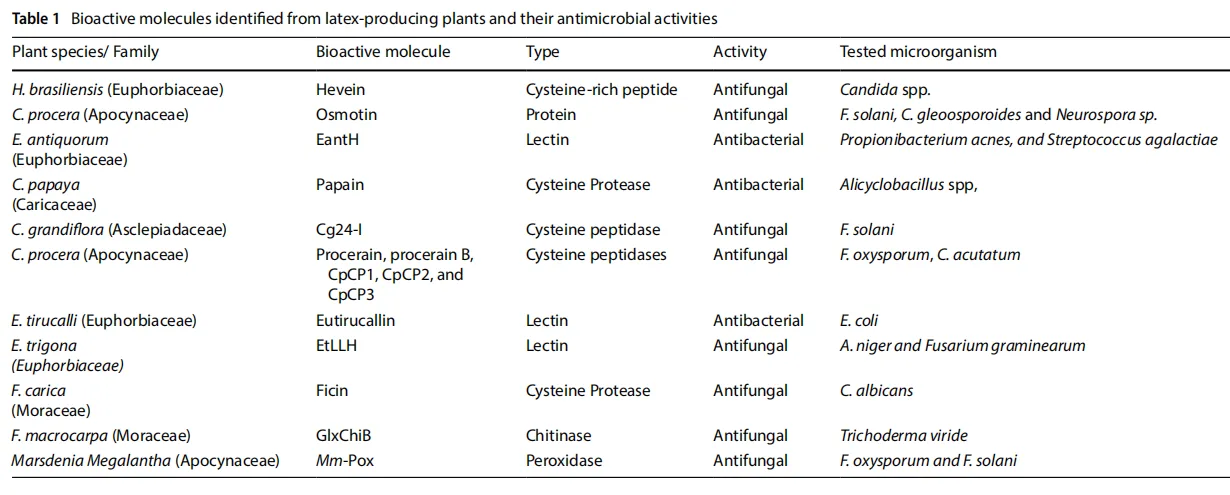
What unites these diverse plants is the adaptive role of latex: it is simultaneously a physical barrier and a chemical shield. This ecological function has endowed latex with an extraordinary diversity of bioactive molecules. For researchers, these natural reservoirs represent a largely untapped goldmine of potential antimicrobial agents. As we confront rising antibiotic resistance, revisiting the protective strategies embedded in plant latex offers both inspiration and practical solutions for drug discovery.
Bioactive Molecules in Latex: Peptides, Proteins, and Enzymes
The therapeutic potential of latex stems from its extraordinary arsenal of bioactive molecules, many of which display direct antimicrobial activity. Among these, antimicrobial peptides (AMPs) stand out for their structural diversity and powerful biological effects. Typically cationic and amphiphilic, these peptides interact with microbial membranes, destabilizing their integrity and leading to cell death—a mechanism that makes resistance development far more difficult compared to traditional antibiotics
Antibacterial Peptides
Studies on Hevea brasiliensis (rubber tree) latex have identified serum peptides capable of suppressing both bacterial and fungal growth. Similarly, latex from Tabernaemontana divaricata selectively inhibits Enterococcus faecalis and Aspergillus niger, demonstrating its dual antibacterial and antifungal capacity.
Antifungal Proteins and Peptidases
Latex-derived antifungal molecules are equally compelling. For instance, the peptide fraction of Calotropis procera latex reduces fungal growth by up to 80% and also displays insecticidal properties. Cysteine peptidases such as CpCP1, CpCP2, and CpCP3 from C. procera exhibit potent antifungal effects against Fusarium and Colletotrichum, while the protease Cg24-I from Cryptostegia grandiflora directly destroys fungal spores. Even larger proteases, such as a 48 kDa enzyme from Artocarpus heterophyllus (jackfruit), have shown activity against Candida albicans.
Antiviral Peptides
Plant latex is also being investigated for its antiviral properties. The yellow-orange latex of Chelidonium majus reduces the infectivity of human papillomavirus (HPV) by blocking viral entry and interfering with genetic material transport. Protein fractions from latex can also stimulate immune signaling, enhancing host antiviral defenses.
Lectins and Proteolytic Enzymes
Lectins, carbohydrate-binding proteins abundant in Euphorbia species, exert antibacterial and antifungal activity by disrupting cell wall integrity. Proteolytic enzymes such as papain and chymopapain from papaya latex have become well-studied for their dual role in plant defense and therapeutic applications, including wound healing and infection control.
Together, these peptides, proteins, and enzymes illustrate the structural richness of latex and its multifaceted antimicrobial strategies. They not only defend the plant but also provide a blueprint for developing novel therapies in human medicine, agriculture, and industry.
From Clinics to Fields: Applications and Hurdles Ahead
While the therapeutic potential of latex-derived molecules is undeniable, their value extends far beyond the medical field. These bioactive compounds are increasingly recognized as versatile tools for agriculture, food preservation, and even cosmetics.

Medical Applications
The most urgent application is in combating multidrug-resistant pathogens. Latex-derived AMPs and enzymes offer new mechanisms of action—membrane disruption, spore degradation, and viral entry inhibition—that could form the basis of novel antimicrobial drugs. Their broad-spectrum activity, coupled with lower likelihood of resistance development, makes them especially attractive in clinical settings
Agricultural Uses
In agriculture, latex AMPs act as natural pesticides, reducing reliance on synthetic chemicals. For instance, hevein from Hevea brasiliensis suppresses Fusarium oxysporum, a fungus responsible for vascular wilt in crops. Similarly, osmotin from Calotropis procera inhibits pathogens like Colletotrichum gloeosporioides, which causes blight in fruits and vegetables. These eco-friendly solutions align with sustainable farming practices while minimizing environmental impact.
Industrial and Consumer Goods
Latex enzymes are also valuable in industry. Proteases from Carica papaya and Calotropis procera have been shown to generate antifungal peptides that delay bread spoilage, suggesting roles as natural food preservatives. Their incorporation into cosmetics and personal care products is another promising avenue, where antimicrobial protection enhances product safety and shelf life.
Challenges to Overcome
Despite their promise, latex-derived AMPs face hurdles. Many are unstable under harsh conditions, prone to degradation by proteases, or costly to produce at scale. These factors have slowed commercialization, even for well-characterized peptides. Addressing these barriers requires advances in peptide stabilization, cost-effective synthesis, and scalable production systems.
Thus, while latex-derived biomolecules offer diverse benefits, realizing their full potential will depend on overcoming scientific and industrial challenges.
Future Horizons: Biotech Innovation and Sustainable Solutions
The future of latex-derived antimicrobials lies in marrying nature’s ingenuity with modern biotechnology. Advances in solid-phase peptide synthesis (SPPS) now allow researchers to construct antimicrobial peptides with high precision, introducing modifications such as cyclization or lipidation to enhance stability and potency. These innovations protect peptides from enzymatic degradation and improve their ability to interact with microbial membranes
Genetic engineering further expands the possibilities. By inserting AMP genes into host organisms like bacteria, yeast, or even plants, scientists can produce large quantities of antimicrobial peptides in a cost-effective and scalable manner. Hybrid peptides—engineered by combining functional motifs from different AMPs—are another exciting avenue, offering broader activity and reduced resistance risks.
The rise of genomics and proteomics has also transformed AMP discovery. High-throughput sequencing, mass spectrometry, and CRISPR/Cas9 gene editing provide unprecedented insights into latex biochemistry. Combined with computational tools and databases such as APD and CAMP, these approaches accelerate the identification of novel peptides and predict their antimicrobial potential.
Equally important is the question of sustainability. Traditional harvesting of latex risks damaging plant populations and ecosystems. Biotechnological production through engineered microbes or transgenic plants presents an eco-friendly alternative that preserves biodiversity while meeting industrial demand.
Ultimately, the convergence of biotechnology and sustainability will determine how effectively latex-derived molecules transition from ecological defense systems to next-generation antimicrobial therapies. With antibiotic resistance intensifying, this natural resource may prove indispensable in safeguarding global health.
Reference
Molik, Z. A., Ajayi, T. O., Ogunniyi, Q. A., Fijagbade, A. O., & Ogbole, O. O. (2025). Latex of medicinal plants: A reservoir of antimicrobial peptides, proteins, and enzymes for drug discovery. Discover Molecules, 2(1), 1.
https://doi.org/10.1007/s44345-025-00008-w
Shanmugaraj, B., Bulaon, C. J. I., Malla, A., & Phoolcharoen, W. (2021). Biotechnological insights on the expression and production of antimicrobial peptides in plants. Molecules, 26(13), 4032.
https://doi.org/10.3390/molecules26134032
Bakare, O. O., Gokul, A., Fadaka, A. O., Wu, R., Niekerk, L. A., Barker, A. M., … & Klein, A. (2022). Plant antimicrobial peptides (PAMPs): features, applications, production, expression, and challenges. Molecules, 27(12), 3703.
https://doi.org/10.3390/molecules27123703
Starr, C. G., & Wimley, W. C. (2017). Antimicrobial peptides are degraded by the cytosolic proteases of human erythrocytes. Biochimica et Biophysica Acta (BBA)-Biomembranes, 1859(12), 2319-2326.