 LinkPeptide
Peptide Substrates: Advances in High-Throughput Screening Technologies
Introduction: The Growing Importance of High-Throughput Screening in Peptide Research
High-throughput screening (HTS) has transformed modern drug discovery and enzymology by enabling the rapid evaluation of thousands to millions of compounds in a relatively short time. As biomedical research increasingly focuses on complex biological targets, peptide substrates have emerged as highly valuable tools in HTS platforms due to their specificity, tunability, and compatibility with modern analytical technologies.
Unlike conventional small molecules, peptide substrates can closely mimic natural protein interactions, making them particularly useful for studying enzymes, receptors, and signaling pathways. Recent advances in automation, microfluidics, computational modeling, fluorescence detection, and mass spectrometry have dramatically expanded the capabilities of peptide-based HTS systems.
These innovations are accelerating:
- Drug discovery
- Enzyme inhibitor screening
- Biomarker identification
- Proteomics research
- Precision medicine applications
This article explores the evolving role of peptide substrates in high-throughput screening technologies and highlights the latest methodological advances shaping modern peptide-based screening workflows.
What Are Peptide Substrates in High-Throughput Screening?
Peptide substrates used in HTS are short amino acid sequences engineered to interact with specific biological targets such as:
- Proteases
- Kinases
- Phosphatases
- Transferases
- Receptors
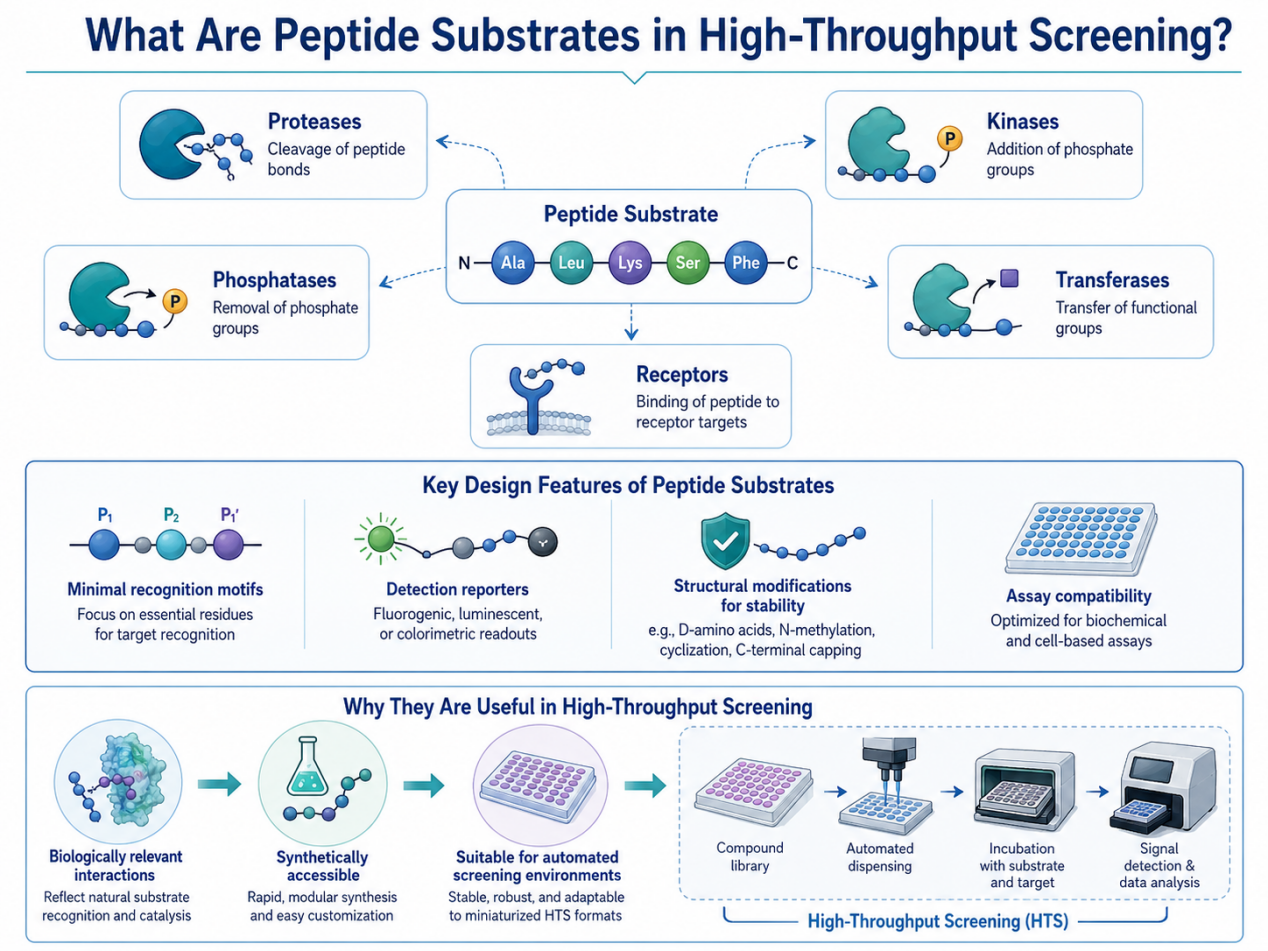
These peptides are typically designed to contain:
- Minimal recognition motifs
- Detection reporters
- Structural modifications for stability and assay compatibility
Because peptide substrates can reproduce biologically relevant interactions while remaining synthetically accessible, they are highly suited for automated screening environments.
Why Peptide Substrates Are Valuable for HTS
Biological Relevance
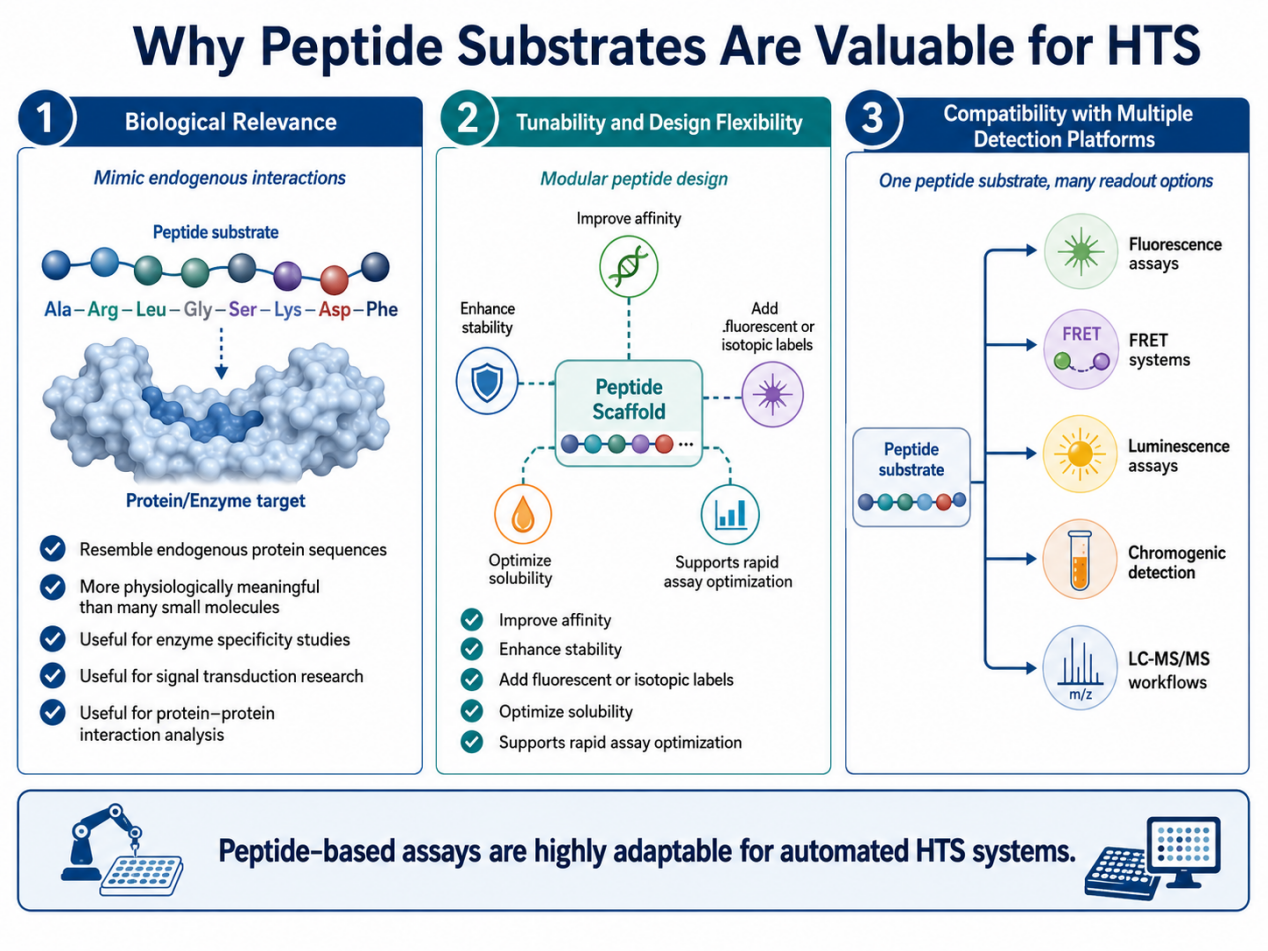
Peptide substrates closely resemble endogenous protein sequences, enabling more physiologically meaningful screening results than many synthetic small molecules.
This is particularly important for:
- Enzyme specificity studies
- Signal transduction research
- Protein–protein interaction analysis
Tunability and Design Flexibility
Peptides can be systematically modified to:
- Improve affinity
- Enhance stability
- Introduce fluorescent or isotopic labels
- Optimize solubility
This modularity supports rapid assay optimization.
Compatibility with Multiple Detection Platforms
Modern peptide substrates are compatible with:
- Fluorescence assays
- FRET systems
- Luminescence assays
- Chromogenic detection
- LC-MS/MS workflows
These features make peptide-based assays highly adaptable for automated HTS systems.
Evolution of High-Throughput Screening Technologies
Traditional biochemical assays were often:
- Labor-intensive
- Low-throughput
- Difficult to scale
Modern HTS platforms now integrate:
- Robotics
- Automated liquid handling
- High-density microplates
- Advanced detection systems
- Computational analytics
These developments enable rapid screening of large peptide libraries with improved reproducibility and sensitivity.
Combinatorial Peptide Libraries and HTVS
Combinatorial Peptide Libraries
One of the most important advances in peptide HTS is the development of combinatorial peptide libraries.
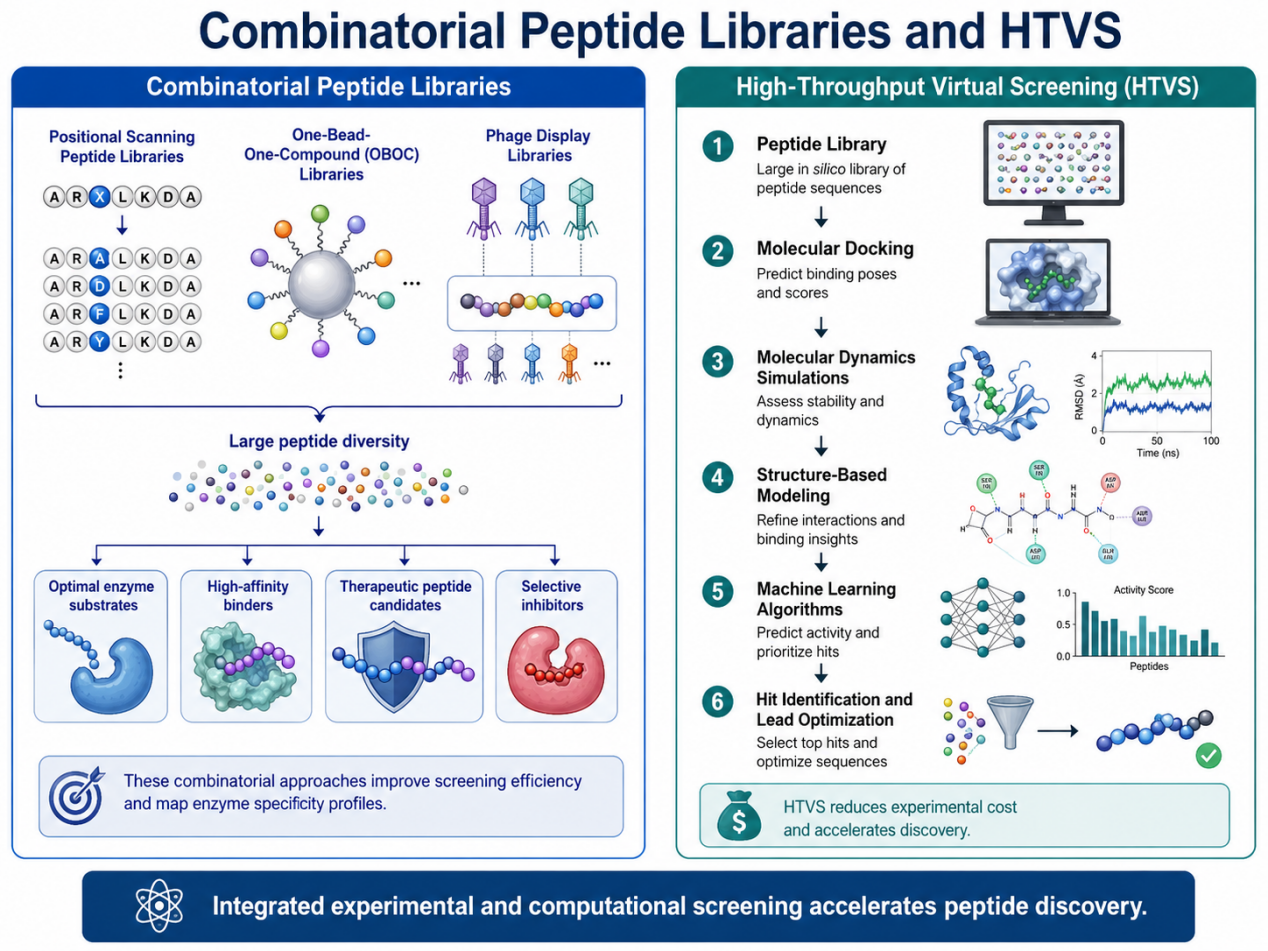
These libraries allow simultaneous generation and screening of thousands of peptide variants to identify:
- Optimal enzyme substrates
- High-affinity binders
- Therapeutic peptide candidates
- Selective inhibitors
Common formats include:
- Positional scanning peptide libraries
- One-bead-one-compound libraries
- Phage display libraries
These approaches dramatically improve screening efficiency and enable detailed mapping of enzyme specificity profiles.
High-Throughput Virtual Screening (HTVS)
Recent advances in computational chemistry have enabled large-scale virtual peptide screening workflows.
Modern HTVS platforms combine:
- Molecular docking
- Molecular dynamics simulations
- Structure-based modeling
- Machine learning algorithms
These technologies reduce experimental costs while accelerating hit identification and lead optimization. The 2022 review in the European Journal of Medicinal Chemistry highlighted how modern HTVS platforms are becoming increasingly important for peptide binder and peptide drug discovery.
Advances in Detection Technologies
Detection systems are central to HTS performance. Modern peptide substrate assays increasingly rely on highly sensitive analytical methods.
Fluorescence-Based Screening
Fluorescence remains one of the most widely used HTS detection strategies.
FRET-Based Peptide Substrates
Fluorescence resonance energy transfer (FRET) substrates contain:
- A fluorophore donor
- A quencher acceptor
Upon enzymatic cleavage:
- Fluorescence signal increases
- Enzyme activity can be monitored in real time
Advantages:
- High sensitivity
- Continuous kinetic monitoring
- Suitable for automation
Luminescence Assays
Luminescent peptide substrates offer:
- Extremely low background noise
- High signal sensitivity
These systems are especially useful for:
- Low-abundance enzymes
- Cell-based assays
Mass Spectrometry-Based HTS
Mass spectrometry (MS) is increasingly integrated into peptide HTS workflows.
Advantages of MS-Based Screening
- Label-free detection
- High specificity
- Multiplexing capability
- Quantitative analysis
Modern LC-MS/MS systems enable:
- Simultaneous monitoring of multiple peptide products
- Accurate quantification of enzymatic activity
This has become especially important in:
- Proteomics
- Biomarker discovery
- Kinase profiling
Microfluidics and Miniaturization
One of the most important advances in HTS is assay miniaturization.
Microfluidic Screening Platforms
Microfluidic systems use:
- Nanoliter-scale reactions
- Droplet-based assays
- Continuous-flow analysis
These technologies offer:
- Reduced reagent consumption
- Faster reaction times
- Increased throughput
Recent studies demonstrate that microfluidic HTS can dramatically increase screening speed while lowering assay costs.
Automation and Robotics in Peptide HTS
Modern HTS platforms rely heavily on automation.
Automated Liquid Handling
Robotic systems improve:
- Precision
- Reproducibility
- Workflow scalability
Automation enables:
- Rapid plate preparation
- Consistent reagent dispensing
- Reduced human error
High-Density Microplate Formats
Current HTS assays commonly use:
- 384-well plates
- 1536-well plates
- Ultra-miniaturized nanowell formats
These formats significantly increase throughput while reducing reagent volumes.
Artificial Intelligence and Computational Analysis
The rapid growth of HTS datasets has accelerated the integration of:
- Machine learning
- AI-assisted hit identification
- Predictive modeling
AI tools are increasingly used to:
- Predict peptide binding affinity
- Optimize substrate sequences
- Identify structure–activity relationships
- Improve hit prioritization
These computational approaches are improving both screening speed and hit quality.
Applications of Peptide-Based HTS
Drug Discovery
Peptide HTS platforms are widely used for:
- Enzyme inhibitor discovery
- Therapeutic peptide identification
- Target validation
Protease and Kinase Profiling
Peptide substrates enable large-scale mapping of:
- Enzyme specificity
- Signaling pathways
- Disease-associated enzymatic activity
Cancer Research
Peptide-based HTS supports:
- Tumor biomarker identification
- Protease activity profiling
- Kinase inhibitor development
Infectious Disease Research
HTS peptide assays are valuable for studying:
- Viral proteases
- Bacterial enzymes
- Host–pathogen interactions
Challenges in Peptide-Based HTS
Despite significant advances, several limitations remain.
Peptide Stability
Peptides are susceptible to:
- Proteolytic degradation
- Oxidation
- Aggregation
Solutions include:
- Incorporation of non-natural amino acids
- Cyclization
- Stabilizing modifications
False Positives and Signal Interference
High-throughput assays may produce:
- Non-specific interactions
- Fluorescence artifacts
- Detection interference
Careful assay validation and controls are essential.
Data Complexity
Modern HTS generates massive datasets requiring:
- Advanced bioinformatics
- Statistical analysis
- Machine learning tools
Future Directions in Peptide HTS Technologies
Several emerging trends are expected to shape the future of peptide-based HTS:
AI-Driven Peptide Design
Machine learning models are increasingly capable of:
- Predicting substrate specificity
- Designing optimized peptide libraries
- Accelerating hit discovery
Single-Cell Screening Technologies
Ultra-sensitive assays may soon enable:
- Single-cell enzymatic profiling
- Personalized therapeutic screening
Integrated Multi-Omics Screening
Future platforms will combine:
- Proteomics
- Genomics
- Metabolomics
This will provide a more comprehensive understanding of biological systems.
How LinkPeptide Supports High-Throughput Screening Research
At LinkPeptide, we provide advanced peptide solutions tailored for high-throughput screening applications, including:
- Custom peptide substrate synthesis
- Fluorescent and quenched peptide probes
- Peptide library design
- Stable and modified peptides for HTS workflows
- High-purity peptides with HPLC and MS validation
Our expertise supports researchers developing next-generation screening platforms for drug discovery and biochemical research.
Conclusion
Advances in high-throughput screening technologies have dramatically expanded the role of peptide substrates in modern biomedical research. Through innovations in:
- Automation
- Microfluidics
- Mass spectrometry
- Computational modeling
- AI-driven analysis
peptide-based HTS platforms now provide unprecedented speed, sensitivity, and biological relevance.
As these technologies continue to evolve, peptide substrates will remain central tools for accelerating discoveries in enzymology, drug development, and precision medicine.
Reference
Tripathi, N. M., & Bandyopadhyay, A. (2022). High throughput virtual screening (HTVS) of peptide library: Technological advancement in ligand discovery. European Journal of Medicinal Chemistry, 243, 114766.
https://doi.org/10.1016/j.ejmech.2022.114766
Klebe, G. (2006). Virtual ligand screening: strategies, perspectives and limitations. Drug discovery today, 11(13-14), 580-594.
https://doi.org/10.1016/j.drudis.2006.05.012
Mascini, M., Montesano, C., Perez, G., Wang, J., Compagnone, D., & Sergi, M. (2017). Selective solid phase extraction of JWH synthetic cannabinoids by using computationally designed peptides. Talanta, 167, 126-133.
https://doi.org/10.1016/j.talanta.2017.01.072
Avan, I., Hall, C. D., & Katritzky, A. R. (2014). Peptidomimetics via modifications of amino acids and peptide bonds. Chemical Society Reviews, 43(10), 3575-3594.