 LinkPeptide
The Future of Peptide Synthesis: Trends and Innovations
Peptide synthesis has already become a core technology in research, drug discovery, diagnostics, and therapeutic development. But the field is evolving quickly. What was once seen mainly as a stepwise chemical process is now becoming faster, smarter, and more adaptable through automation, better chemistry, and data-driven design.
That is why the future of peptide synthesis is such an important topic for researchers and biotech teams. Modern workflows are moving toward higher precision, better scalability, shorter development timelines, and improved support for complex peptide structures.
Why Peptide Synthesis Is Changing So Quickly
Peptides are now used across more research and therapeutic areas than ever before. They are studied in oncology, metabolism, infectious disease, immunology, cell signaling, enzyme biology, and targeted delivery.
As peptide applications expand, synthesis demands are also increasing. Researchers now want:
- Faster turnaround
- Better reproducibility
- Higher purity
- Easier scale-up
- More complex modifications
- Smarter design support
- More efficient production workflows
This growing demand is driving innovation across the full peptide development pipeline.
The Future of Peptide Synthesis: What Is Driving It?
The future of peptide synthesis is being shaped by a few major trends that are already influencing how researchers design and produce peptides.
These trends include:
- Greater laboratory automation
- AI-assisted peptide design and process optimization
- Faster and more efficient solid-phase peptide synthesis workflows
- Better support for modified and complex peptides
- Stronger analytical integration
- More scalable and flexible custom peptide synthesis services
Together, these changes are helping peptide science move from manual, time-intensive workflows toward more predictable, innovation-friendly systems.
Why Solid-Phase Peptide Synthesis Still Leads the Field
Even as the field evolves, solid-phase peptide synthesis remains one of the most important methods in modern peptide production.
This is because it offers several practical strengths:
- Stepwise sequence control
- Easier washing between reaction cycles
- Good compatibility with automation
- Strong support for modified peptide assembly
- Useful scalability from research to development work
For many modern applications, SPPS remains the backbone of both routine peptide production and advanced peptide engineering.
The Continued Role of Fmoc Synthesis and Boc Synthesis
As new technologies emerge, classic peptide chemistry still matters.
Fmoc Synthesis
Fmoc synthesis remains one of the most widely used strategies in peptide assembly. It is strongly favored in many workflows because it is flexible, broadly compatible with modern automation, and suitable for many custom sequences and modifications.
In practical terms, Fmoc-based methods support the future of peptide production by aligning well with high-throughput, programmable synthesis systems.
Boc Synthesis
Boc synthesis is used less frequently in many modern routine workflows, but it still has value in selected peptide chemistries and specialized applications.
That means the future is not about replacing all older methods. It is about choosing the chemistry that best fits the peptide, the platform, and the project goal.
Advantages of Automated Peptide Synthesis
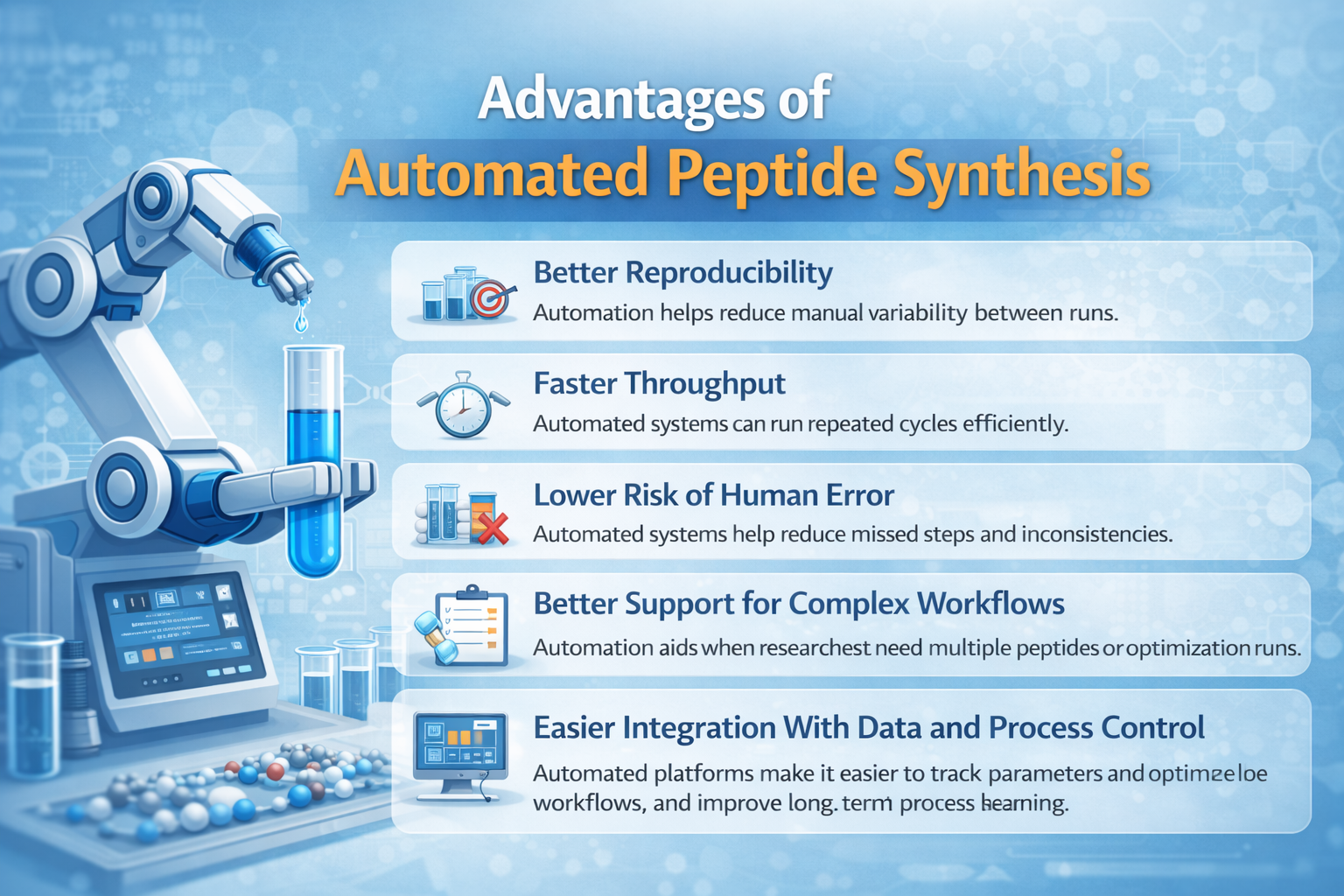
One of the biggest drivers of change is automation. The advantages of automated peptide synthesis are making a real difference in both research laboratories and production-focused environments.
Key advantages include:
Better Reproducibility
Automation helps reduce manual variability between runs. This is especially important for multi-step synthesis, where small differences can affect final purity and yield.
Faster Throughput
Automated systems can run repeated cycles with more consistent timing, helping researchers complete peptide projects more efficiently.
Lower Risk of Human Error
Manual synthesis requires careful repetition and timing. Automated systems help reduce missed steps, handling inconsistencies, and setup variation.
Better Support for Complex Workflows
Automation is especially useful when researchers need multiple peptide candidates, repeated optimization runs, or sequences with modifications.
Easier Integration With Data and Process Control
Automated platforms also make it easier to track reaction parameters, standardize workflows, and improve long-term process learning.
These are some of the reasons automated synthesis is becoming more central to modern peptide development.
How AI Is Used in Peptide Synthesis
Another major question is: How is AI used in peptide synthesis?
Artificial intelligence is not replacing chemistry. Instead, it is helping researchers make smarter decisions before and during peptide development.
AI in Peptide Design
AI can help analyze sequence patterns, predict activity-related features, and support the design of peptides with better functional potential. This is especially relevant in therapeutic peptide discovery and screening.
AI in Process Optimization
In synthesis workflows, AI can help identify patterns linked to poor yield, aggregation risk, difficult coupling steps, or purification challenges. This may improve planning before a peptide is synthesized.
AI in Candidate Prioritization
Instead of testing every possible peptide sequence manually, AI-assisted tools can help narrow down promising candidates based on predicted behavior.
AI in Workflow Efficiency
Over time, AI may become more useful for selecting synthesis routes, predicting difficult sequences, improving reagent use, and reducing unnecessary trial-and-error.
So when we ask how AI is used in peptide synthesis, the best answer is that AI acts as a powerful support tool for design, optimization, and decision-making.
Why Custom Peptide Synthesis Will Become Even More Important
As peptide applications become more specialized, custom peptide synthesis is expected to play an even larger role.
Researchers increasingly need peptides that are not standard catalog products. They may require:
- Unique sequences
- Specific purity targets
- Terminal modifications
- Fluorescent labels
- Cyclic structures
- Conjugation-ready designs
- Scale flexibility from early research to advanced development
This means the future of peptide science is closely tied to the growth of flexible, technically robust custom peptide synthesis services.
Emerging Innovations Beyond Standard Batch Workflows
Innovation in peptide synthesis is not limited to software and robotics. The chemistry workflow itself is evolving.
Modern trends include growing interest in:
- Faster cycle times
- Improved coupling efficiency
- Better handling of difficult sequences
- Flow-based peptide synthesis concepts
- Stronger integration between synthesis and purification
- More sustainable and efficient reagent use
These developments point toward a future where peptide production becomes not only faster, but also more practical for complex sequences and larger pipelines.
Smarter Support for Difficult and Modified Peptides
One of the most useful innovations in modern peptide work is the ability to support more challenging molecules.
Researchers increasingly work with:
- Long peptides
- Hydrophobic sequences
- Aggregation-prone peptides
- Labeled peptides
- Delivery peptides
- Therapeutic peptide candidates
- Peptides with specialized linkers or conjugates
Future peptide synthesis platforms will likely continue to improve to address these needs, helping more difficult projects move forward with greater confidence.
The Growing Importance of Analytics and Quality Control
The future of peptide synthesis is not only about making peptides faster. It is also about confirming quality more effectively.
As workflows become more advanced, strong analytics become even more important for:
- Identity confirmation
- Purity profiling
- Batch consistency
- Process troubleshooting
- Data-backed development decisions
This is why peptide analysis and analytical verification will remain essential parts of innovation, not secondary steps.
What the Future Means for Researchers
For researchers, the future of peptide synthesis is encouraging. Better tools mean more flexibility, faster testing, and stronger confidence in results.
In practical terms, these innovations can help researchers:
- Explore more peptide candidates in less time
- Improve success rates for difficult sequences
- Reduce workflow inefficiencies
- Support more advanced delivery and therapeutic designs
- Move from discovery to optimization more smoothly
That is a positive shift for academic labs, biotech teams, and translational research programs alike.
What the Future Means for Service Providers
For peptide suppliers and service partners, the future will likely favor teams that combine chemistry expertise with workflow flexibility.
Researchers increasingly value providers that can offer:
- Reliable custom peptide synthesis
- Strong analytical support
- Access to peptide building blocks
- Support for modifications
- Smarter technical communication
- Better handling of sequence complexity
This is where companies like LinkPeptide can remain highly relevant by supporting both today’s peptide needs and the more advanced demands that are emerging.
Conclusion
The future of peptide synthesis is being shaped by a clear set of innovations: smarter automation, stronger custom peptide synthesis, continued leadership of solid-phase peptide synthesis, practical use of Fmoc synthesis, selected roles for Boc synthesis, and growing interest in how AI is used in peptide synthesis.
At the same time, the advantages of automated peptide synthesis are making peptide workflows more reproducible, efficient, and scalable. These changes are not just technical improvements. They are expanding what researchers can realistically design, test, and develop.
FAQ
What is the future of peptide synthesis?
The future of peptide synthesis is moving toward smarter automation, AI-assisted design, better process optimization, stronger analytics, and more flexible custom synthesis workflows.
Why is solid-phase peptide synthesis still important?
Solid-phase peptide synthesis remains important because it offers strong sequence control, easy washing between steps, good compatibility with automation, and practical support for the production of complex peptides.
How is AI used in peptide synthesis?
AI is used in peptide synthesis to support sequence design, identify difficult synthesis patterns, improve candidate selection, and help optimize development workflows.
What are the advantages of automated peptide synthesis?
The main advantages of automated peptide synthesis include better reproducibility, faster throughput, reduced risk of human error, and improved support for complex or repetitive workflows.
What is the role of custom peptide synthesis in the future?
Custom peptide synthesis will become more important as research and therapeutic projects increasingly need tailored sequences, modifications, purity targets, and scalable production support.
Are Fmoc synthesis and Boc synthesis still relevant?
Yes. Fmoc synthesis remains widely used in modern peptide workflows, while Boc synthesis still has value in selected specialized applications.