 LinkPeptide
What Do You Do When Your Peptide Synthesis Fails?
Peptide synthesis can be highly effective, but even well-planned projects do not always go smoothly. Low crude purity, missing peaks, incomplete coupling, deletion sequences, and difficult purification are common challenges in modern peptide work.
The good news is that peptide synthesis failure is often a solvable process issue, not the end of a project. With the right troubleshooting steps, better reagent selection, and smarter workflow design, many synthesis problems can be corrected or prevented in future runs.
This guide explains what to do when peptide synthesis fails, why problems occur in solid-phase peptide synthesis, how peptide aggregation affects outcomes, and how optimizing peptide synthesis protocols can improve the quality of your synthetic peptides. We will also look at common issues in Fmoc peptide synthesis and broader lessons from solid-phase peptide chemistry.
What Counts as Peptide Synthesis Failure?
Not every disappointing result means total failure. In practice, peptide synthesis failure can show up in several ways:
- Low crude purity
- Incomplete peptide chain assembly
- Unexpected side products
- Poor yield after cleavage
- Difficult purification
- Insoluble final peptide
- Wrong molecular weight or mixed analytical data
Sometimes the peptide is present, but the quality is too low for the intended application. In other cases, the main issue may be purification rather than synthesis itself. The first step is to identify where the workflow started to break down.
Step 1: Confirm Where the Problem Happened
Before changing everything, isolate the stage where the issue is most likely to have occurred.
Ask these questions:
- Did coupling efficiency drop during chain elongation?
- Did deprotection become incomplete?
- Did aggregation start on the resin?
- Did cleavage conditions damage the sequence?
- Did purification fail to separate closely related impurities?
This matters because the solution depends on the failure point. A coupling problem needs a different response than a cleavage or purification problem.
Step 2: Review the Sequence for Difficulty Risk
Some peptide sequences are naturally harder to synthesize than others. A sequence may look simple on paper but behave poorly during assembly.
Common high-risk features include:
- Long sequences
- Hydrophobic stretches
- Repetitive amino acid motifs
- Strong beta-sheet tendency
- Multiple bulky residues
- Sensitive residues prone to side reactions
- Sequences that favor on-resin aggregation
In many cases, the peptide itself is the reason the process becomes difficult. Recognizing this early makes troubleshooting faster and more effective.
Step 3: Check for Peptide Aggregation
Peptide aggregation is one of the most common reasons for poor synthesis performance. During solid-phase peptide synthesis, growing peptide chains on the resin can interact with one another and form secondary structures. When that happens, reagents may not reach reactive sites efficiently.
This can cause:
- Incomplete coupling
- n- Incomplete deprotection
- Lower yield
- More deletion sequences
- Poor crude purity
If aggregation is suspected, helpful strategies may include:
- Using stronger or alternative coupling systems
- Extending coupling time
- Repeating difficult coupling steps
- Lowering resin loading where appropriate
- Introducing pseudoproline or backbone-disrupting strategies when available
- Using modified solvents or additives to improve chain accessibility
For many difficult sequences, solving aggregation is the turning point between repeated failure and a workable synthesis route.
Step 4: Evaluate Fmoc Deprotection and Coupling Efficiency
In Fmoc peptide synthesis, two repeated steps control much of the process: deprotection and coupling.
If Fmoc removal is incomplete, the next amino acid cannot attach correctly. If coupling is weak, deletion sequences begin to accumulate.
Things to review include:
Deprotection Conditions
- Was the deprotection time sufficient?
- Were fresh reagents used?
- Was resin mixing consistent?
- Did the sequence require double deprotection?
Coupling Conditions
- Was the coupling reagent suitable for the sequence?
- Were amino acid equivalents high enough?
- Was the reaction repeated for difficult residues?
- Were the protected amino acids and activators still in good condition?
Small improvements in these repeated steps can produce major gains in crude quality.
Step 5: Reassess Reagents, Amino Acids, and Resin Choice
Sometimes the workflow is acceptable, but the materials limit success. In solid-phase peptide chemistry, the quality of reagents and building blocks matters greatly.
Review:
- Amino acid derivative quality
- Coupling reagent freshness
- Resin type and loading
- Solvent quality
- Storage conditions for sensitive materials
Poor storage conditions or exposure to moisture can reduce reagent performance. In longer syntheses, even a small drop in building block quality can affect the entire chain.
This is why reliable reagents for peptide synthesis, high-quality amino acid derivatives, and suitable linkers and resins are essential for consistent outcomes.
Step 6: Optimize the Protocol Instead of Repeating the Same Run
When a synthesis fails, simply repeating the same protocol may waste time and materials. A better approach is to optimize the peptide synthesis protocol.
Useful adjustments may include:
- Double coupling at difficult positions
- Longer reaction times
- Capping unreacted sites when appropriate
- Changing activation chemistry
- Adjusting the solvent system
- Using a lower loading resin
- Adding wash steps for cleaner processing
- Modifying cleavage conditions for sensitive sequences
Protocol optimization is especially important for complex synthetic peptides, modified peptides, and longer therapeutic candidates.
Step 7: Distinguish Synthesis Problems From Purification Problems
A peptide may be synthesized reasonably well but still appear to fail because purification is difficult. Closely related impurities, truncated sequences, and hydrophobic variants may be hard to separate.
This is common in solid-phase peptide synthesis, where even minor side products can look significant during analysis.
If synthesis appears acceptable but purity is poor, review:
- Crude analytical profile
- Expected impurity pattern
- HPLC method suitability
- Solubility before purification
- Cleavage side products
In these cases, stronger analytical support can save the project. Proper HPLC and MS review often reveals whether the peptide needs a new synthesis strategy or simply a better purification plan.
Step 8: Use Analytical Data to Guide the Next Decision
Troubleshooting should be evidence-based. Analytical data helps show whether the main issue is deletion, modification loss, incomplete cleavage, oxidation, aggregation-related impurity, or poor purification.
Key tools include:
- HPLC for purity profiling
- Mass spectrometry for identity confirmation
- Stepwise monitoring where possible
- Comparison with expected impurity patterns
This is one reason why strong peptide analysis support is valuable. It helps teams make better technical decisions instead of guessing.
Common Causes of Peptide Synthesis Failure
peptide synthesis failure
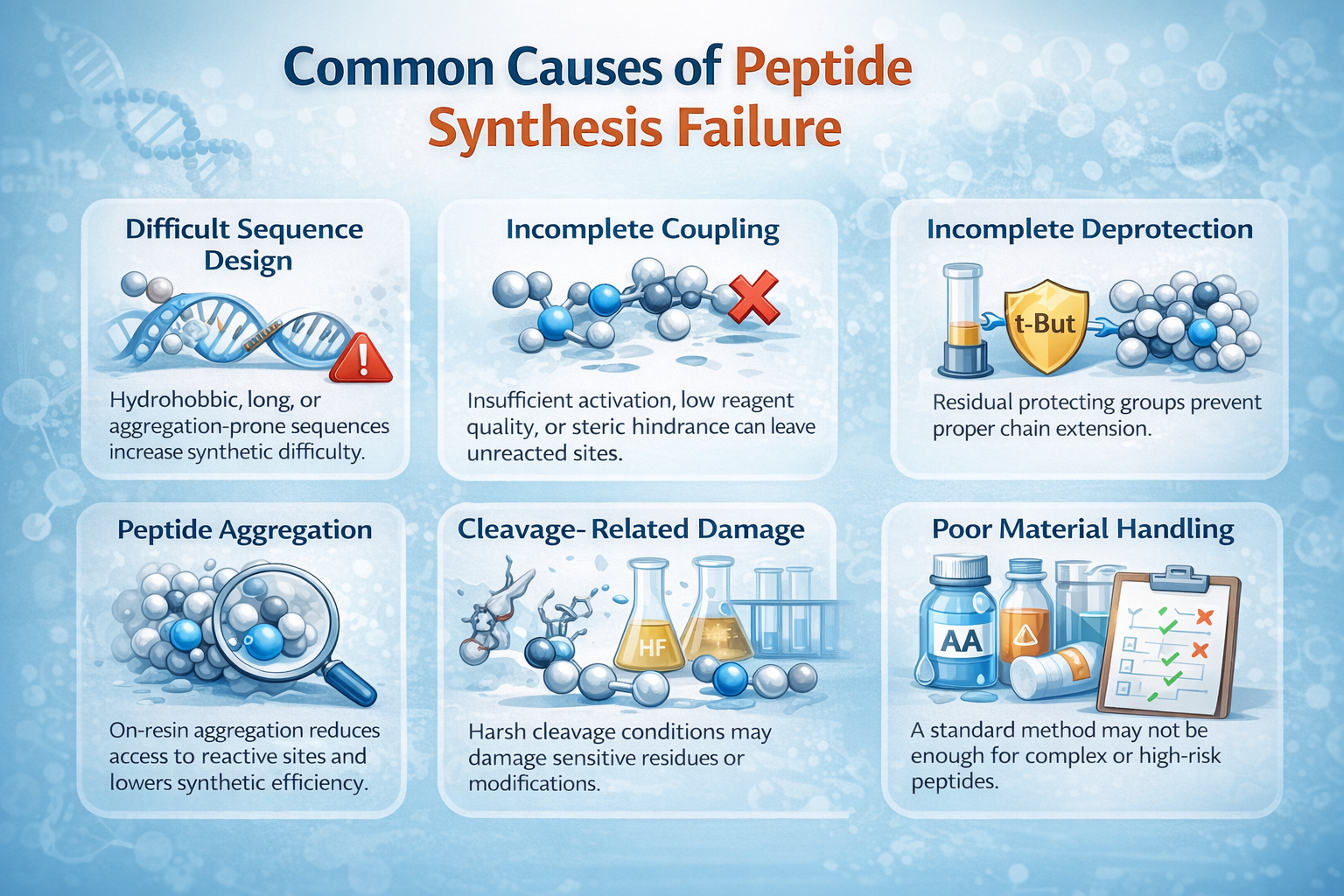
Here are some of the most frequent causes of peptide synthesis failure:
Difficult Sequence Design
Hydrophobic, long, or aggregation-prone sequences increase synthetic difficulty.
Incomplete Coupling
Insufficient activation, low reagent quality, or steric hindrance can leave unreacted sites.
Incomplete Deprotection
Residual protecting groups prevent proper chain extension.
Peptide Aggregation
On-resin aggregation reduces access to reactive sites and lowers synthesis efficiency.
Cleavage-Related Damage
Harsh cleavage conditions may damage sensitive residues or modifications.
Poor Material Handling
Wet solvents, degraded amino acids, or poorly stored reagents reduce reliability.
Inadequate Protocol Design
A standard method may not be enough for complex or high-risk peptides.
How to Prevent Peptide Synthesis Failure Next Time
The best troubleshooting strategy is prevention.
To reduce future risk:
- Review sequence difficulty before synthesis starts
- Choose a synthesis plan that fits the peptide, not just a standard template
- Use high-quality building blocks and fresh reagents
- Watch for aggregation-prone motifs early
- Build in double coupling where needed
- Use strong analytical checkpoints
- Partner with an experienced custom synthesis team for difficult peptides
This proactive approach improves reproducibility and lowers overall project cost.
Why Expert Support Matters for Difficult Synthetic Peptides
When internal troubleshooting reaches its limit, expert support can save both time and material. Complex synthetic peptides may require specialized design changes, resin selection, modification strategies, or purification planning that are not obvious at first glance.
That is where an experienced partner can add real value. LinkPeptide supports custom peptide workflows, building blocks, and analytical services that help researchers explore better options when a peptide route becomes challenging.
Final Thoughts
When peptide synthesis fails, the most useful response is not to stop. It is to troubleshoot methodically. Most synthesis problems can be traced to sequence difficulty, aggregation, incomplete coupling, weak deprotection, material quality, or purification challenges.
By reviewing the full workflow, improving Fmoc peptide synthesis steps, addressing peptide aggregation, and applying smart peptide synthesis protocol optimization, researchers can often turn poor results into a successful route.
FAQ
What causes peptide synthesis failure?
Peptide synthesis failure is commonly caused by incomplete coupling, incomplete deprotection, peptide aggregation, poor reagent quality, difficult sequences, or purification challenges.
How do you fix peptide synthesis failure?
You fix peptide synthesis failure by identifying the weak step, checking sequence difficulty, improving coupling and deprotection conditions, reducing aggregation, and optimizing the synthesis protocol.
Why does peptide aggregation happen during solid-phase peptide synthesis?
Peptide aggregation occurs when growing peptide chains interact with the resin, reducing access to reactive sites and making coupling and deprotection less efficient.
What is peptide synthesis protocol optimization?
Peptide synthesis protocol optimization involves adjusting reaction conditions, such as coupling time, reagent choice, resin loading, solvent system, and cleavage conditions, to improve yield and purity.
Why is Fmoc peptide synthesis sometimes difficult?
Fmoc peptide synthesis can become difficult when deprotection is incomplete, coupling efficiency drops, or the peptide sequence is long, hydrophobic, or prone to aggregation.