 LinkPeptide
Zilucoplan: A Breakthrough Complement Inhibitor for Generalized Myasthenia Gravis Treatment
Blog 270
Abstract
Zilucoplan is a subcutaneously administered macrocyclic peptide that functions as a potent inhibitor of complement component 5 (C5). Developed by UCB, it is approved for the treatment of generalized myasthenia gravis (gMG) in patients who are positive for acetylcholine receptor (AChR) antibodies and have not responded adequately to standard therapies. Zilucoplan exerts a dual mechanism of action, effectively suppressing complement-mediated inflammation and preventing the neuromuscular damage that leads to muscle weakness in gMG. Clinical studies have demonstrated its rapid onset of action and statistically significant improvements in disease severity metrics such as MG-ADL and QMG scores. With a favorable safety profile and the convenience of once-daily self-administration, Zilucoplan represents a major advancement in the management of refractory gMG. Its regulatory approval in multiple global regions signals a promising new era in targeted therapy for autoimmune neuromuscular disorders.
A Novel Treatment for Generalized Myasthenia Gravis
Zilucoplan is a subcutaneously administered macrocyclic peptide developed by UCB, designed to inhibit co[1]mplement component 5 (C5). It is used in the treatment of generalized myasthenia gravis (gMG), an autoimmune disorder that leads to muscle weakness. Zilucoplan works by preventing the cleavage of C5 into C5a and C5b, thereby blocking the activation of the terminal complement pathway, a key player in the inflammatory processes driving gMG .
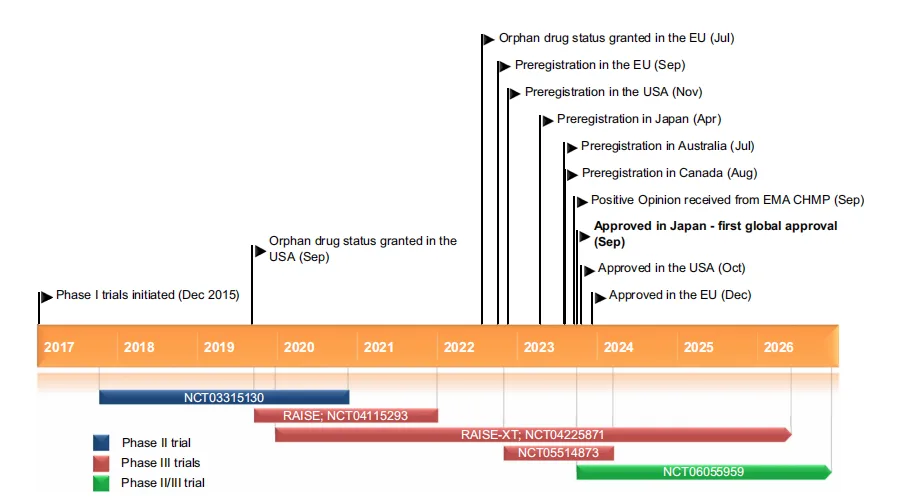
In September 2023, Zilucoplan received its first regulatory approval in Japan, followed by approvals in the USA and the European Union later that year [2]. It is indicated for adult patients with gMG who are positive for anti-acetylcholine receptor (AChR) antibodies and have not adequately responded to conventional treatments like steroids or immunosuppressants.
One of the primary advantages of Zilucoplan is its subcutaneous self-administration, offering a more convenient alternative to intravenous C5 inhibitors. This allows patients to manage their treatment independently, reducing the need for frequent hospital visits. Zilucoplan is also under regulatory review in other regions, including Australia and Canada, marking a significant advancement in gMG treatment.
Understanding Zilucoplan’s Mechanism of Action
Zilucoplan exerts its therapeutic effects through high-affinity binding to complement component C5, inhibiting its cleavage into C5a and C5b, both of which are critical for the activation of the terminal complement pathway. By blocking this pathway, Zilucoplan prevents the downstream inflammatory responses involved in generalized myasthenia gravis (gMG)[3]. Furthermore, Zilucoplan also inhibits the binding of C5b to C6, thereby using a dual mechanism to effectively block complement-mediated damage. This dual action has been demonstrated to provide rapid and sustained complement inhibition in clinical trials, showing over 97% inhibition within the first week of treatment and maintaining this effect throughout the 12-week study period.
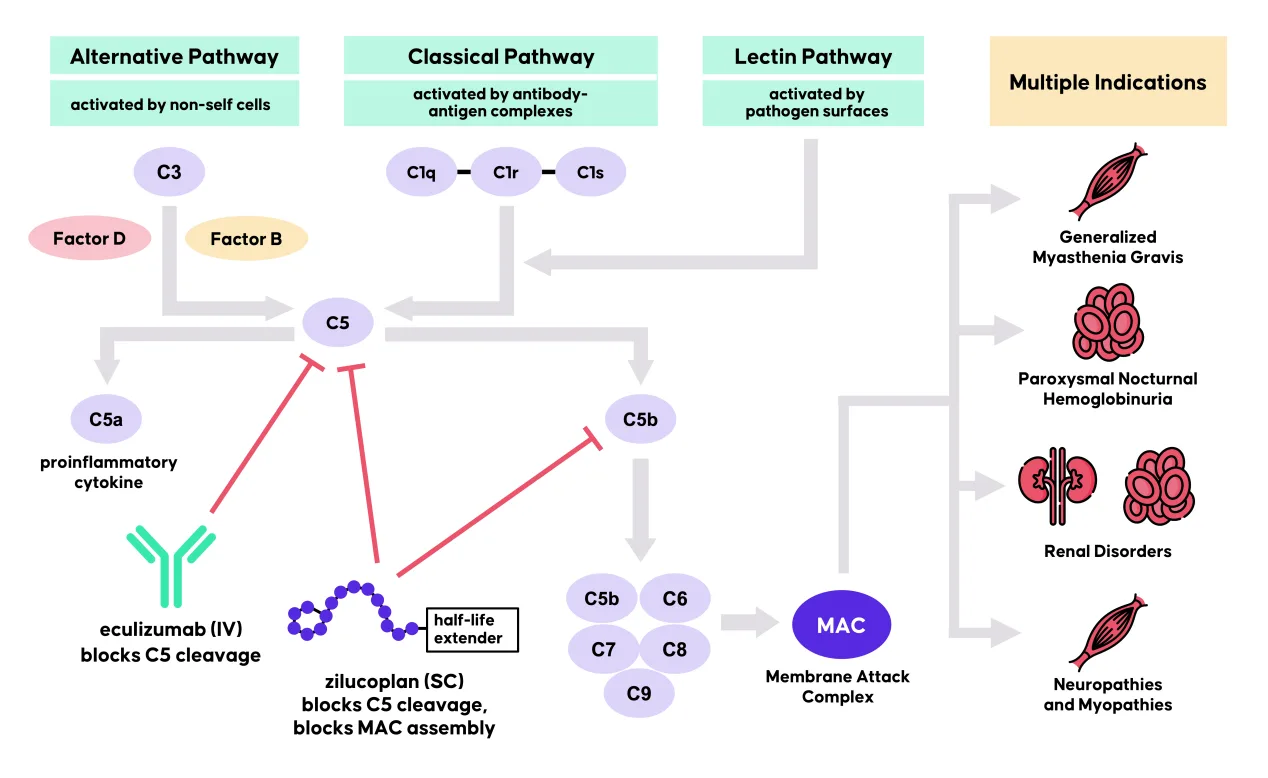
Pharmacokinetic studies have shown that Zilucoplan is efficiently absorbed following subcutaneous administration. Peak plasma concentrations are typically reached between 3 to 6 hours post-dose, with the drug exhibiting a mean terminal half-life of approximately 172 hours[4]. Zilucoplan’s metabolism primarily involves catabolic pathways, breaking down into small peptides and amino acids. Two main metabolites are observed in the plasma, though they are present at low concentrations, contributing minimally to the overall pharmacological effect. The drug achieves steady-state trough concentrations within four weeks of once-daily dosing, making it suitable for chronic management of gMG.
Insights from Key Therapeutic Trials
Zilucoplan has undergone extensive clinical evaluation, demonstrating significant efficacy in the treatment of generalized myasthenia gravis (gMG). The pivotal phase III RAISE trial was a randomized, double-blind, placebo-controlled study conducted across multiple countries. This trial included adult patients with acetylcholine receptor (AChR)-positive gMG, who exhibited inadequate responses to standard treatments such as steroids or immunosuppressants. Zilucoplan was administered subcutaneously once daily at a dose of 0.3 mg/kg. The primary endpoint was the change in Myasthenia Gravis Activities of Daily Living (MG-ADL) score, with Zilucoplan showing a significantly greater improvement compared to placebo over 12 weeks[5].
Patients receiving Zilucoplan experienced a rapid onset of action, with clinically meaningful reductions in MG-ADL scores observed as early as week one. By week 12, the least-squares mean (LSM) change in MG-ADL score was −4.39 for the Zilucoplan group, compared to −2.30 in the placebo group. Additionally, Zilucoplan demonstrated significant improvements in secondary endpoints such as the Quantitative Myasthenia Gravis (QMG) score and Myasthenia Gravis Composite (MGC) score, further supporting its efficacy[6].
Long-term benefits were confirmed in the RAISE-XT extension trial, where patients continued to show sustained improvement in MG-specific outcome measures for up to 60 weeks. These findings underscore Zilucoplan’s potential as a highly effective treatment option for patients with refractory gMG.
Evaluating Zilucoplan’s Risk Profile
Zilucoplan has generally been well tolerated in clinical trials, with a safety profile consistent across studies. In the 12-week RAISE phase III trial, the most common treatment-emergent adverse events (TEAEs) reported by patients included injection-site reactions such as bruising and pain, headaches, and diarrhea. The incidence of TEAEs was similar between the Zilucoplan and placebo groups, with 77% of patients in the Zilucoplan group experiencing any-grade TEAEs, compared to 70% in the placebo group. Serious TEAEs, such as worsening myasthenia gravis, were also observed, but their occurrence was comparable between treatment and placebo arms.
A notable safety concern with Zilucoplan, as with other complement C5 inhibitors, is the elevated risk of serious infections, particularly meningococcal infections. To mitigate this risk, patients must receive vaccination against Neisseria meningitidis prior to starting treatment. In the RAISE trial, no cases of meningococcal infections were reported, although infection rates were slightly higher in the Zilucoplan group compared to placebo (27% vs. 18%). Most infections were mild, involving upper respiratory tract infections, with no new major safety issues observed in long-term extension studies.
Overall, Zilucoplan has shown a favorable safety profile, with manageable adverse effects. With continued long-term monitoring in extension studies, no significant additional safety concerns have arisen, supporting the drug’s suitability for long-term use in patients with generalized myasthenia gravis .
Zilucoplan’s Impact on the Future of Myasthenia Gravis Therapy
Zilucoplan represents a notable advancement in the management of generalized myasthenia gravis (gMG), providing an innovative therapeutic option for patients who have demonstrated insufficient response to conventional treatments. As a subcutaneously administered complement C5 inhibitor, Zilucoplan operates through a dual mechanism, effectively inhibiting the terminal complement pathway and mitigating the inflammatory processes central to the pathophysiology of gMG. Clinical evidence, including data from the pivotal phase III RAISE trial, has demonstrated its rapid onset of action and significant improvements in critical efficacy measures, such as the Myasthenia Gravis Activities of Daily Living (MG-ADL) and Quantitative Myasthenia Gravis (QMG) scores.
Beyond its efficacy, Zilucoplan exhibits a favorable safety profile, with manageable adverse events and no major safety concerns identified in long-term follow-up studies. The ability for patients to self-administer Zilucoplan subcutaneously offers a substantial advantage, granting patients greater autonomy and reducing the burden of frequent hospital visits.
In summary, Zilucoplan holds the potential to significantly alter the therapeutic landscape for gMG, especially in refractory cases. Its robust clinical performance, combined with expanding regulatory approvals across multiple regions, underscores its increasing importance in the treatment of this debilitating autoimmune disorder. Ongoing long-term studies will continue to clarify its role in chronic disease management, solidifying its value as a critical therapeutic option globally.
Frequently Asked Questions (FAQ)
What is Zilucoplan?
Zilucoplan is a subcutaneously administered macrocyclic peptide that inhibits complement component 5 (C5). It is used to treat generalized myasthenia gravis (gMG) in patients who are positive for acetylcholine receptor (AChR) antibodies and unresponsive to conventional therapies.
How does Zilucoplan work?
Zilucoplan blocks the cleavage of complement component C5, preventing the formation of the membrane attack complex (MAC). This action reduces inflammation and protects the neuromuscular junction from immune-mediated damage, helping alleviate muscle weakness in gMG.
What is the mechanism of action of Zilucoplan?
Zilucoplan has a dual mechanism of action:
- It inhibits C5 activation in the complement cascade.
- It reduces downstream immune responses that cause tissue damage in AChR antibody-positive gMG.
Who can benefit from Zilucoplan?
Patients with generalized myasthenia gravis who test positive for AChR antibodies and do not respond to standard immunosuppressive therapies may benefit from Zilucoplan treatment.
Is Zilucoplan self-administered?
Yes. Zilucoplan is designed for once-daily subcutaneous self-injection, offering convenience for long-term management outside clinical settings.
What clinical outcomes has Zilucoplan improved?
Clinical trials showed improvements in:
- MG-ADL scores (Myasthenia Gravis Activities of Daily Living)
- QMG scores (Quantitative Myasthenia Gravis)
These reflect reduced disease burden and improved patient functionality.
Is Zilucoplan approved by the FDA?
Yes, Zilucoplan has been approved in multiple regions, including the FDA (U.S.), for the treatment of AChR-positive gMG.
Reference
- Shirley, M. (2024). Zilucoplan: first approval. Drugs, 84(1), 99-104.
- Howard, J. F., Bresch, S., Genge, A., Hewamadduma, C., Hinton, J., Hussain, Y., … & Rivner, M. (2023). Safety and efficacy of zilucoplan in patients with generalised myasthenia gravis (RAISE): a randomised, double-blind, placebo-controlled, phase 3 study. The Lancet Neurology, 22(5), 395-406.
- Tang, G. Q., Tang, Y., Dhamnaskar, K., Hoarty, M. D., Vyasamneni, R., Vadysirisack, D. D., … & Ricardo, A. (2023). Zilucoplan, a macrocyclic peptide inhibitor of human complement component 5, uses a dual mode of action to prevent terminal complement pathway activation. Frontiers in Immunology, 14, 1213920.
- Howard, J. F., Nowak, R. J., Wolfe, G. I., Freimer, M. L., Vu, T. H., Hinton, J. L., … & Zilucoplan MG Study Group. (2020). Clinical effects of the self-administered subcutaneous complement inhibitor zilucoplan in patients with moderate to severe generalized myasthenia gravis: results of a phase 2 randomized, double-blind, placebo-controlled, multicenter clinical trial. JAMA neurology, 77(5), 582-592.
- Genge, A., Leite, M. I., Bresch, S., Freimer, M., Hewamadduma, C., Hussain, Y., … & Howard, J. F. (2023). Long-term safety, efficacy & self-injection satisfaction with zilucoplan in myasthenia gravis: RAISE-XT interim analysis. Journal of the Neurological Sciences, 455.
- Genge, A., Hussain, Y., Kaminski, H. J., Leite, M. I., Mantegazza, R., Utsugisawa, K., … & Howard, J. F. (2023). 2603 Safety and tolerability of zilucoplan in RAISE-XT: a multicenter, open-label extension study in patients with myasthenia gravis.