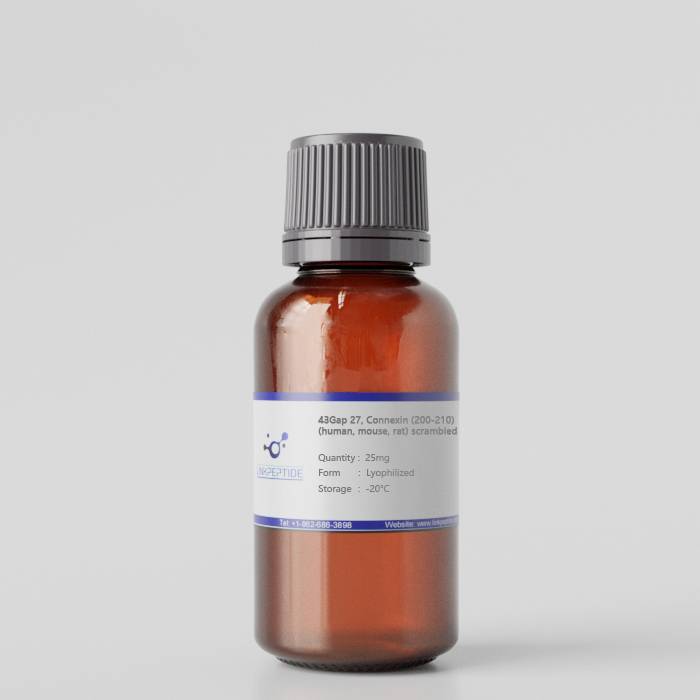
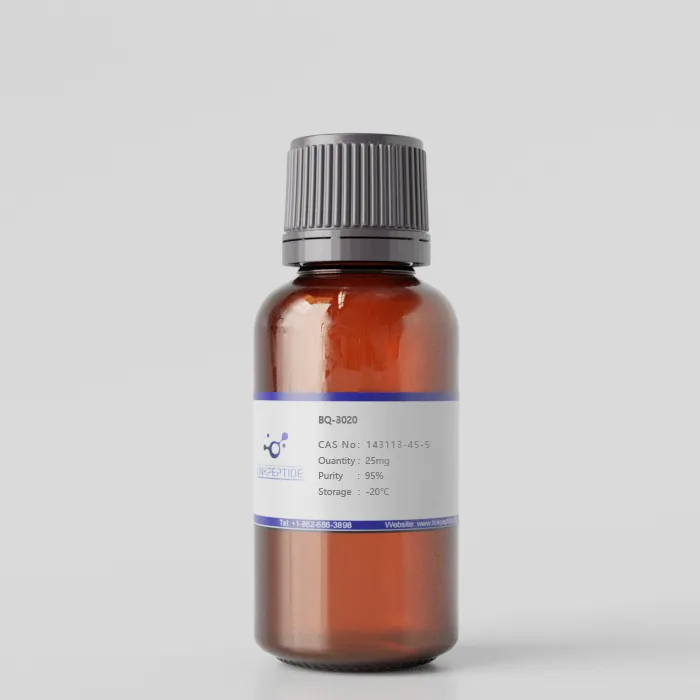
Product Name: 43Gap 27, Connexin (200-210) (human, mouse, rat) scrambled
Sequence One Letter Code: REKIITSFIPT
Sequence Three Letter Code: H-Arg-Glu-Lys-Ile-Ile-Thr-Ser-Phe-Ile-Pro-Thr-OH
Chemical Formula:C60H101N15O17
Molecular Weight: 1304.6
Purity: 95%
Form: Lyophilized
Storage Conditions: - 20 °C
Research Area: Peptide Series
Source / Species: Human, mouse, rat
Conjugation: Unconjugated
Code Nacres: NA.26
Application: Scrambled Gap 27 Peptide is a control peptide derived from the connexin Gap 27 region (amino acids 200–210) with a randomized sequence that lacks biological activity. Connexins are key components of gap junctions that mediate intercellular communication. Unlike the native Gap 27 peptide, this scrambled version does not modulate connexin function, making it an essential negative control in gap junction studies. It is widely used to distinguish sequence-specific effects from nonspecific peptide interactions in experiments investigating cell–cell communication, signaling pathways, and connexin-mediated processes. This peptide supports accurate interpretation of functional assays involving gap junction modulation and intercellular signaling mechanisms.
Current Research: Gap junctions are specialized intercellular channels that enable direct communication between adjacent cells, allowing the passage of ions, metabolites, and signaling molecules. These channels are formed by connexin proteins, which play essential roles in coordinating cellular activity across tissues. To study connexin function and gap junction–mediated signaling, researchers frequently use modulatory peptides such as Gap 27. Equally important in these studies is the use of appropriate controls, such as the Scrambled Gap 27 Peptide, which ensures experimental specificity and reliability. Connexins and Gap Junction Communication Connexins assemble into hexameric structures known as connexons, which dock with connexons on neighboring cells to form functional gap junction channels. These channels facilitate direct cytoplasmic exchange between cells and are critical for processes such as: Electrical coupling in cardiac and neuronal tissues Metabolic coordination between cells Regulation of cell growth, differentiation, and apoptosis Propagation of intracellular signaling events The activity and regulation of connexins are therefore central to maintaining tissue homeostasis and coordinated cellular responses. The Role of Gap 27 Peptide The native Gap 27 peptide, derived from amino acids 200–210 of connexin proteins (commonly connexin43), is widely used to modulate gap junction communication. It can inhibit connexin channel function, making it a valuable tool for studying how gap junctions influence cellular signaling and physiological processes. However, to confirm that observed effects are due to specific sequence-dependent interactions, researchers must include a control peptide that mimics the physical properties of Gap 27 without retaining its biological activity. Design of Scrambled Gap 27 Peptide The Scrambled Gap 27 Peptide is constructed using the same amino acid composition as the native Gap 27 sequence but arranged in a randomized order. This design preserves general physicochemical characteristics—such as peptide length, charge, and molecular weight—while eliminating the specific sequence required for interaction with connexins. As a result, the scrambled peptide: Does not bind to or modulate connexin channels Does not inhibit gap junction communication Lacks biological activity associated with the native peptide This makes it an ideal negative control for experiments involving Gap 27 or related connexin-targeting peptides. Importance in Experimental Validation In studies of gap junction function, distinguishing between specific and nonspecific effects is essential. Peptides can sometimes produce unintended outcomes due to factors such as membrane interaction, peptide uptake, or general cellular stress. By including Scrambled Gap 27 Peptide in experimental designs, researchers can: Confirm that observed effects are sequence-specific Rule out nonspecific peptide interactions Validate the functional role of connexin-targeting peptides Improve reproducibility and reliability of experimental results This control is particularly important in assays measuring cell communication, signaling responses, or physiological changes. Applications in Gap Junction and Cell Signaling Research Scrambled Gap 27 Peptide is widely used across multiple research areas involving connexin biology and intercellular communication. Typical applications include: Gap junction functional assays to assess intercellular communication Comparative studies with active Gap 27 peptide Cell signaling experiments involving connexin-mediated pathways Studies of tissue coordination and cellular coupling Evaluation of peptide-based modulation of connexin activity By serving as a baseline control, the scrambled peptide enables accurate interpretation of results in these experimental systems. Supporting Studies of Intercellular Communication Gap junctions are essential for coordinating responses across cells within tissues, and their dysfunction is associated with a range of diseases, including cardiac arrhythmias, cancer, and neurological disorders. Tools that allow precise investigation of connexin function are therefore critical for advancing our understanding of these conditions. The Scrambled Gap 27 Peptide supports this effort by ensuring that experimental conclusions about gap junction modulation are based on true biological effects rather than artifacts. A Reliable Control for Connexin Research The Scrambled Gap 27 Peptide is an indispensable reagent in studies of gap junctions and connexin-mediated signaling. By maintaining similar structural properties to the active Gap 27 peptide while lacking functional activity, it provides a robust negative control for validating sequence-specific interactions. Its use enhances the rigor of experiments investigating cell–cell communication, signal propagation, and connexin function, making it a foundational tool for accurate and reproducible research in cellular and molecular biology.
Get a Quote
 LinkPeptide