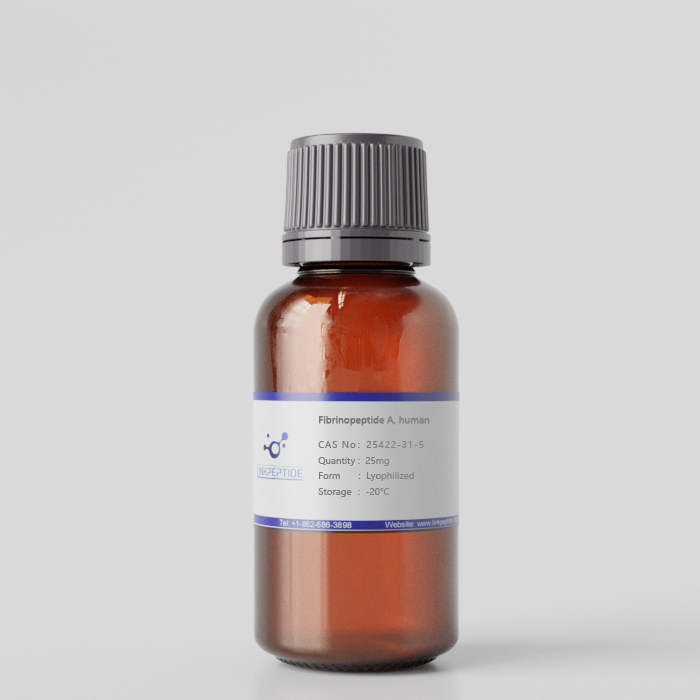
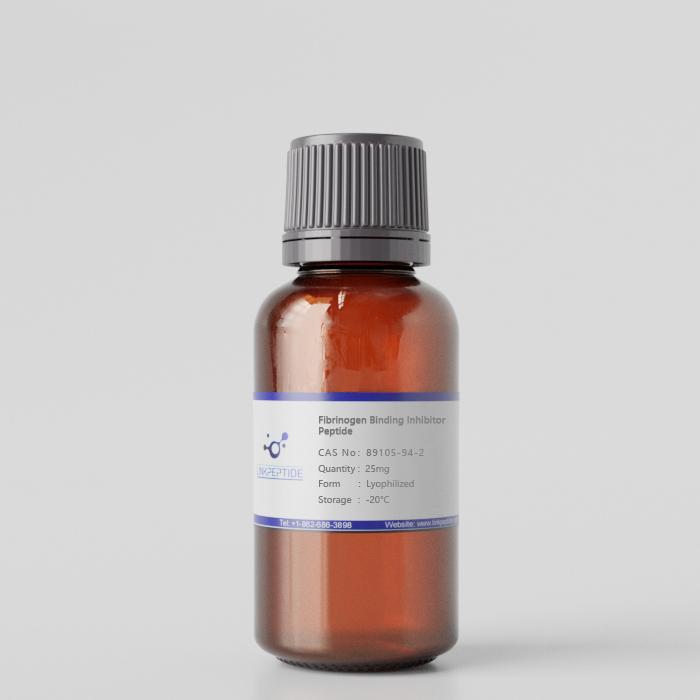
Product Name: Fibrinopeptide A, human
Sequence One Letter Code: ADSGEGDFLAEGGGVR
Sequence Three Letter Code: H-Ala-Asp-Ser-Gly-Glu-Gly-Asp-Phe-Leu-Ala-Glu-Gly-Gly-Gly-Val-Arg-OH
Cas No: 25422-31-5
Chemical Formula:C63H97N19O26
Molecular Weight: 1536.7
Purity: 95%
Form: Lyophilized
Storage Conditions: - 20 °C
Research Area: Cardiovascular Disease Research
SMILES: C[C@@H](C(=O)N[C@@H](CC(=O)O)C(=O)N[C@@H](CO)C(=O)NCC(=O)N[C@@H](CCC(=O)O)C(=O)NCC(=O)N[C@@H](CC(=O)O)C(=O)N[C@@H](CC1=CC=CC=C1)C(=O)NC(CC(C)C)C(=O)N[C@@H](C)C(=O)N[C@@H](CCC(=O)O)C(=O)NCC(=O)NCC(=O)NCC(=O)N[C@@H](C(C)C)C(=O)N[C@@H](CCCN=C(N)N)C(=O)O)N
IUPAC: (4S)-4-[[2-[[(2S)-2-[[(2S)-2-[[(2S)-2-aminopropanoyl]amino]-3-carboxypropanoyl]amino]-3-hydroxypropanoyl]amino]acetyl]amino]-5-[[2-[[(2S)-3-carboxy-1-[[(2S)-1-[[1-[[(2S)-1-[[(2S)-4-carboxy-1-[[2-[[2-[[2-[[(2S)-1-[[(1S)-1-carboxy-4-(diaminomethylideneamino)butyl]amino]-3-methyl-1-oxobutan-2-yl]amino]-2-oxoethyl]amino]-2-oxoethyl]amino]-2-oxoethyl]amino]-1-oxobutan-2-yl]amino]-1-oxopropan-2-yl]amino]-4-methyl-1-oxopentan-2-yl]amino]-1-oxo-3-phenylpropan-2-yl]amino]-1-oxopropan-2-yl]amino]-2-oxoethyl]amino]-5-oxopentanoic acid
INCHIKEY: JWICNZAGYSIBAR-LEEGLKINSA-N
INCHI:
InChI=1S/C63H97N19O26/c1-29(2)19-37(57(102)73-32(6)53(98)76-35(15-17-48(91)92)55(100)70-24-43(85)68-23-42(84)69-25-46(88)82-51(30(3)4)61(106)77-36(62(107)108)13-10-18-67-63(65)66)79-58(103)38(20-33-11-8-7-9-12-33)80-59(104)39(21-49(93)94)75-45(87)27-71-54(99)34(14-16-47(89)90)74-44(86)26-72-56(101)41(28-83)81-60(105)40(22-50(95)96)78-52(97)31(5)64/h7-9,11-12,29-32,34-41,51,83H,10,13-28,64H2,1-6H3,(H,68,85)(H,69,84)(H,70,100)(H,71,99)(H,72,101)(H,73,102)(H,74,86)(H,75,87)(H,76,98)(H,77,106)(H,78,97)(H,79,103)(H,80,104)(H,81,105)(H,82,88)(H,89,90)(H,91,92)(H,93,94)(H,95,96)(H,107,108)(H4,65,66,67)/t31-,32-,34-,35-,36-,37?,38-,39-,40-,41-,51-/m0/s1
Source / Species: human
Conjugation: Unconjugated
Code Nacres: NA.26
Application: Fibrinopeptide A (FPA), human is a 16–residue peptide released from the N-terminal region of the fibrinogen Aα-chain during thrombin-mediated cleavage in early coagulation. Removal of FPA exposes polymerization sites within fibrinogen, enabling fibrin monomer formation and clot assembly. Because FPA is generated rapidly and cleared quickly from circulation, its levels closely reflect acute thrombin activity. Synthetic FPA is widely used in coagulation research as a reference standard and biomarker tool in studies of thrombosis, disseminated intravascular coagulation, and acute coronary syndromes. It supports investigations of thrombin kinetics, clot formation dynamics, and cardiovascular pathophysiology.
Current Research: Fibrinopeptide A (FPA), human is a 16–amino acid peptide released from the N-terminal region of the fibrinogen Aα-chain during thrombin-mediated cleavage in the early phase of coagulation. The liberation of FPA represents one of the first measurable biochemical events following thrombin activation and is essential for the conversion of soluble fibrinogen into polymerizing fibrin monomers. Because FPA generation occurs rapidly and its plasma half-life is short, circulating levels serve as a sensitive indicator of acute thrombin activity. Role in Coagulation Cascade During hemostasis, thrombin cleaves fibrinogen at specific arginine–glycine bonds, first releasing fibrinopeptide A from the Aα-chain. This cleavage exposes “knob A” polymerization sites that interact with complementary binding pockets (“hole a”) in adjacent fibrin molecules, initiating fibrin monomer assembly. Subsequent cleavage of fibrinopeptide B further stabilizes fibrin polymerization and clot maturation. The removal of FPA is therefore a critical regulatory step in clot formation, directly linking thrombin enzymatic activity to structural fibrin network development. Biochemical and Functional Significance FPA release reflects real-time thrombin generation in vivo. Because thrombin is central to both coagulation and platelet activation, quantification of FPA provides insight into early hemostatic activation prior to overt clot formation. Elevated FPA levels have been observed in conditions characterized by enhanced thrombin generation, including acute thrombosis, disseminated intravascular coagulation (DIC), unstable angina, and myocardial infarction. Synthetic FPA provides a defined standard for assay calibration and analytical validation in research settings. Applications in Thrombosis and Cardiovascular Research Fibrinopeptide A (FPA), human is widely applied in: Thrombin kinetics studies Measurement of fibrinogen cleavage rates Development and validation of immunoassays for thrombin activity Investigation of clot formation dynamics Experimental models of thrombosis and coagulation disorders Because FPA generation occurs upstream of fibrin cross-linking, it allows researchers to isolate early proteolytic events in the coagulation cascade. Biomarker Utility Due to its rapid appearance and clearance in circulation, FPA serves as a dynamic biomarker of thrombin activity. Monitoring FPA levels supports investigation of: Hypercoagulable states Acute coronary syndromes Sepsis-associated coagulopathy Anticoagulant therapy effects Synthetic FPA is frequently used as a reference peptide in assay development for detecting thrombin-mediated fibrinogen cleavage in plasma samples. Mechanistic Studies of Clot Formation In addition to biomarker applications, FPA is employed in mechanistic studies examining fibrin polymerization and clot architecture. By correlating thrombin concentration with FPA release kinetics, researchers can model the relationship between enzymatic activation and structural clot assembly. This approach aids in understanding how variations in thrombin generation influence clot density, stability, and susceptibility to fibrinolysis. Experimental Advantages Defined 16–residue sequence corresponding to native human FPA Direct product of thrombin cleavage Sensitive indicator of early coagulation activation Suitable as a calibration standard in analytical assays Supports kinetic and mechanistic studies of fibrin formation Research Significance Fibrinopeptide A (FPA), human is a critical molecular marker linking thrombin activity to fibrin formation. By enabling precise measurement of early coagulation events, it supports investigations into thrombosis, hemostatic regulation, and cardiovascular pathology. Its defined structure and physiological relevance make it an essential reagent in coagulation research and translational studies of thrombin-driven disease processes.
Get a Quote
 LinkPeptide