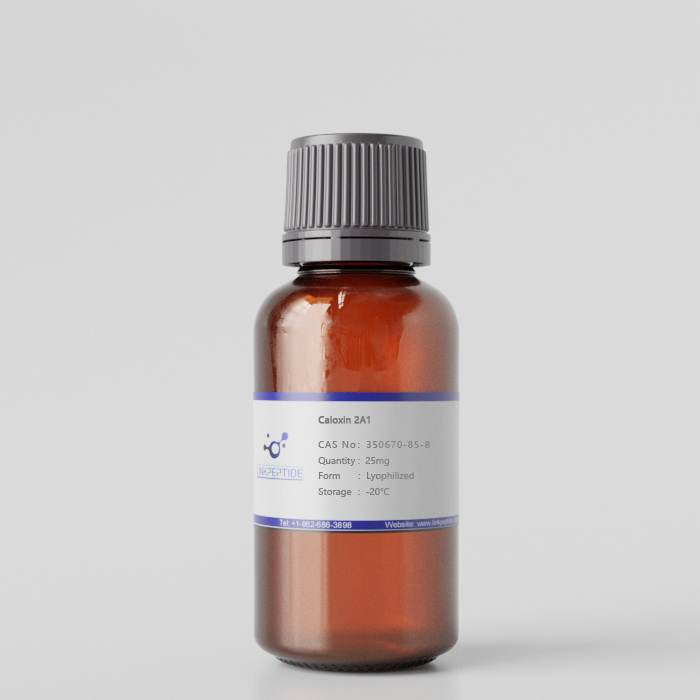
Product Name: Caloxin 2A1
Sequence One Letter Code: VSNSNWPSFPSSGGG
Sequence Three Letter Code: H-Val-Ser-Asn-Ser-Asn-Trp-Pro-Ser-Phe-Pro-Ser-Ser-Gly-Gly-Gly-OH
Cas No: 350670-85-8
Chemical Formula:C64H91N19O22
Molecular Weight: 1479.6
Purity: 95%
Form: Lyophilized
Storage Conditions: - 20 °C
Research Area: Ion Channel Modulation
SMILES: CC(C)[C@@H](C(=O)N[C@@H](CO)C(=O)N[C@@H](CC(=O)N)C(=O)N[C@@H](CO)C(=O)N[C@@H](CC(=O)N)C(=O)N[C@@H](CC1=CNC2=CC=CC=C21)C(=O)N3CCC[C@H]3C(=O)N[C@@H](CO)C(=O)N[C@@H](CC4=CC=CC=C4)C(=O)N5CCC[C@H]5C(=O)N[C@@H](CO)C(=O)N[C@@H](CO)C(=O)NCC(=O)NCC(=O)NCC(=O)N)N.C(=O)(C(F)(F)F)O
IUPAC: (2S)-2-[[(2S)-2-[[(2S)-4-amino-2-[[(2S)-2-[[(2S)-2-amino-3-methylbutanoyl]amino]-3-hydroxypropanoyl]amino]-4-oxobutanoyl]amino]-3-hydroxypropanoyl]amino]-N-[(2S)-1-[(2S)-2-[[(2S)-1-[[(2S)-1-[(2S)-2-[[(2S)-1-[[(2S)-1-[[2-[[2-[(2-amino-2-oxoethyl)amino]-2-oxoethyl]amino]-2-oxoethyl]amino]-3-hydroxy-1-oxopropan-2-yl]amino]-3-hydroxy-1-oxopropan-2-yl]carbamoyl]pyrrolidin-1-yl]-1-oxo-3-phenylpropan-2-yl]amino]-3-hydroxy-1-oxopropan-2-yl]carbamoyl]pyrrolidin-1-yl]-3-(1H-indol-3-yl)-1-oxopropan-2-yl]butanediamide;2,2,2-trifluoroacetic acid
INCHIKEY: WWVYZHSQQMQNOR-HPUWVREWSA-N
INCHI:
InChI=1S/C64H91N19O22.C2HF3O2/c1-31(2)52(68)62(103)81-44(30-88)57(98)74-37(21-48(66)90)55(96)78-41(27-85)56(97)73-36(20-47(65)89)54(95)76-39(19-33-22-69-35-13-7-6-12-34(33)35)64(105)83-17-9-15-46(83)61(102)79-42(28-86)58(99)75-38(18-32-10-4-3-5-11-32)63(104)82-16-8-14-45(82)60(101)80-43(29-87)59(100)77-40(26-84)53(94)72-25-51(93)71-24-50(92)70-23-49(67)91;3-2(4,5)1(6)7/h3-7,10-13,22,31,36-46,52,69,84-88H,8-9,14-21,23-30,68H2,1-2H3,(H2,65,89)(H2,66,90)(H2,67,91)(H,70,92)(H,71,93)(H,72,94)(H,73,97)(H,74,98)(H,75,99)(H,76,95)(H,77,100)(H,78,96)(H,79,102)(H,80,101)(H,81,103);(H,6,7)/t36-,37-,38-,39-,40-,41-,42-,43-,44-,45-,46-,52-;/m0./s1
Conjugation: Unconjugated
Code Nacres: NA.26
Application: Caloxin 2A1 is a synthetic peptide that functions as a selective extracellular inhibitor of plasma membrane Ca²⁺-ATPase (PMCA). By binding to an external domain of the calcium pump, it inhibits Ca²⁺-Mg²⁺-ATPase activity and modulates calcium efflux without requiring cell permeabilization. This property distinguishes it from intracellular PMCA inhibitors and allows controlled extracellular manipulation of calcium homeostasis. Caloxin 2A1 has been characterized in human erythrocyte membrane models and is widely used in studies of calcium signaling, membrane transport regulation, and ion homeostasis. The peptide supports research into PMCA function, intracellular calcium dynamics, and physiological processes dependent on precise calcium regulation.
Current Research: Caloxin 2A1 is a synthetic peptide inhibitor developed to selectively target the plasma membrane Ca²⁺-ATPase (PMCA), a P-type ATPase responsible for extruding cytosolic Ca²⁺ to maintain low resting intracellular calcium concentrations. PMCA plays a central role in calcium homeostasis, particularly in excitable cells, erythrocytes, smooth muscle, and epithelial tissues where precise Ca²⁺ regulation governs contraction, secretion, signal transduction, and metabolic control. Unlike many pharmacologic modulators of calcium transport that act intracellularly or require membrane permeabilization, Caloxin 2A1 binds to an extracellular loop domain of PMCA. This extracellular accessibility enables inhibition of Ca²⁺-Mg²⁺-ATPase activity without disrupting membrane integrity. As a result, researchers can manipulate calcium efflux selectively from the outside of intact cells, offering a controlled approach to studying PMCA-dependent calcium clearance. Mechanistically, PMCA couples ATP hydrolysis to Ca²⁺ extrusion, thereby restoring basal cytosolic Ca²⁺ levels following signaling events. Caloxin 2A1 interferes with this process by reducing pump activity, leading to prolonged intracellular Ca²⁺ elevations after stimulation. This allows investigators to isolate the contribution of PMCA-mediated extrusion from other calcium-handling systems, such as the sarco/endoplasmic reticulum Ca²⁺-ATPase (SERCA), sodium–calcium exchangers (NCX), and mitochondrial uptake pathways. Initial characterization of Caloxin 2A1 was performed using human erythrocyte membrane preparations, where PMCA is the primary calcium extrusion mechanism. In these models, the peptide demonstrated selective inhibition of Ca²⁺-ATPase activity while preserving membrane integrity and avoiding nonspecific ion transport disruption. This specificity established Caloxin 2A1 as a valuable biochemical probe for PMCA function. In contemporary calcium signaling research, Caloxin 2A1 is applied in live-cell calcium imaging experiments using fluorescent Ca²⁺ indicators such as Fura-2, Fluo-4, or genetically encoded calcium sensors. By inhibiting PMCA, researchers can examine how altered calcium clearance kinetics influence oscillatory signaling, frequency encoding, and downstream activation of calcium-dependent effectors including calmodulin, CaMKII, calcineurin, and PKC. These pathways regulate gene transcription, secretion, muscle contraction, and cell proliferation. The peptide is also used to investigate tissue-specific PMCA isoform contributions. PMCA exists as multiple isoforms (PMCA1–4) with differential expression patterns and regulatory properties. Although Caloxin 2A1 primarily acts on extracellular domains shared among PMCA isoforms, it provides a means to assess overall PMCA involvement in physiological processes such as vascular tone regulation, erythrocyte deformability, and neuronal excitability. In cardiovascular and smooth muscle research, inhibition of PMCA with Caloxin 2A1 helps clarify how calcium extrusion influences contraction–relaxation dynamics. In neuronal systems, modulation of PMCA activity impacts synaptic calcium transients and plasticity-related signaling. Because the peptide acts extracellularly, it permits reversible and temporally controlled modulation in intact preparations. Caloxin 2A1 also supports mechanistic studies of membrane transport regulation. Its selective extracellular binding enables mapping of functional domains within PMCA’s external loops and investigation of conformational states during the ATPase cycle. These studies contribute to understanding how extracellular structural elements influence pump activity and ion transport efficiency. Overall, Caloxin 2A1 is a selective extracellular inhibitor of plasma membrane Ca²⁺-ATPase that enables targeted modulation of calcium efflux in intact cells. By providing precise control over PMCA activity without intracellular disruption, it serves as a valuable tool for studying calcium homeostasis, membrane transport mechanisms, and physiological processes dependent on tightly regulated intracellular Ca²⁺ dynamics.
Get a Quote
 LinkPeptide

![[Des-Arg10]-HOE I40, B1 Bradykinin Receptor Ant...](https://www.linkpeptide.com/wp-content/uploads/2026/05/Des-Arg10-HOE-I40-B1-Bradykinin-Receptor-Antagonist.jpg "[Des-Arg10]-HOE I40, B1 Bradykinin Receptor Ant...")