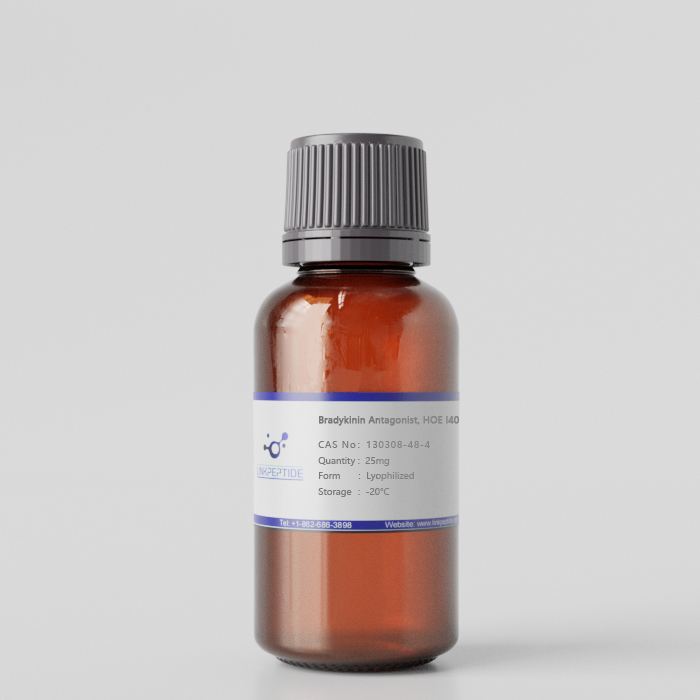
Product Name: Bradykinin Antagonist, HOE I40
Sequence One Letter Code: rRP-(Hyp)-G-(Thi)-S-(D-Tic)-(Oic)-R
Sequence Three Letter Code: H-D-Arg-Arg-Pro-Hyp-Gly-Thi-Ser-D-Tic-Oic-Arg-OH
Cas No: 130308-48-4
Chemical Formula:C59H89N19O13S
Molecular Weight: 1304.5
Purity: 95%
Form: Lyophilized
Storage Conditions: - 20 °C
Research Area: Cardiovascular Disease Research
SMILES: C1CC[C@H]2[C@@H](C1)C[C@H](N2C(=O)[C@H]3CC4=CC=CC=C4CN3C(=O)[C@H](CO)NC(=O)[C@H](CC5=CC=CS5)NC(=O)CNC(=O)[C@@H]6C[C@H](CN6C(=O)[C@@H]7CCCN7C(=O)[C@H](CCCN=C(N)N)NC(=O)[C@@H](CCCN=C(N)N)N)O)C(=O)N[C@@H](CCCN=C(N)N)C(=O)O
IUPAC: (2S)-2-[[(2S,3aS,7aS)-1-[(3R)-2-[(2S)-2-[[(2S)-2-[[2-[[(2S,4R)-1-[(2S)-1-[(2S)-2-[[(2R)-2-amino-5-(diaminomethylideneamino)pentanoyl]amino]-5-(diaminomethylideneamino)pentanoyl]pyrrolidine-2-carbonyl]-4-hydroxypyrrolidine-2-carbonyl]amino]acetyl]amino]-3-thiophen-2-ylpropanoyl]amino]-3-hydroxypropanoyl]-3,4-dihydro-1H-isoquinoline-3-carbonyl]-2,3,3a,4,5,6,7,7a-octahydroindole-2-carbonyl]amino]-5-(diaminomethylideneamino)pentanoic acid
INCHIKEY: QURWXBZNHXJZBE-SKXRKSCCSA-N
INCHI:
InChI=1S/C59H89N19O13S/c60-37(14-5-19-67-57(61)62)48(82)72-38(15-6-20-68-58(63)64)52(86)75-22-8-18-43(75)54(88)77-30-35(80)26-44(77)50(84)70-28-47(81)71-40(27-36-13-9-23-92-36)49(83)74-41(31-79)53(87)76-29-34-12-2-1-10-32(34)24-46(76)55(89)78-42-17-4-3-11-33(42)25-45(78)51(85)73-39(56(90)91)16-7-21-69-59(65)66/h1-2,9-10,12-13,23,33,35,37-46,79-80H,3-8,11,14-22,24-31,60H2,(H,70,84)(H,71,81)(H,72,82)(H,73,85)(H,74,83)(H,90,91)(H4,61,62,67)(H4,63,64,68)(H4,65,66,69)/t33-,35+,37+,38-,39-,40-,41-,42-,43-,44-,45-,46+/m0/s1
Source / Species: Human, mouse, rat
Conjugation: Unconjugated
Code Nacres: NA.26
Application: Bradykinin Antagonist, HOE I40 (Hoe 140) is a metabolically stable peptide antagonist with high affinity for the constitutively expressed bradykinin B2 receptor. B2 receptor activation mediates acute bradykinin responses, including vasodilation, increased vascular permeability, and nociceptive signaling. By selectively blocking B2 receptor activity, HOE I40 enables controlled evaluation of bradykinin-dependent pathways in experimental models. It is extensively used in cardiovascular, inflammation, and pain research to dissect receptor-specific mechanisms and assess the contribution of bradykinin signaling to edema formation and vascular dysfunction.
Current Research: Bradykinin Antagonist, HOE I40 (Hoe 140) is a metabolically stable peptide antagonist with high affinity and selectivity for the constitutively expressed bradykinin B2 receptor (B2R). The B2 receptor mediates the acute physiological actions of bradykinin, including vasodilation, increased vascular permeability, smooth muscle contraction, and nociceptive signaling. By competitively inhibiting B2 receptor activation, HOE I40 provides a precise pharmacological tool for dissecting bradykinin-dependent pathways in cardiovascular, inflammatory, and pain-related research models. Bradykinin and B2 Receptor Signaling Bradykinin is a nonapeptide generated through the kallikrein–kinin system during tissue injury, inflammation, or activation of plasma proteases. The B2 receptor is widely expressed under basal physiological conditions in endothelial cells, smooth muscle cells, sensory neurons, and other tissues. Upon ligand binding, B2R primarily couples to G_q and G_i proteins, leading to phospholipase C activation, inositol trisphosphate (IP₃) generation, intracellular calcium mobilization, and activation of downstream effectors such as protein kinase C (PKC). In endothelial cells, B2 receptor activation stimulates nitric oxide (NO) synthesis and prostacyclin release, promoting vasodilation and increased vascular permeability. In sensory neurons, bradykinin enhances nociceptive signaling and contributes to acute pain responses. Mechanism of Antagonism HOE I40 acts as a competitive antagonist at the B2 receptor, binding with high affinity and preventing endogenous bradykinin from activating receptor-mediated signaling cascades. Its peptide structure incorporates modifications that confer metabolic stability and resistance to rapid proteolytic degradation, ensuring reliable performance in both in vitro and in vivo systems. By selectively blocking B2R, HOE I40 allows researchers to isolate acute bradykinin signaling effects and differentiate them from pathways mediated by the inducible B1 receptor. This specificity is essential for distinguishing receptor subtype contributions in complex inflammatory environments. Applications in Cardiovascular Research Bradykinin plays a critical role in regulating vascular tone and endothelial function. HOE I40 is widely used in: Vascular reactivity and myography studies Endothelial nitric oxide signaling analysis Evaluation of ACE inhibitor–mediated bradykinin effects Models of hypotension and vascular leakage In cardiovascular disease research, selective B2 receptor blockade enables assessment of bradykinin’s contribution to edema formation, inflammatory vasodilation, and endothelial dysfunction. Role in Inflammation and Pain Models Acute inflammation is often associated with bradykinin-mediated plasma extravasation and hyperalgesia. HOE I40 is extensively applied in: Edema formation assays Acute inflammatory response models Nociception and pain signaling studies Evaluation of kinin pathway modulators By inhibiting B2 receptor activation, the antagonist reduces bradykinin-induced vascular permeability and sensory neuron sensitization, facilitating mechanistic analysis of inflammatory pathways. Pharmacological and Mechanistic Studies HOE I40 is also valuable for: Competitive binding assays Functional receptor antagonism experiments Comparative analysis of B1 versus B2 receptor signaling Investigation of receptor cross-talk with other GPCR pathways Its defined receptor selectivity supports clear interpretation of experimental outcomes in systems where multiple inflammatory mediators are present. Experimental Advantages High affinity and selectivity for B2 receptor Competitive antagonism of bradykinin signaling Enhanced metabolic stability Suitable for in vitro and in vivo models Enables receptor subtype discrimination Research Significance Bradykinin Antagonist, HOE I40 (Hoe 140) is a widely established reagent for investigating acute bradykinin-mediated responses. By selectively blocking B2 receptor activity, it provides a controlled means to evaluate vascular, inflammatory, and nociceptive signaling pathways. Its application supports detailed mechanistic studies of edema formation, endothelial regulation, and pain modulation in cardiovascular and inflammatory research settings.
Get a Quote
 LinkPeptide