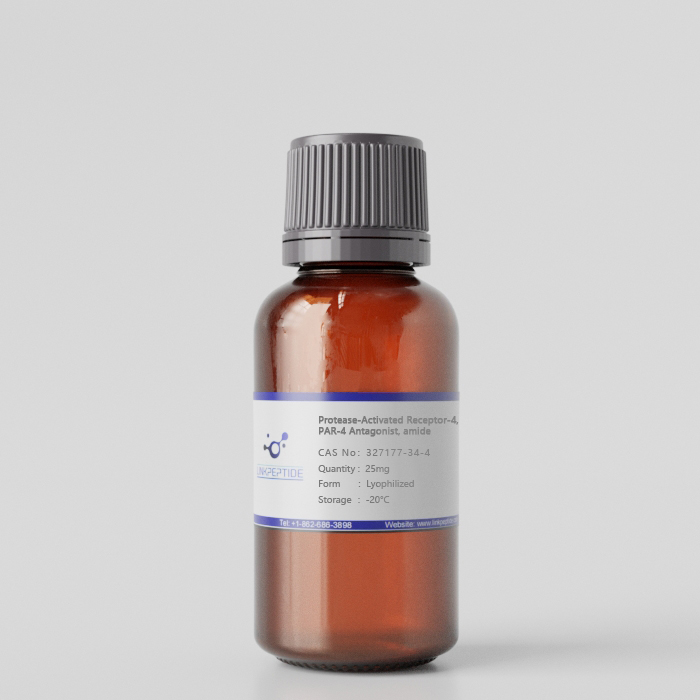
Product Name: Protease-Activated Receptor-4, PAR-4 Antagonist, amide
Sequence One Letter Code: trans-Cinnamoyl-YPGKF-NH2
Sequence Three Letter Code: trans-Cinnamoyl-Tyr-Pro-Gly-Lys-Phe-NH2
Cas No: 327177-34-4
Chemical Formula:C40H49N7O7
Molecular Weight: 739.9
Purity: 95%
Form: Lyophilized
Storage Conditions: - 20 °C
Research Area: Cardiovascular Disease Research
SMILES: C1C[C@H](N(C1)C(=O)[C@H](CC2=CC=C(C=C2)O)NC(=O)/C=C/C3=CC=CC=C3)C(=O)NCC(=O)N[C@@H](CCCCN)C(=O)N[C@@H](CC4=CC=CC=C4)C(=O)N
IUPAC: (2S)-N-[2-[[(2S)-6-amino-1-[[(2S)-1-amino-1-oxo-3-phenylpropan-2-yl]amino]-1-oxohexan-2-yl]amino]-2-oxoethyl]-1-[(2S)-3-(4-hydroxyphenyl)-2-[[(E)-3-phenylprop-2-enoyl]amino]propanoyl]pyrrolidine-2-carboxamide
INCHIKEY: XKRAKQXQVIGYQC-PHOSSJRVSA-N
INCHI:
InChI=1S/C40H49N7O7/c41-22-8-7-14-31(38(52)46-32(37(42)51)24-28-12-5-2-6-13-28)44-36(50)26-43-39(53)34-15-9-23-47(34)40(54)33(25-29-16-19-30(48)20-17-29)45-35(49)21-18-27-10-3-1-4-11-27/h1-6,10-13,16-21,31-34,48H,7-9,14-15,22-26,41H2,(H2,42,51)(H,43,53)(H,44,50)(H,45,49)(H,46,52)/b21-18+/t31-,32-,33-,34-/m0/s1
Source / Species: human
Conjugation: Unconjugated
Code Nacres: NA.26
Application: Protease-Activated Receptor-4 (PAR-4) Antagonist, amide is a selective synthetic peptide that inhibits thrombin- and PAR-4 agonist–induced platelet aggregation in rat models. PAR-4 is a critical mediator of thrombin-driven platelet activation and contributes significantly to hemostasis and thrombosis. By selectively blocking PAR-4 signaling, this peptide enables mechanistic dissection of receptor-specific platelet responses distinct from PAR-1–mediated pathways. It is widely used in studies of platelet activation, thrombin receptor pharmacology, and antithrombotic strategy development. The peptide supports cardiovascular research focused on coagulation signaling, thrombosis mechanisms, and receptor-targeted therapeutic evaluation.
Current Research: Protease-Activated Receptor-4 (PAR-4) Antagonist, amide is a selective synthetic peptide designed to inhibit PAR-4–mediated signaling in platelet activation models. PAR-4 is a G protein–coupled receptor (GPCR) activated by thrombin through proteolytic cleavage of its extracellular N-terminus, exposing a tethered ligand that initiates intracellular signaling. In rodents, PAR-4 serves as a principal thrombin receptor on platelets, whereas in humans, both PAR-1 and PAR-4 contribute to thrombin responsiveness. Selective inhibition of PAR-4 enables receptor-specific analysis of thrombin-driven platelet activation. Thrombin is a central effector in hemostasis and thrombosis, activating platelets to promote aggregation, granule secretion, and procoagulant surface exposure. PAR-4 activation triggers intracellular signaling cascades involving G_q, G_i, and G_12/13 proteins, leading to phospholipase C activation, inositol trisphosphate (IP₃) generation, intracellular calcium mobilization, RhoA activation, and integrin αIIbβ3 activation. Compared with PAR-1, PAR-4 signaling typically exhibits slower onset but more sustained calcium responses, contributing to stable platelet aggregation and thrombus consolidation. The PAR-4 Antagonist, amide selectively blocks thrombin- and PAR-4 agonist–induced platelet aggregation in rat models without significantly interfering with PAR-1–dependent pathways. This specificity allows investigators to dissect distinct receptor contributions to platelet activation. In platelet-rich plasma or washed platelet preparations, the antagonist reduces aggregation, calcium flux, granule secretion, and integrin activation induced by PAR-4–selective agonist peptides. These experimental systems help clarify how PAR-4 signaling integrates with other platelet activation pathways. In thrombosis research, selective PAR-4 inhibition is particularly relevant because receptor-targeted strategies may reduce thrombotic risk while preserving essential hemostatic function. Excessive platelet activation contributes to arterial thrombosis underlying myocardial infarction and ischemic stroke. By attenuating PAR-4–mediated signaling, researchers evaluate potential antithrombotic benefits and bleeding risk profiles in preclinical models. Comparative studies between PAR-1 and PAR-4 antagonism provide insight into receptor-specific therapeutic windows. Pharmacologically, peptide antagonists serve as mechanistic tools for validating receptor involvement before development of small-molecule inhibitors or monoclonal antibodies. The amide modification often enhances peptide stability and bioactivity in experimental settings. In vitro assays typically assess platelet aggregation using light transmission aggregometry, flow cytometric measurement of activation markers (e.g., P-selectin expression), and calcium mobilization assays. Beyond platelets, PAR-4 is expressed in vascular smooth muscle cells, endothelial cells, and certain immune cell populations. Inhibition of PAR-4 signaling therefore contributes to broader investigations into vascular inflammation, endothelial barrier function, and thromboinflammatory interactions. Studies may examine ERK phosphorylation, NF-κB activation, and cytokine production following receptor blockade. Recent research also explores species differences in thrombin receptor biology. In rodents, PAR-4 plays a dominant role in platelet activation, making rat models particularly suitable for evaluating PAR-4–selective antagonists. Understanding these differences is critical for translational interpretation of antithrombotic strategies targeting PAR signaling. Overall, Protease-Activated Receptor-4 (PAR-4) Antagonist, amide is a selective inhibitor of thrombin-induced PAR-4 signaling that supports detailed mechanistic studies of platelet activation and coagulation biology. By enabling receptor-specific dissection of thrombin responses, it provides a valuable tool for cardiovascular research focused on thrombosis mechanisms, platelet pharmacology, and development of targeted antithrombotic therapies.
Get a Quote
 LinkPeptide