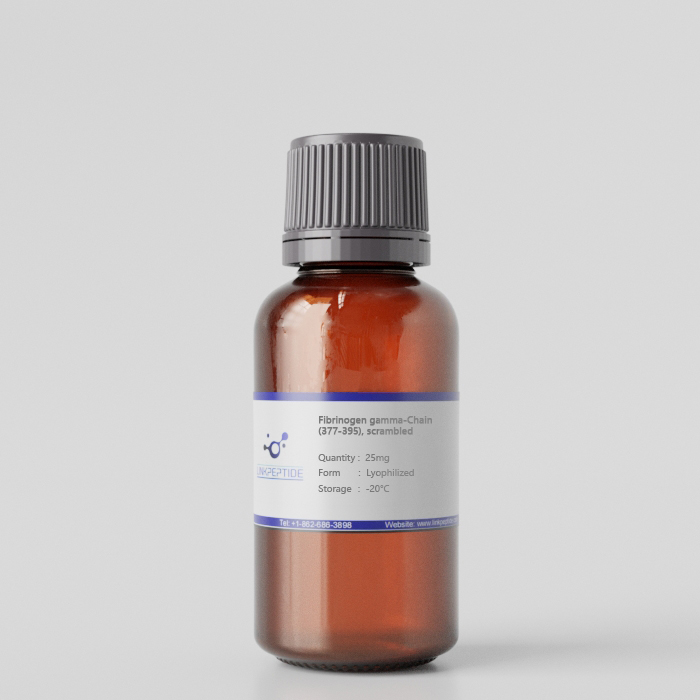
Product Name: Fibrinogen gamma-Chain (377-395), scrambled
Sequence One Letter Code: KMMISYTFPIERTGLISNK
Sequence Three Letter Code: H-Lys-Met-Met-Ile-Ser-Tyr-Thr-Phe-Pro-Ile-Glu-Arg-Thr-Gly-Leu-Ile-Ser-Asn--Lys-OH
Chemical Formula:C100H165N25O28S2
Molecular Weight: 2229.8
Purity: 95%
Form: Lyophilized
Storage Conditions: - 20 °C
Research Area: Multiple Sclerosis (MS)
Source / Species: mouse
Conjugation: Unconjugated
Code Nacres: NA.26
Application: This peptide is a scrambled sequence corresponding to fibrinogen γ-chain residues 377–395 and serves as a negative control for studies using the native inhibitory fragment. The original fibrinogen-derived peptide attenuates microglial activation and reduces relapsing paralysis in experimental multiple sclerosis models, whereas the scrambled sequence lacks these biological effects. It is used to confirm sequence-specific activity in studies of neuroinflammation, microglial signaling, and autoimmune demyelinating disease.
Current Research: Fibrinogen, a plasma glycoprotein best known for its role in coagulation, has emerged as an important mediator of neuroinflammatory signaling within the central nervous system (CNS). Following blood–brain barrier disruption, fibrinogen deposits in the CNS parenchyma and interacts with immune cells, particularly microglia, contributing to inflammatory responses observed in disorders such as multiple sclerosis (MS). A defined fragment derived from the fibrinogen γ-chain (residues 377–395) has been shown to attenuate microglial activation and reduce relapsing paralysis in experimental autoimmune encephalomyelitis (EAE), a widely used model of MS. The scrambled version of this peptide, containing the same amino acid composition in a randomized sequence, serves as a negative control to validate sequence-specific biological effects. The native γ-chain (377–395) fragment modulates microglial function by interfering with fibrinogen-mediated signaling pathways, including interactions with integrin receptors such as CD11b/CD18 (Mac-1). These receptor engagements normally promote pro-inflammatory activation, cytokine release, and oxidative stress. By competitively inhibiting or modifying these interactions, the native peptide reduces inflammatory signaling and mitigates disease severity in EAE models. In contrast, the scrambled peptide lacks the structural arrangement required for receptor binding and does not reproduce these anti-inflammatory or neuroprotective effects. Use of a scrambled control is essential in peptide-based functional studies. Because short peptides can exert nonspecific effects related to charge, hydrophobicity, or cellular uptake, distinguishing true sequence-dependent activity from incidental properties is critical. The scrambled γ-chain (377–395) peptide preserves overall length and amino acid composition while eliminating the defined spatial arrangement necessary for receptor interaction. When administered in parallel with the native inhibitory fragment, it provides a rigorous control for assessing specificity in cellular and in vivo assays. In microglial culture systems, the scrambled peptide is used to confirm that reductions in cytokine production, nitric oxide release, or morphological activation are attributable to the native γ-chain sequence. For example, experiments measuring TNF-α, IL-1β, or reactive oxygen species generation can compare responses to native versus scrambled peptides under identical stimulation conditions. Lack of activity in the scrambled control supports the conclusion that modulation of microglial signaling depends on precise sequence determinants. In animal models of autoimmune demyelination, such as EAE, inclusion of the scrambled peptide ensures that observed therapeutic effects—such as delayed onset of paralysis or reduced relapse frequency—are not due to nonspecific peptide administration or immune modulation. This is particularly important in translational research, where peptide-based interventions are evaluated for potential therapeutic development. Sequence-specific validation strengthens mechanistic interpretation and reproducibility. Beyond multiple sclerosis models, the scrambled fibrinogen γ-chain peptide supports broader investigations into fibrinogen–immune cell interactions and CNS inflammatory pathways. Fibrinogen deposition has been implicated in traumatic brain injury, stroke, and neurodegenerative diseases characterized by vascular leakage. In these contexts, comparing native inhibitory fragments with scrambled controls clarifies the molecular basis of fibrinogen-driven microglial activation and downstream signaling cascades. The scrambled peptide is also valuable in receptor-binding and structural assays. Competitive binding experiments can demonstrate that only the correctly ordered γ-chain sequence interacts with target receptors, while the scrambled variant shows negligible affinity. Such studies help define structural motifs responsible for integrin recognition and inflammatory signaling modulation. In summary, the scrambled fibrinogen γ-chain (377–395) peptide functions as a critical negative control for studies employing the native inhibitory fragment. By lacking the sequence-specific structural features required for biological activity, it validates the mechanistic specificity of observed effects on microglial activation and autoimmune demyelination. Its use strengthens experimental rigor in neuroinflammation research and supports accurate interpretation of peptide-mediated modulation of CNS immune responses.
Get a Quote
 LinkPeptide