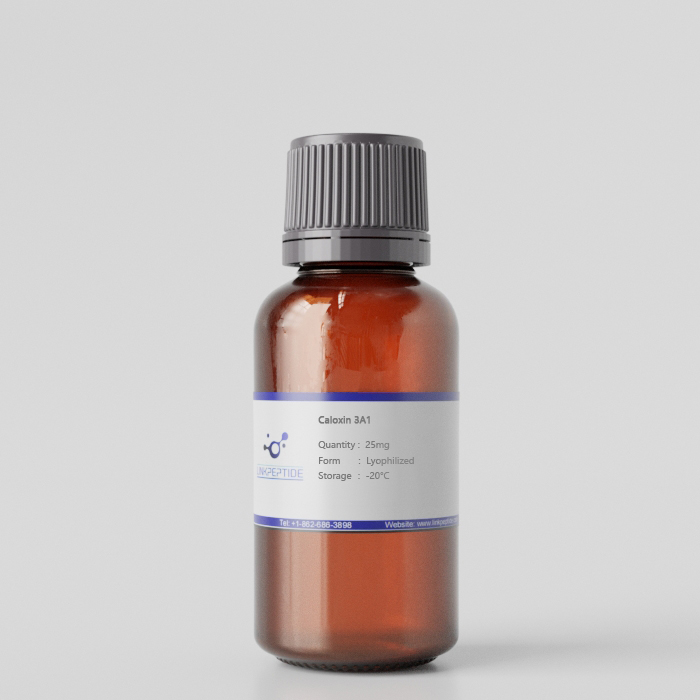
Product Name: Caloxin 3A1
Sequence One Letter Code: WSSTSSVSAPLEFGGGGSAK
Sequence Three Letter Code: H-Trp-Ser-Ser-Thr-Ser-Ser-Val-Ser-Ala-Pro-Leu-Glu-Phe-Gly-Gly-Gly-Gly-Ser-Ala-Lys-OH
Chemical Formula:C83H126N22O30
Molecular Weight: 1912.2
Purity: 95%
Form: Lyophilized
Storage Conditions: - 20 °C
Research Area: Ion Channel Modulation
Conjugation: Unconjugated
Code Nacres: NA.26
Application: Caloxin 3A1 is a synthetic peptide belonging to the caloxin family of selective extracellular inhibitors of plasma membrane Ca²⁺-ATPases (PMCAs). It inhibits PMCA activity without affecting sarcoplasmic reticulum Ca²⁺ pumps and does not interfere with acylphosphate intermediate formation from ATP. Acting at an extracellular site, Caloxin 3A1 enables controlled modulation of calcium efflux without compromising membrane integrity. This peptide is used to study calcium transport dynamics, PMCA isoform function, and calcium-dependent signaling pathways. It supports research in membrane physiology, ion homeostasis, and cellular processes regulated by precise control of intracellular calcium levels.
Current Research: Calcium ions (Ca²⁺) function as universal second messengers regulating a broad spectrum of cellular processes, including muscle contraction, neurotransmitter release, gene transcription, secretion, and apoptosis. Tight regulation of intracellular Ca²⁺ concentration is therefore essential for cellular homeostasis. Among the principal mechanisms responsible for Ca²⁺ extrusion from the cytosol are plasma membrane Ca²⁺-ATPases (PMCAs), a family of P-type ATPases that actively transport Ca²⁺ out of cells using ATP hydrolysis. Caloxin 3A1 is a synthetic peptide belonging to the caloxin family of selective extracellular PMCA inhibitors, developed to enable targeted modulation of Ca²⁺ efflux with high specificity. PMCAs exist as multiple isoforms (PMCA1–4), each with distinct tissue distributions and regulatory properties. These pumps maintain low basal cytosolic Ca²⁺ levels and shape the amplitude and duration of Ca²⁺ transients following cellular stimulation. Dysregulation of PMCA activity has been implicated in cardiovascular disorders, neurodegeneration, and altered cell proliferation. Consequently, pharmacological tools that selectively modulate PMCA function are critical for dissecting isoform-specific roles in physiological and pathological contexts. Caloxin 3A1 exerts its inhibitory activity by binding to an extracellular domain of the PMCA protein. This mode of action distinguishes it from many classical P-type ATPase inhibitors that act intracellularly or disrupt catalytic intermediates. Notably, Caloxin 3A1 does not interfere with the formation of the acylphosphate intermediate generated during ATP hydrolysis, indicating that it does not directly block ATP binding or phosphorylation of the enzyme. Instead, it modulates pump function allosterically from the extracellular face of the membrane. This selective targeting allows inhibition of Ca²⁺ extrusion without broadly compromising ATP-dependent processes or intracellular enzymatic machinery. Importantly, Caloxin 3A1 does not inhibit sarcoplasmic/endoplasmic reticulum Ca²⁺-ATPases (SERCAs), which are responsible for sequestering Ca²⁺ into intracellular stores. This selectivity enables researchers to differentiate between Ca²⁺ clearance mediated by PMCAs at the plasma membrane and Ca²⁺ reuptake into the endoplasmic or sarcoplasmic reticulum. Such discrimination is essential in experimental systems where both pathways contribute to shaping Ca²⁺ signaling dynamics. In functional studies, Caloxin 3A1 is used to prolong cytosolic Ca²⁺ transients by limiting Ca²⁺ extrusion. When applied extracellularly, it increases intracellular Ca²⁺ levels in response to stimulation without disrupting membrane integrity. This controlled modulation facilitates investigation of Ca²⁺-dependent signaling cascades, including activation of calmodulin-dependent kinases, calcineurin, protein kinase C, and transcription factors such as NFAT. By adjusting the rate of Ca²⁺ clearance, researchers can assess how signal duration and amplitude influence downstream gene expression and cellular responses. The peptide has proven particularly useful in membrane physiology and electrophysiology studies. In excitable cells such as neurons and cardiomyocytes, precise regulation of Ca²⁺ extrusion determines recovery from depolarization and influences repetitive firing or contractile activity. Application of Caloxin 3A1 enables evaluation of PMCA contributions to these processes without affecting intracellular Ca²⁺ stores. In non-excitable cells, including epithelial and immune cells, the peptide supports analysis of Ca²⁺-regulated secretion, migration, and proliferation. Isoform-specific investigations also benefit from caloxin-based inhibition. Different PMCA isoforms display variable sensitivity to caloxin peptides, allowing comparative studies of isoform distribution and functional dominance in distinct tissues. Combined with genetic approaches such as knockdown or overexpression, Caloxin 3A1 provides a complementary pharmacological strategy to dissect isoform-dependent Ca²⁺ handling mechanisms. Overall, Caloxin 3A1 is a selective extracellular inhibitor of plasma membrane Ca²⁺-ATPases that enables targeted modulation of calcium efflux without interfering with sarcoplasmic reticulum Ca²⁺ pumps or ATP-dependent catalytic intermediates. By offering precise control over intracellular Ca²⁺ dynamics, this peptide serves as a valuable research tool in studies of ion homeostasis, membrane transport physiology, and Ca²⁺-dependent signaling pathways.
Get a Quote
 LinkPeptide