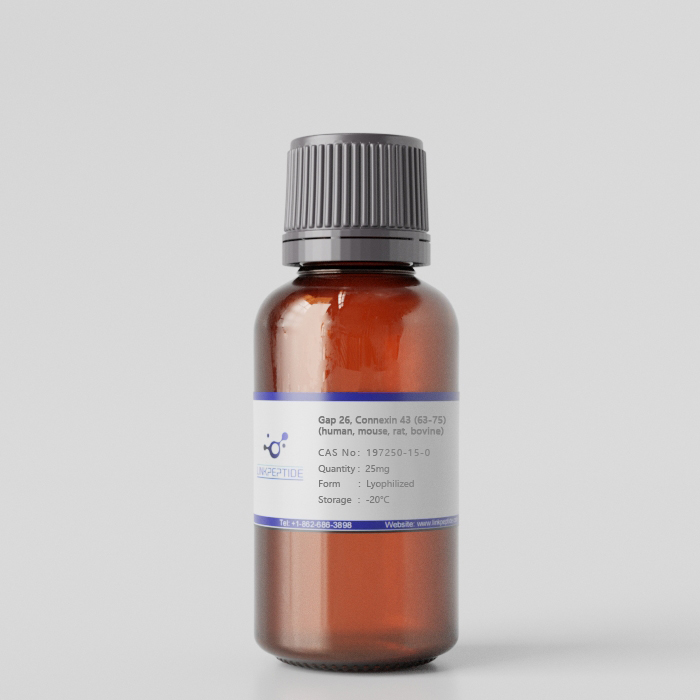
Product Name: Gap 26, Connexin 43 (63-75) (human, mouse, rat, bovine)
Sequence One Letter Code: VCYDKSFPISHVR
Sequence Three Letter Code: H-Val-Cys-Tyr-Asp-Lys-Ser-Phe-Pro-Ile-Ser-His-Val-Arg-OH
Cas No: 197250-15-0
Chemical Formula:C70H107N19O19S
Molecular Weight: 1550.9
Purity: 95%
Form: Lyophilized
Storage Conditions: - 20 °C
Research Area: Cardiovascular Disease Research
SMILES: CC[C@H](C)[C@@H](C(=O)N[C@@H](CO)C(=O)N[C@@H](CC1=CN=CN1)C(=O)N[C@@H](C(C)C)C(=O)N[C@@H](CCCN=C(N)N)C(=O)O)NC(=O)[C@@H]2CCCN2C(=O)[C@H](CC3=CC=CC=C3)NC(=O)[C@H](CO)NC(=O)[C@H](CCCCN)NC(=O)[C@H](CC(=O)O)NC(=O)[C@H](CC4=CC=C(C=C4)O)NC(=O)[C@H](CS)NC(=O)[C@H](C(C)C)N
IUPAC: (2S)-2-[[(2S)-2-[[(2S)-2-[[(2S)-2-[[(2S,3S)-2-[[(2S)-1-[(2S)-2-[[(2S)-2-[[(2S)-6-amino-2-[[(2S)-2-[[(2S)-2-[[(2R)-2-[[(2S)-2-amino-3-methylbutanoyl]amino]-3-sulfanylpropanoyl]amino]-3-(4-hydroxyphenyl)propanoyl]amino]-3-carboxypropanoyl]amino]hexanoyl]amino]-3-hydroxypropanoyl]amino]-3-phenylpropanoyl]pyrrolidine-2-carbonyl]amino]-3-methylpentanoyl]amino]-3-hydroxypropanoyl]amino]-3-(1H-imidazol-5-yl)propanoyl]amino]-3-methylbutanoyl]amino]-5-(diaminomethylideneamino)pentanoic acid
INCHIKEY: FDPIMWZHGJNESB-VCSXYVMHSA-N
INCHI:
InChI=1S/C70H107N19O19S/c1-7-38(6)56(67(105)85-50(33-91)61(99)81-46(29-41-31-75-35-77-41)60(98)87-55(37(4)5)66(104)79-44(69(107)108)18-13-25-76-70(73)74)88-64(102)52-19-14-26-89(52)68(106)48(28-39-15-9-8-10-16-39)83-62(100)49(32-90)84-57(95)43(17-11-12-24-71)78-59(97)47(30-53(93)94)82-58(96)45(27-40-20-22-42(92)23-21-40)80-63(101)51(34-109)86-65(103)54(72)36(2)3/h8-10,15-16,20-23,31,35-38,43-52,54-56,90-92,109H,7,11-14,17-19,24-30,32-34,71-72H2,1-6H3,(H,75,77)(H,78,97)(H,79,104)(H,80,101)(H,81,99)(H,82,96)(H,83,100)(H,84,95)(H,85,105)(H,86,103)(H,87,98)(H,88,102)(H,93,94)(H,107,108)(H4,73,74,76)/t38-,43-,44-,45-,46-,47-,48-,49-,50-,51-,52-,54-,55-,56-/m0/s1
Source / Species: Human, mouse, rat, bovine
Conjugation: Unconjugated
Code Nacres: NA.26
Application: Gap 26 is a connexin-mimetic peptide derived from the first extracellular loop of connexin 43 (Cx43), a major structural component of gap junction channels that mediate direct intercellular communication. The peptide acts as a reversible inhibitor of gap junction–mediated signaling by interfering with connexin channel function. Gap junctions formed by Cx43 allow the transfer of ions and small signaling molecules, including calcium ions and inositol phosphates, between adjacent cells, thereby coordinating cellular responses within tissues. By blocking these channels, Gap 26 disrupts the propagation of calcium waves and other signaling events across connected cells. This property makes it a widely used tool for investigating gap junction–dependent communication in physiological and pathological systems. Gap 26 has been applied in studies of epithelial cell signaling, cardiovascular physiology, and tissue-level coordination of calcium signaling and intercellular communication.
Current Research: Intercellular communication is essential for maintaining coordinated cellular activity in multicellular organisms. One of the most important structures responsible for direct cell–cell communication is the gap junction, a specialized membrane channel that allows neighboring cells to exchange ions and small signaling molecules. Among the various connexin proteins that form these channels, Connexin 43 (Cx43) is the most widely expressed and extensively studied. To investigate the biological roles of these channels, researchers frequently rely on connexin-mimetic peptides such as Gap 26, a peptide derived from the first extracellular loop of Cx43. By selectively interfering with gap junction channel function, Gap 26 has become an essential experimental tool for studying intercellular signaling mechanisms across multiple physiological systems. Connexin 43 and the Role of Gap Junctions Gap junctions are formed by the docking of two connexons, each composed of six connexin proteins. When connexons from adjacent cells align, they create a continuous channel that bridges the cytoplasm of neighboring cells. These channels enable the rapid exchange of small molecules, typically under 1 kDa in size, including calcium ions (Ca²⁺), cyclic nucleotides, and inositol phosphates. This direct communication allows tissues to coordinate cellular behavior in processes such as electrical conduction, metabolic regulation, and synchronized signaling. Among the connexin family, Cx43 is particularly significant due to its widespread expression in tissues including the heart, epithelial layers, and the nervous system. Cx43-mediated gap junctions are involved in processes ranging from cardiac impulse propagation to tissue repair and inflammatory signaling. Dysregulation of Cx43 communication has been implicated in numerous pathological conditions, including arrhythmias, ischemic injury, and abnormal wound healing. Mechanism of Action of Gap 26 Gap 26 is a connexin-mimetic peptide designed from the first extracellular loop of Cx43, a region that plays a key role in connexon docking and channel formation. Because of its sequence similarity to this extracellular domain, Gap 26 can interact with connexin channels and reversibly inhibit gap junction communication. Rather than permanently blocking channel formation, Gap 26 interferes with the functional state of connexin channels at the cell surface. This interaction prevents the efficient transfer of signaling molecules through gap junctions and thereby disrupts intercellular signal propagation. Importantly, the inhibition is reversible and transient, which makes Gap 26 particularly valuable in experimental systems where temporary suppression of communication is required. One of the most notable effects of Gap 26 is the suppression of intercellular calcium wave propagation. Calcium waves are critical signaling events that travel across connected cells through gap junctions and play important roles in tissue-level coordination. By blocking Cx43 channels, Gap 26 prevents these waves from spreading between cells, allowing researchers to isolate and study the role of gap junctions in calcium signaling networks. Applications in Cellular and Physiological Research Due to its targeted mechanism of action, Gap 26 has been widely used as a research tool to dissect gap junction–dependent communication in a variety of biological contexts. In epithelial cell biology, Gap 26 has been employed to examine how coordinated signaling regulates processes such as wound repair, barrier function, and cellular differentiation. Gap junction communication is critical in epithelial tissues where coordinated responses across large cell layers are required. By temporarily inhibiting Cx43 channels, researchers can determine how signaling pathways propagate across epithelial sheets. In cardiovascular research, Gap 26 has played a significant role in investigating the importance of connexin-mediated communication in the heart. Cardiac tissue relies on gap junctions to synchronize electrical conduction between cardiomyocytes. Experimental inhibition of Cx43 channels with Gap 26 helps researchers study how disruptions in gap junction communication influence cardiac electrophysiology, arrhythmogenesis, and responses to ischemic injury. Gap 26 has also been applied in studies focused on tissue-level calcium signaling and coordinated cellular responses. Calcium waves are crucial for processes such as vascular signaling, epithelial coordination, and neuronal communication. By blocking connexin channels, Gap 26 allows researchers to distinguish between signaling events mediated by direct intercellular transfer and those propagated through extracellular mechanisms. Importance as a Research Tool Connexin-mimetic peptides such as Gap 26 have become indispensable tools in modern cell biology because they allow researchers to selectively manipulate gap junction activity without genetic modification. Compared with permanent gene knockouts or long-term pharmacological inhibitors, Gap 26 provides a rapid and reversible approach for studying dynamic communication processes in living tissues. As research continues to reveal the complex roles of gap junctions in health and disease, tools that allow precise modulation of connexin signaling will remain essential. Gap 26 continues to support investigations into intercellular communication, calcium signaling, and tissue coordination, helping researchers better understand how cells communicate within complex biological systems.
Get a Quote
 LinkPeptide