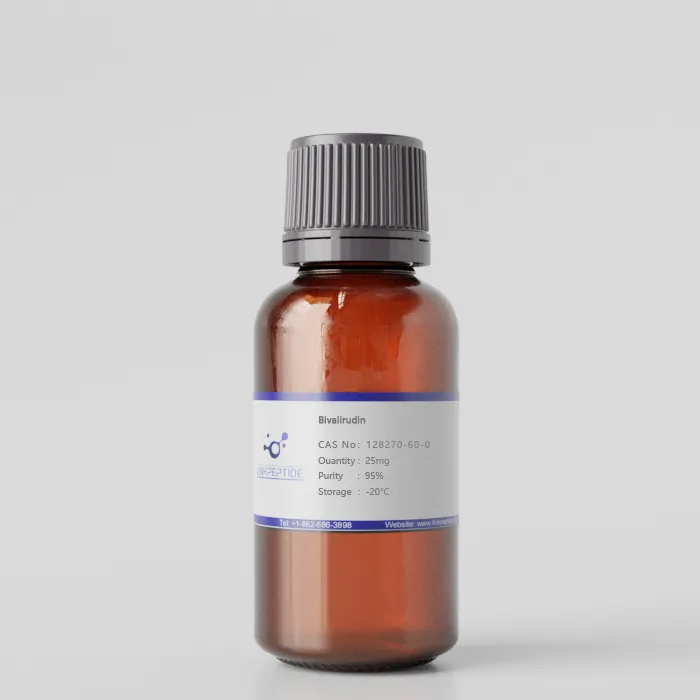
Product Name:Bivalirudin
Form:TFA salt
Purity:95%
Storage:-20oC
Cas No:128270-60-0
Molar Mass:2180.3
Chemical Formula:C98H138N24O33
Synonyms:Angiomax
IUPAC Name:(2S)-2-[[(2S)-2-[[(2S)-2-[[(2S)-2-[[(2S)-1-[(2S,3S)-2-[[(2S)-2-[[(2S)-2-[[(2S)-2-[[(2S)-2-[[2-[[(2S)-4-amino-2-[[2-[[2-[[2-[[2-[[(2S)-1-[(2S)-2-[[(2S)-1-[(2R)-2-amino-3-phenylpropanoyl]pyrrolidine-2-carbonyl]amino]-5-carbamimidamidopentanoyl]pyrrolidine-2-carbonyl]amino]acetyl]amino]acetyl]amino]acetyl]amino]acetyl]amino]-4-oxobutanoyl]amino]acetyl]amino]-3-carboxypropanoyl]amino]-3-phenylpropanoyl]amino]-4-carboxybutanoyl]amino]-4-carboxybutanoyl]amino]-3-methylpentanoyl]pyrrolidine-2-carbonyl]amino]-4-carboxybutanoyl]amino]-4-carboxybutanoyl]amino]-3-(4-hydroxyphenyl)propanoyl]amino]-4-methylpentanoic acid
SMILES:CC[C@H](C)[C@@H](C(=O)N1CCC[C@H]1C(=O)N[C@@H](CCC(=O)O)C(=O)N[C@@H](CCC(=O)O)C(=O)N[C@@H](CC2=CC=C(C=C2)O)C(=O)N[C@@H](CC(C)C)C(=O)O)NC(=O)[C@H](CCC(=O)O)NC(=O)[C@H](CCC(=O)O)NC(=O)[C@H](CC3=CC=CC=C3)NC(=O)[C@H](CC(=O)O)NC(=O)CNC(=O)[C@H](CC(=O)N)NC(=O)CNC(=O)CNC(=O)CNC(=O)CNC(=O)[C@@H]4CCCN4C(=O)[C@H](CCCNC(=N)N)NC(=O)[C@@H]5CCCN5C(=O)[C@@H](CC6=CC=CC=C6)N
InChIKey:OIRCOABEOLEUMC-GEJPAHFPSA-N
InChI:InChI=1S/C98H138N24O33/c1-5-52(4)82(96(153)122-39-15-23-70(122)92(149)114-60(30-34-79(134)135)85(142)111-59(29-33-78(132)133)86(143)116-64(43-55-24-26-56(123)27-25-55)89(146)118-67(97(154)155)40-51(2)3)119-87(144)61(31-35-80(136)137)112-84(141)58(28-32-77(130)131)113-88(145)63(42-54-18-10-7-11-19-54)117-90(147)66(45-81(138)139)110-76(129)50-107-83(140)65(44-71(100)124)109-75(128)49-106-73(126)47-104-72(125)46-105-74(127)48-108-91(148)68-21-13-38-121(68)95(152)62(20-12-36-103-98(101)102)115-93(150)69-22-14-37-120(69)94(151)57(99)41-53-16-8-6-9-17-53/h6-11,16-19,24-27,51-52,57-70,82,123H,5,12-15,20-23,28-50,99H2,1-4H3,(H2,100,124)(H,104,125)(H,105,127)(H,106,126)(H,107,140)(H,108,148)(H,109,128)(H,110,129)(H,111,142)(H,112,141)(H,113,145)(H,114,149)(H,115,150)(H,116,143)(H,117,147)(H,118,146)(H,119,144)(H,130,131)(H,132,133)(H,134,135)(H,136,137)(H,138,139)(H,154,155)(H4,101,102,103)/t52-,57+,58-,59-,60-,61-,62-,63-,64-,65-,66-,67-,68-,69-,70-,82-/m0/s1
Sequence:FPRPGGGGNGDFEEIPEEYL
Application:Bivalirudin is a synthetic direct thrombin inhibitor (DTI) used as an anticoagulant in percutaneous coronary intervention (PCI), acute coronary syndrome (ACS), and heparin-induced thrombocytopenia (HIT). Unlike heparin, Bivalirudin binds directly to thrombin, inhibiting both free and clot-bound thrombin, reducing the risk of thrombosis while minimizing bleeding complications. It has a short half-life and predictable pharmacokinetics, making it a safer alternative in cardiovascular procedures and critically ill patients. Ongoing research explores its role in stroke prevention, extracorporeal membrane oxygenation (ECMO), and thromboembolic disorders, positioning it as a key agent in anticoagulation management.
Current Research:Bivalirudin is a synthetic bivalent direct thrombin inhibitor (DTI) that selectively inhibits thrombin (factor IIa), preventing fibrin clot formation. It is widely used in interventional cardiology and thrombosis management, with expanding research in stroke prevention, extracorporeal circulation, and alternative anticoagulant therapies. Percutaneous Coronary Intervention (PCI) and Acute Coronary Syndrome (ACS) Bivalirudin is an established alternative to heparin plus glycoprotein IIb/IIIa inhibitors (GPIs) in patients undergoing PCI. Reduced bleeding risk: Clinical trials (e.g., HORIZONS-AMI) have demonstrated that Bivalirudin reduces major bleeding complications compared to heparin-based regimens. Comparable ischemic protection: Research continues to evaluate dual-antithrombotic strategies combining Bivalirudin with P2Y12 inhibitors (e.g., clopidogrel, ticagrelor) for optimal balance between bleeding risk and thrombotic protection. Use in high-risk patients: Studies are assessing its benefits in high-risk ACS patients, particularly those with chronic kidney disease (CKD) or bleeding predispositions. Heparin-Induced Thrombocytopenia (HIT) and Alternative Anticoagulation Bivalirudin serves as a heparin-free anticoagulant in patients with HIT, a condition where heparin exposure leads to life-threatening thrombosis and low platelet count. Reduced pro-thrombotic effects: Compared to heparin, Bivalirudin does not activate platelet factor 4 (PF4), lowering HIT risk. Use in cardiac surgery: Research is evaluating Bivalirudin??s efficacy in cardiopulmonary bypass (CPB) and off-pump procedures in HIT-positive patients. Stroke Prevention and Neurological Applications Acute ischemic stroke (AIS): Studies suggest Bivalirudin may be effective in reducing clot formation during mechanical thrombectomy or thrombolysis. Neurovascular interventions: Research is exploring its role in preventing intracranial thrombosis in neurointerventional procedures, such as aneurysm coiling and carotid stenting. Extracorporeal Circulation and ECMO Research Bivalirudin is increasingly being studied as an anticoagulant for extracorporeal membrane oxygenation (ECMO) and left ventricular assist devices (LVADs). Stable anticoagulation: Compared to heparin, Bivalirudin offers more predictable anticoagulant effects with fewer fluctuations in clotting parameters. Lower inflammatory response: Research suggests that Bivalirudin may reduce ECMO-associated inflammation and platelet activation. Emerging Research Areas Venous thromboembolism (VTE) treatment: Studies are assessing its role in deep vein thrombosis (DVT) and pulmonary embolism (PE) management. Cancer-associated thrombosis: Research is exploring its use in thrombosis prevention in cancer patients, particularly those on chemotherapy-induced pro-thrombotic states. Post-surgical thrombosis prevention: Some studies suggest Bivalirudin may be effective in reducing thrombotic complications after major orthopedic and cardiovascular surgeries. With expanding research, Bivalirudin continues to evolve as a key anticoagulant, offering advantages over traditional heparin-based therapies in cardiovascular, neurological, and extracorporeal applications.
Get a Quote
 LinkPeptide