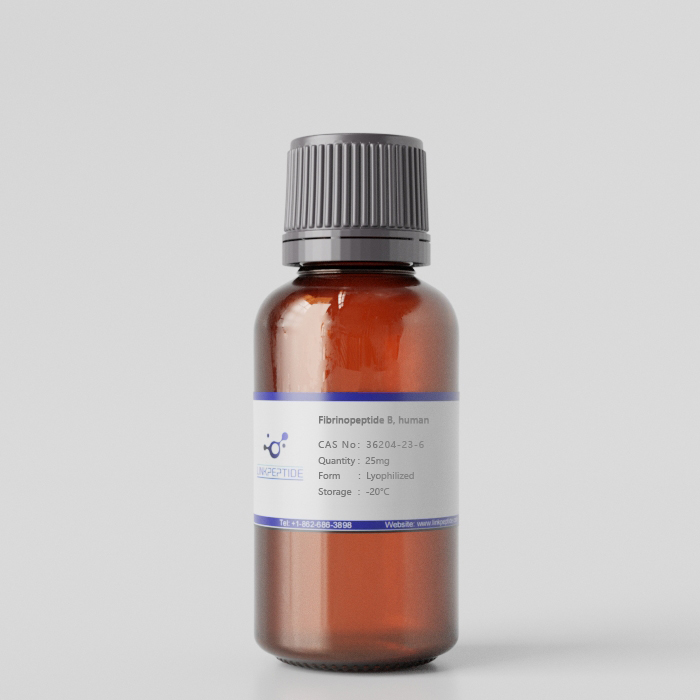
Product Name: Fibrinopeptide B, human
Sequence One Letter Code: Pyr-GVNDNEEGFFSAR
Sequence Three Letter Code: Pyr-Gly-Val-Asn-Asp-Asn-Glu-Glu-Gly-Phe-Phe-Ser-Ala-Arg-OH
Cas No: 36204-23-6
Chemical Formula:C66H93N19O25
Molecular Weight: 1552.7
Purity: 95%
Form: Lyophilized
Storage Conditions: - 20 °C
Research Area: Cardiovascular Disease Research
SMILES: C[C@@H](C(=O)N[C@@H](CCCNC(=N)N)C(=O)O)NC(=O)[C@H](CO)NC(=O)[C@H](CC1=CC=CC=C1)NC(=O)[C@H](CC2=CC=CC=C2)NC(=O)CNC(=O)[C@H](CCC(=O)O)NC(=O)[C@H](CCC(=O)O)NC(=O)[C@H](CC(=O)N)NC(=O)[C@H](CC(=O)O)NC(=O)[C@H](CC(=O)N)NC(=O)[C@H](C(C)C)NC(=O)CNC(=O)[C@@H]3CCC(=O)N3
IUPAC: (4S)-4-[[(2S)-2-[[(2S)-4-amino-2-[[(2S)-2-[[(2S)-4-amino-2-[[(2S)-3-methyl-2-[[2-[[(2S)-5-oxopyrrolidine-2-carbonyl]amino]acetyl]amino]butanoyl]amino]-4-oxobutanoyl]amino]-3-carboxypropanoyl]amino]-4-oxobutanoyl]amino]-4-carboxybutanoyl]amino]-5-[[2-[[(2S)-1-[[(2S)-1-[[(2S)-1-[[(2S)-1-[[(1S)-4-carbamimidamido-1-carboxybutyl]amino]-1-oxopropan-2-yl]amino]-3-hydroxy-1-oxopropan-2-yl]amino]-1-oxo-3-phenylpropan-2-yl]amino]-1-oxo-3-phenylpropan-2-yl]amino]-2-oxoethyl]amino]-5-oxopentanoic acid
INCHIKEY: MYRIFIVQGRMHRF-OECXYHNASA-N
INCHI:
InChI=1S/C66H93N19O25/c1-31(2)53(85-49(91)29-73-55(99)35-16-19-47(89)75-35)64(108)83-42(26-46(68)88)61(105)82-43(27-52(96)97)62(106)81-41(25-45(67)87)60(104)78-37(18-21-51(94)95)57(101)77-36(17-20-50(92)93)56(100)72-28-48(90)76-39(23-33-11-6-4-7-12-33)58(102)80-40(24-34-13-8-5-9-14-34)59(103)84-44(30-86)63(107)74-32(3)54(98)79-38(65(109)110)15-10-22-71-66(69)70/h4-9,11-14,31-32,35-44,53,86H,10,15-30H2,1-3H3,(H2,67,87)(H2,68,88)(H,72,100)(H,73,99)(H,74,107)(H,75,89)(H,76,90)(H,77,101)(H,78,104)(H,79,98)(H,80,102)(H,81,106)(H,82,105)(H,83,108)(H,84,103)(H,85,91)(H,92,93)(H,94,95)(H,96,97)(H,109,110)(H4,69,70,71)/t32-,35-,36-,37-,38-,39-,40-,41-,42-,43-,44-,53-/m0/s1
Source / Species: human
Conjugation: Unconjugated
Code Nacres: NA.26
Application: Fibrinopeptide B (FPB), human is a coagulation-derived peptide released from the N-terminus of the fibrinogen β-chain during thrombin-mediated clot formation. Following the release of fibrinopeptide A, FPB cleavage facilitates the conversion of fibrin I to fibrin II, promoting fibrin polymerization and stabilization of the clot matrix. The peptide contains an N-terminal pyroglutamyl modification consistent with its native structure. Because FPB remains soluble in plasma and increases significantly during active thrombin generation, it is widely used as a marker of coagulation activity. This peptide supports research in thrombosis, hemostasis, and cardiovascular biology, enabling studies of coagulation cascade dynamics, thrombin function, fibrin assembly, and biomarker development for acute thrombotic events.
Current Research: Fibrinopeptide B (FPB), human, is a 14–amino acid peptide released from the N-terminus of the fibrinogen β-chain during thrombin-mediated coagulation. Together with fibrinopeptide A (FPA), its proteolytic removal represents a precisely ordered step in fibrin formation. While FPA is cleaved rapidly upon thrombin exposure to generate fibrin I monomers, subsequent cleavage of FPB converts fibrin I to fibrin II, accelerating lateral aggregation and promoting formation of a stable fibrin polymer network. Because FPB remains soluble in circulation and rises in proportion to thrombin activity, it has become a well-established biomarker of in vivo coagulation activation. Sequential Fibrinogen Processing and Structural Implications Current structural and biochemical studies emphasize that thrombin cleavage of fibrinogen is not a single event but a kinetically regulated sequence. Initial release of FPA exposes “A knobs” that interact with complementary “a holes” on adjacent fibrin molecules, initiating protofibril formation. FPB release exposes “B knobs,” which bind to “b holes,” facilitating lateral protofibril association and enhancing fiber thickness and network branching. Recent work using high-resolution imaging and rheological assays demonstrates that the timing and extent of FPB cleavage influence fibrin architecture, mechanical stiffness, and susceptibility to fibrinolysis. Delayed or partial FPB release can alter clot porosity and fiber density, affecting resistance to shear stress and enzymatic degradation. Synthetic FPB is therefore used in controlled in vitro systems to dissect the specific contribution of β-chain cleavage to fibrin assembly kinetics and clot biomechanics. Marker of Thrombin Generation Because FPB is released only during active thrombin-mediated conversion of fibrinogen, circulating levels provide a sensitive index of coagulation cascade activation. Compared with downstream markers such as D-dimer—which reflect fibrin degradation—FPB reflects an earlier phase of thrombin activity and fibrin formation. Contemporary research continues to evaluate FPB quantification in plasma as a biomarker in conditions characterized by heightened thrombin generation, including: Acute coronary syndromes Venous thromboembolism Disseminated intravascular coagulation Sepsis-associated coagulopathy Major surgery and trauma Advances in mass spectrometry–based proteomics have improved the sensitivity and specificity of FPB detection, enabling more precise temporal profiling of thrombin activity in both clinical and experimental settings. Role in Thrombus Architecture and Stability Emerging studies in thrombosis research highlight that fibrin network structure is a determinant of thrombus stability and embolic potential. FPB cleavage enhances fibrin fiber bundling and cross-linking efficiency, indirectly influencing factor XIIIa-mediated stabilization. Experimental systems employing purified fibrinogen and thrombin often incorporate synthetic FPB to evaluate how β-chain–derived peptides affect protofibril interactions, lateral aggregation, and clot contraction dynamics. In platelet-rich thrombi, fibrin assembly is closely coordinated with integrin αIIbβ3 engagement and platelet-driven contractile forces. By studying FPB release and function in reconstituted plasma or cell-based clot models, researchers can delineate the interplay between enzymatic fibrin formation and cellular contributions to clot consolidation. Pyroglutamyl Modification and Structural Fidelity Native human FPB contains an N-terminal pyroglutamyl (pGlu) residue, resulting from cyclization of glutamine. This modification enhances resistance to aminopeptidase degradation and preserves structural integrity in circulation. Synthetic FPB incorporating this modification ensures biochemical fidelity to the endogenous peptide, which is particularly important in assay calibration and mechanistic investigations of proteolytic processing. Applications in Experimental Hemostasis Models In laboratory research, human FPB is applied in: Thrombin activity assays Fibrin polymerization and turbidity measurements Clot rheology and viscoelastic testing Proteomic profiling of coagulation peptides Biomarker validation studies in plasma samples It is also used to benchmark novel anticoagulants by quantifying suppression of thrombin-mediated fibrinogen cleavage. Because FPB generation directly reflects thrombin catalytic function, it provides a precise readout of anticoagulant efficacy at the level of fibrin formation rather than downstream fibrinolysis. Translational Relevance As cardiovascular and thromboinflammatory disorders remain leading causes of morbidity and mortality, there is sustained interest in identifying reliable early markers of coagulation activation. FPB measurement complements established markers by offering insight into real-time thrombin activity and fibrin assembly. Ongoing clinical research aims to integrate FPB quantification into multiplex biomarker panels for risk stratification and monitoring of antithrombotic therapy. Overall, human Fibrinopeptide B serves both as a mechanistic probe of fibrin assembly and as a sensitive biochemical indicator of thrombin-driven coagulation. Its defined structure, native post-translational modification, and central position in fibrin polymerization make it a valuable tool in thrombosis, hemostasis, and cardiovascular research.
Get a Quote
 LinkPeptide

![[Des-Arg10]-HOE I40, B1 Bradykinin Receptor Ant...](https://www.linkpeptide.com/wp-content/uploads/2026/05/Des-Arg10-HOE-I40-B1-Bradykinin-Receptor-Antagonist.jpg "[Des-Arg10]-HOE I40, B1 Bradykinin Receptor Ant...")