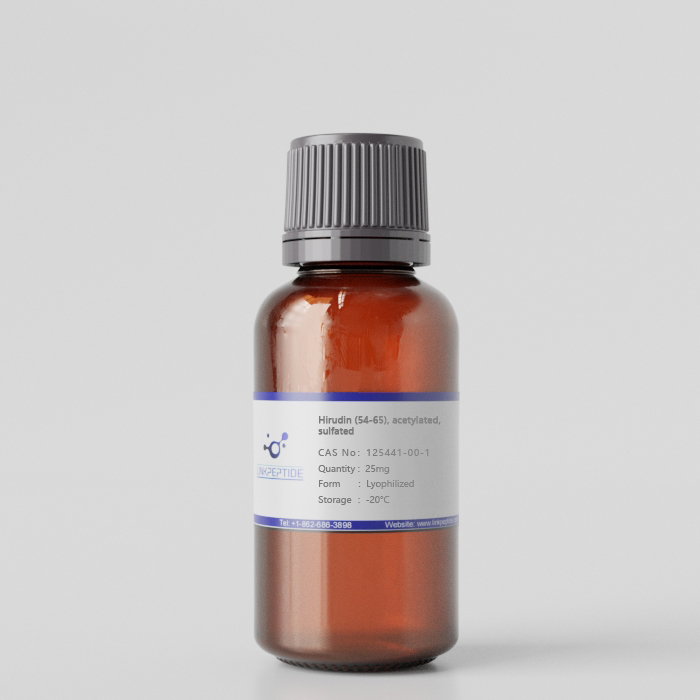
Product Name: Hirudin (54-65), acetylated, sulfated
Sequence One Letter Code: Ac-GDFEEIPEE-Y(SO3H)-LQ
Sequence Three Letter Code: Ac-Gly-Asp-Phe-Glu-Glu-Ile-Pro-Glu-Glu-Tyr(SO3H)-Leu-Gln-OH
Cas No: 125441-00-1
Chemical Formula:C68H95N13O29S
Molecular Weight: 1590.7
Purity: 95%
Form: Lyophilized
Storage Conditions: - 20 °C
Research Area: Cardiovascular Disease Research
SMILES: CCC(C)C(C(=O)N1CCCC1C(=O)NC(CCC(=O)O)C(=O)NC(CCC(=O)O)C(=O)NC(CC2=CC=C(C=C2)OS(=O)(=O)O)C(=O)NC(CC(C)C)C(=O)NC(CCC(=O)N)C(=O)O)NC(=O)C(CCC(=O)O)NC(=O)C(CCC(=O)O)NC(=O)C(CC3=CC=CC=C3)NC(=O)C(CC(=O)O)NC(=O)CNC(=O)C
IUPAC: 2-[[2-[[2-[[2-[[2-[[1-[2-[[2-[[2-[[2-[[2-[(2-acetamidoacetyl)amino]-3-carboxypropanoyl]amino]-3-phenylpropanoyl]amino]-4-carboxybutanoyl]amino]-4-carboxybutanoyl]amino]-3-methylpentanoyl]pyrrolidine-2-carbonyl]amino]-4-carboxybutanoyl]amino]-4-carboxybutanoyl]amino]-3-(4-sulfooxyphenyl)propanoyl]amino]-4-methylpentanoyl]amino]-5-amino-5-oxopentanoic acid
INCHIKEY: XYECDVVWKGPHGI-UHFFFAOYSA-N
INCHI:
InChI=1S/C68H95N13O29S/c1-6-35(4)57(80-61(98)43(22-27-55(91)92)73-58(95)40(19-24-52(85)86)74-63(100)46(30-37-11-8-7-9-12-37)79-65(102)48(32-56(93)94)71-51(84)33-70-36(5)82)67(104)81-28-10-13-49(81)66(103)75-42(21-26-54(89)90)59(96)72-41(20-25-53(87)88)60(97)78-47(31-38-14-16-39(17-15-38)110-111(107,108)109)64(101)77-45(29-34(2)3)62(99)76-44(68(105)106)18-23-50(69)83/h7-9,11-12,14-17,34-35,40-49,57H,6,10,13,18-33H2,1-5H3,(H2,69,83)(H,70,82)(H,71,84)(H,72,96)(H,73,95)(H,74,100)(H,75,103)(H,76,99)(H,77,101)(H,78,97)(H,79,102)(H,80,98)(H,85,86)(H,87,88)(H,89,90)(H,91,92)(H,93,94)(H,105,106)(H,107,108,109)
Source / Species: Leech
Conjugation: Unconjugated
Code Nacres: NA.26
Application: This peptide represents residues 54–65 of hirudin, a thrombin-binding protein derived from Hirudo medicinalis. The sequence is N-terminally acetylated and tyrosine-sulfated, modifications critical for high-affinity interaction with thrombin exosite I. While it binds tightly to thrombin, it does not inhibit cleavage of synthetic substrates, allowing selective investigation of exosite-mediated interactions independent of catalytic site inhibition. This peptide is suitable for studies of thrombin structure–function relationships, exosite binding mechanisms, and regulation of coagulation pathways. It provides a valuable tool for dissecting thrombin-mediated signaling and protein–protein interactions.
Current Research: Thrombin is a central enzyme in the blood coagulation cascade, responsible for converting fibrinogen into fibrin and activating multiple components involved in clot formation. Beyond its catalytic activity, thrombin contains specialized surface regions known as exosites, which mediate interactions with regulatory proteins and substrates. One of the most important of these regions is exosite I, a positively charged surface that recognizes several physiological binding partners. The hirudin (54–65) peptide, derived from the thrombin-binding protein hirudin and modified with N-terminal acetylation and tyrosine sulfation, provides a powerful experimental tool for studying thrombin exosite interactions and protein–protein recognition mechanisms. Hirudin and Its Interaction with Thrombin Hirudin is a naturally occurring anticoagulant protein produced by the medicinal leech Hirudo medicinalis. The protein binds thrombin with exceptionally high affinity and blocks its activity, preventing blood clot formation during feeding. The inhibitory activity of hirudin results from a bivalent interaction with thrombin. One region of the protein interacts with the catalytic site of thrombin, while another region binds to exosite I. Together, these interactions form a highly stable complex that effectively inhibits thrombin function. Because of its strong and specific binding properties, hirudin has long been used as a model system for studying thrombin structure and regulation. The Hirudin (54–65) Exosite-Binding Segment The 54–65 region of hirudin corresponds to a sequence that specifically interacts with thrombin exosite I. This region does not directly block the catalytic site but instead binds to the regulatory exosite responsible for recognizing substrates and cofactors. Synthetic peptides corresponding to this sequence can reproduce the exosite-binding interaction of hirudin while lacking the catalytic inhibitory domain. As a result, the peptide binds strongly to thrombin yet does not prevent cleavage of synthetic substrates by the enzyme. This unique property allows researchers to isolate and study exosite-mediated interactions independently from catalytic inhibition. Importance of Tyrosine Sulfation A key feature of the hirudin-derived peptide is tyrosine sulfation, a post-translational modification in which a sulfate group is attached to the hydroxyl group of a tyrosine residue. This modification introduces a negatively charged group that enhances electrostatic interactions with positively charged regions on thrombin. In the case of hirudin, tyrosine sulfation is essential for high-affinity binding to thrombin exosite I. The sulfate group strengthens the interaction between the peptide and thrombin’s exosite surface, significantly increasing binding specificity and stability. Including this modification in the synthetic peptide ensures that it closely mimics the binding behavior of the native hirudin protein. Role of N-Terminal Acetylation The peptide is also N-terminally acetylated, a modification that neutralizes the positive charge normally present at the amino terminus of peptides. This modification can improve structural stability and better reproduce the chemical environment present in the native protein context. Acetylation may also help maintain the peptide conformation required for effective interaction with thrombin exosite I. Studying Thrombin Exosite I Thrombin contains two major exosites—exosite I and exosite II—which serve as docking surfaces for substrates, cofactors, and regulatory proteins. Exosite I plays an especially important role in binding fibrinogen, thrombomodulin, and several other proteins involved in coagulation and cell signaling. The hirudin (54–65) peptide provides a convenient model for studying exosite I binding mechanisms. Because it binds specifically to this regulatory site, it can be used to examine how thrombin interacts with proteins that rely on exosite recognition. Researchers can also use the peptide to investigate how modifications or mutations in thrombin affect exosite interactions. Applications in Thrombin Structure–Function Studies Understanding how thrombin recognizes and interacts with its binding partners is essential for elucidating its role in coagulation and vascular biology. Synthetic peptides derived from hirudin are frequently used in structure–function studies aimed at mapping thrombin interaction surfaces. These studies often involve biochemical binding assays, structural analysis, or kinetic measurements to determine how peptide binding influences thrombin conformation and activity. Because the hirudin (54–65) peptide does not block the catalytic site, researchers can study exosite interactions without interfering with the enzyme’s catalytic function. Investigating Protein–Protein Interactions in Coagulation Thrombin participates in a wide range of protein–protein interactions that regulate clot formation, platelet activation, and vascular signaling. Many of these interactions depend on exosite binding rather than catalytic cleavage. By using the hirudin-derived peptide as a competitive ligand for exosite I, researchers can analyze how thrombin interacts with physiological substrates and regulatory proteins. These experiments help clarify how exosite recognition contributes to the specificity and regulation of thrombin-mediated processes. Applications in Coagulation Research The peptide is widely used in coagulation and hemostasis research, where it helps dissect the mechanisms by which thrombin coordinates multiple signaling pathways. Experiments using this peptide can reveal how thrombin binding events influence fibrin formation, platelet activation, and interactions with endothelial proteins. Because thrombin also participates in inflammatory signaling and vascular regulation, studying exosite-mediated interactions provides insight into broader physiological roles of this enzyme. Conclusion The hirudin (54–65) peptide, featuring N-terminal acetylation and tyrosine sulfation, reproduces the exosite-binding segment of the natural thrombin inhibitor hirudin. By binding selectively to thrombin exosite I without blocking catalytic activity, the peptide enables focused investigation of regulatory interactions that control thrombin function. Through applications in structure–function analysis, exosite binding studies, and investigations of coagulation signaling pathways, this peptide provides a valuable experimental tool for exploring the complex mechanisms that govern thrombin-mediated protein interactions and regulation of the coagulation cascade.
Get a Quote
 LinkPeptide