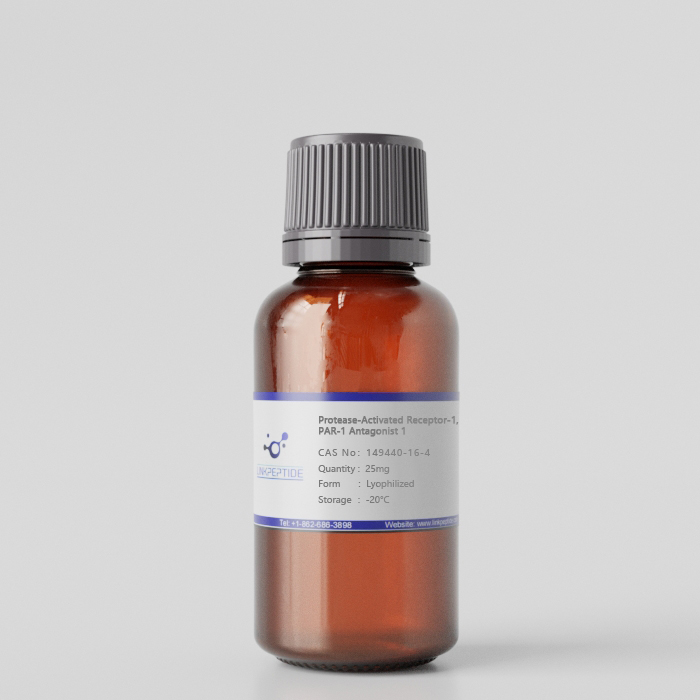
Product Name: Protease-Activated Receptor-1, PAR-1 Antagonist 1
Sequence One Letter Code: YFLLRNP-OH
Sequence Three Letter Code: Tyr-Phe-Leu-Leu-Arg-Asn-Pro-OH
Cas No: 149440-16-4
Chemical Formula:C45H67N11O10
Molecular Weight: 922.1
Purity: 95%
Form: Lyophilized
Storage Conditions: - 20 °C
Research Area: Cardiovascular Disease Research
SMILES: CC(C)C[C@@H](C(=O)N[C@@H](CC(C)C)C(=O)N[C@@H](CCCN=C(N)N)C(=O)N[C@@H](CC(=O)N)C(=O)N1CCC[C@H]1C(=O)O)NC(=O)[C@H](CC2=CC=CC=C2)NC(=O)[C@H](CC3=CC=C(C=C3)O)N
IUPAC: (2S)-1-[(2S)-4-amino-2-[[(2S)-2-[[(2S)-2-[[(2S)-2-[[(2S)-2-[[(2S)-2-amino-3-(4-hydroxyphenyl)propanoyl]amino]-3-phenylpropanoyl]amino]-4-methylpentanoyl]amino]-4-methylpentanoyl]amino]-5-(diaminomethylideneamino)pentanoyl]amino]-4-oxobutanoyl]pyrrolidine-2-carboxylic acid
INCHIKEY: NNUNPUFRTIMQBH-QJCLFNHPSA-N
INCHI:
InChI=1S/C45H67N11O10/c1-25(2)20-32(40(61)51-31(12-8-18-50-45(48)49)39(60)55-35(24-37(47)58)43(64)56-19-9-13-36(56)44(65)66)53-41(62)33(21-26(3)4)54-42(63)34(23-27-10-6-5-7-11-27)52-38(59)30(46)22-28-14-16-29(57)17-15-28/h5-7,10-11,14-17,25-26,30-36,57H,8-9,12-13,18-24,46H2,1-4H3,(H2,47,58)(H,51,61)(H,52,59)(H,53,62)(H,54,63)(H,55,60)(H,65,66)(H4,48,49,50)/t30-,31-,32-,33-,34-,35-,36-/m0/s1
Source / Species: human
Conjugation: Unconjugated
Code Nacres: NA.26
Application: Protease-Activated Receptor-1 (PAR-1) Antagonist 1 is a synthetic peptide with the sequence YFLLRNP that selectively antagonizes thrombin-mediated PAR-1 signaling in human platelets. By competitively interfering with thrombin and the thrombin receptor agonist peptide SFLLRNP, this peptide modulates receptor activation and downstream platelet signaling pathways. YFLLRNP induces partial platelet activation characterized by shape change but does not trigger full aggregation, enabling selective analysis of receptor-dependent responses. It is widely used to dissect PAR-1–specific signaling mechanisms, thrombin receptor pharmacology, and platelet activation dynamics. The peptide supports research in thrombosis, hemostasis, and cardiovascular biology focused on receptor-mediated platelet function.
Current Research: Protease-Activated Receptor-1 (PAR-1) Antagonist 1 (sequence: YFLLRNP) is a synthetic peptide derived from the N-terminal tethered ligand region of the human PAR-1 receptor. PAR-1 is a G protein–coupled receptor (GPCR) activated by thrombin-mediated proteolytic cleavage, which exposes a new N-terminus beginning with the sequence SFLLRN that functions as an intramolecular agonist. Short peptides mimicking this tethered ligand, such as SFLLRNP, are widely used to directly stimulate PAR-1 independent of proteolysis. In contrast, YFLLRNP acts as a competitive antagonist that selectively interferes with thrombin- and agonist peptide–induced PAR-1 activation. Mechanistically, YFLLRNP differs from the canonical agonist sequence by a single amino acid substitution at the N-terminus (tyrosine replacing serine), which alters receptor conformational activation while preserving receptor binding affinity. This modification allows the peptide to occupy or partially engage the ligand-binding domain of PAR-1 without inducing full receptor activation. As a result, YFLLRNP competitively inhibits thrombin signaling and attenuates responses elicited by agonist peptides such as SFLLRNP. In human platelets, PAR-1 is the primary high-affinity thrombin receptor and plays a central role in hemostasis and thrombosis. Upon activation, PAR-1 couples to multiple G proteins, including G_q, G_i, and G_12/13, initiating phospholipase C activation, intracellular calcium mobilization, RhoA-mediated cytoskeletal rearrangement, granule secretion, integrin αIIbβ3 activation, and platelet aggregation. YFLLRNP modulates these signaling pathways in a selective manner. Experimental observations demonstrate that it can induce partial platelet activation characterized by morphological changes (e.g., platelet shape change mediated via G_12/13–RhoA pathways) without promoting full integrin activation or irreversible aggregation. This partial agonist/antagonist profile makes it particularly valuable for dissecting discrete receptor-dependent signaling branches. Current research uses YFLLRNP to differentiate thrombin-specific PAR-1 signaling from PAR-4–mediated effects, as human platelets express both receptors with distinct activation kinetics and signaling profiles. By selectively attenuating PAR-1 activation, investigators can parse receptor subtype contributions to calcium flux, granule secretion, ERK phosphorylation, and cytoskeletal remodeling. This is especially relevant in studies examining biased signaling, receptor desensitization, and GPCR conformational dynamics. In thrombosis and cardiovascular biology, PAR-1 signaling is implicated not only in platelet aggregation but also in endothelial activation, vascular inflammation, and smooth muscle cell responses. Although YFLLRNP is most frequently studied in platelets, it also serves as a pharmacological probe in broader PAR-1 research contexts. Its competitive antagonistic behavior enables mechanistic comparison with clinically approved PAR-1 antagonists (e.g., vorapaxar), supporting translational studies of receptor inhibition strategies. Methodologically, YFLLRNP is used in platelet aggregation assays, light transmission aggregometry, flow cytometry for integrin activation (PAC-1 binding), P-selectin expression assays, calcium mobilization measurements, and Western blot analysis of downstream kinases. Because it induces platelet shape change without full aggregation, it is particularly useful for isolating early receptor-proximal signaling events from later amplification cascades driven by secondary mediators such as ADP and thromboxane A₂. Additionally, the peptide facilitates investigation into receptor pharmacology, including ligand–receptor binding competition, structure–activity relationship (SAR) analysis, and receptor mutagenesis studies. Subtle modifications within the tethered ligand motif provide insights into how PAR-1 distinguishes between full agonists, partial agonists, and antagonists, contributing to a deeper understanding of GPCR activation mechanisms. Overall, PAR-1 Antagonist 1 (YFLLRNP) is a selective and mechanistically informative tool for studying thrombin receptor signaling. By competitively modulating PAR-1 activation and inducing controlled, partial platelet responses, it enables precise analysis of receptor-mediated signaling pathways. Its applications span thrombosis research, hemostasis studies, GPCR pharmacology, and cardiovascular biology, where understanding PAR-1–dependent platelet function remains central to elucidating mechanisms of thrombotic disease.
Get a Quote
 LinkPeptide