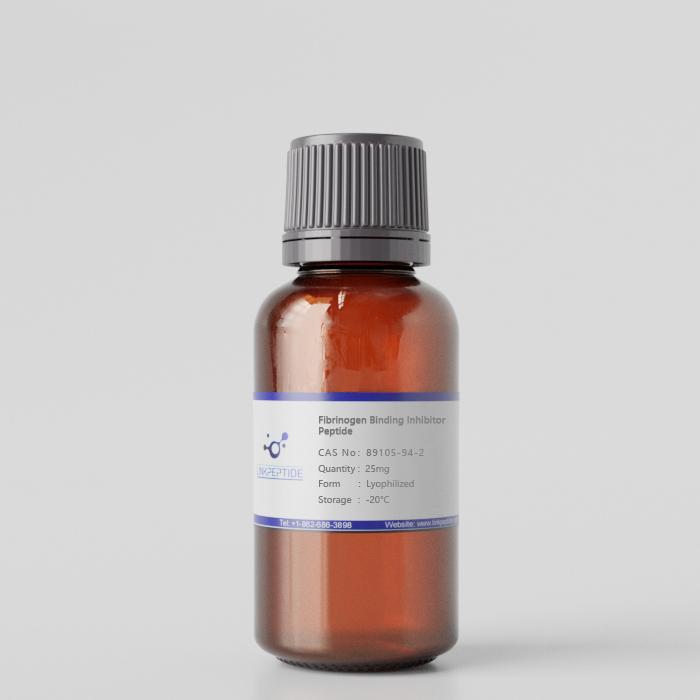
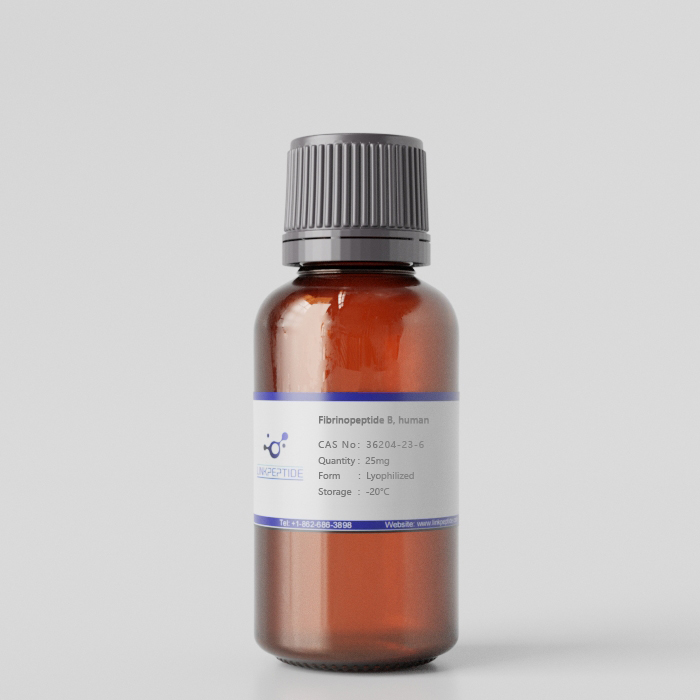
Product Name: Fibrinogen Binding Inhibitor Peptide
Sequence One Letter Code: HHLGGAKQAGDV
Sequence Three Letter Code: H-His-His-Leu-Gly-Gly-Ala-Lys-Gln-Ala-Gly-Asp-Val-OH
Cas No: 89105-94-2
Chemical Formula: C50H80N18O16
Molecular Weight: 1189.3
Purity: 95%
Form: Lyophilized
Storage Conditions: - 20 °C
Research Area: Cardiovascular Disease Research
SMILES: C[C@@H](C(=O)N[C@@H](CCCCN)C(=O)N[C@@H](CCC(=O)N)C(=O)N[C@@H](C)C(=O)NCC(=O)N[C@@H](CC(=O)O)C(=O)N[C@@H](C(C)C)C(=O)O)NC(=O)CNC(=O)CNC(=O)[C@H](CC(C)C)NC(=O)[C@H](CC1=CN=CN1)NC(=O)[C@H](CC2=CN=CN2)N
IUPAC: (2S)-2-[[(2S)-2-[[2-[[(2S)-2-[[(2S)-5-amino-2-[[(2S)-6-amino-2-[[(2S)-2-[[2-[[2-[[(2S)-2-[[(2S)-2-[[(2S)-2-amino-3-(1H-imidazol-5-yl)propanoyl]amino]-3-(1H-imidazol-5-yl)propanoyl]amino]-4-methylpentanoyl]amino]acetyl]amino]acetyl]amino]propanoyl]amino]hexanoyl]amino]-5-oxopentanoyl]amino]propanoyl]amino]acetyl]amino]-3-carboxypropanoyl]amino]-3-methylbutanoic acid
INCHIKEY: STSKWZSBFZRSGP-GYDGUXFESA-N
INCHI:
InChI=1S/C50H80N18O16/c1-24(2)13-33(67-48(81)34(15-29-18-55-23-60-29)66-44(77)30(52)14-28-17-54-22-59-28)45(78)58-19-37(70)56-20-38(71)61-27(6)43(76)64-31(9-7-8-12-51)47(80)65-32(10-11-36(53)69)46(79)62-26(5)42(75)57-21-39(72)63-35(16-40(73)74)49(82)68-41(25(3)4)50(83)84/h17-18,22-27,30-35,41H,7-16,19-21,51-52H2,1-6H3,(H2,53,69)(H,54,59)(H,55,60)(H,56,70)(H,57,75)(H,58,78)(H,61,71)(H,62,79)(H,63,72)(H,64,76)(H,65,80)(H,66,77)(H,67,81)(H,68,82)(H,73,74)(H,83,84)/t26-,27-,30-,31-,32-,33-,34-,35-,41-/m0/s1
Source / Species: human
Conjugation: Unconjugated
Conjugation Type:
Code Nacres: NA.26
Application: Fibrinogen Binding Inhibitor Peptide is a synthetic sequence derived from the carboxy-terminal region of the fibrinogen γ-chain (residues 400–401). It mimics a critical recognition motif responsible for platelet aggregation. This peptide acts as a competitive ligand for the platelet integrin GPIIb/IIIa (αIIbβ3), the primary receptor mediating fibrinogen binding during thrombus formation. By selectively disrupting fibrinogen–GPIIb/IIIa interactions, it enables detailed investigation of platelet adhesion, integrin activation, and clot stabilization mechanisms. The peptide is widely applied in thrombosis and hemostasis research, particularly in studies examining platelet activation pathways and integrin-dependent signaling. Its defined structure and targeted mechanism provide a reliable experimental tool for analyzing molecular events underlying thrombus formation and evaluating antithrombotic strategies in biochemical and cell-based models.
Current Research:
Recent platelet research increasingly positions fibrinogen–αIIbβ3 (GPIIb/IIIa) engagement as a dynamic signaling event rather than a passive end-stage adhesive interaction. Beyond simply bridging adjacent platelets, fibrinogen binding to activated αIIbβ3 initiates a cascade of outside-in signaling events that regulate cytoskeletal reorganization, platelet spreading, granule secretion, and clot consolidation. Within this framework, fibrinogen γ-chain C-terminal–derived inhibitory peptides remain indispensable mechanistic tools because they selectively disrupt ligand–integrin engagement without globally suppressing upstream platelet activation pathways.
Renewed Focus on the γ-Chain C-Terminal Motif
The platelet-binding determinant within fibrinogen is classically mapped to the carboxy-terminal region of the γ-chain (around residues 400–411). Short synthetic peptides derived from this region competitively inhibit fibrinogen binding to αIIbβ3, providing a structurally defined mimic of the endogenous recognition motif. Contemporary structural studies continue to refine our understanding of how this γ-chain sequence docks into the αIIbβ3 ligand-binding pocket, emphasizing conformational specificity and integrin activation state as critical determinants of affinity.
Because this interaction occurs only after inside-out signaling has converted αIIbβ3 to a high-affinity state, γ-chain–derived inhibitor peptides are frequently used to discriminate between (1) integrin activation and (2) downstream ligand-dependent signaling events. This distinction is central to current platelet biology, where researchers aim to parse the precise sequence of molecular transitions that stabilize thrombi.
Outside-In Signaling: Multiple Functional Axes
Recent pharmacological and mechanistic investigations demonstrate that αIIbβ3 outside-in signaling is not a monolithic cascade. Distinct phenotypes—such as platelet spreading on immobilized fibrinogen, actin remodeling, clot retraction, and traction force generation—can be regulated by partially separable signaling nodes. As a result, blocking fibrinogen occupancy with a competitive peptide allows researchers to evaluate which aspects of platelet function strictly depend on productive ligand engagement versus those that rely on parallel receptor systems (e.g., GPVI–collagen signaling or thrombin receptor activation).
This approach is particularly important in flow-based thrombosis models and microfluidic assays, where shear forces amplify integrin-dependent stabilization. In such systems, fibrinogen-binding inhibitor peptides enable precise interrogation of thrombus architecture, platelet cohesion, and resistance to detachment under physiologically relevant shear conditions.
Integrin–Cytoskeleton Coupling and Mechanobiology
A major area of current investigation centers on how αIIbβ3 physically couples to the cytoskeleton after ligand binding. Talin-mediated activation exposes binding sites that permit integrin clustering and recruitment of adaptor proteins such as filamin, kindlins, and Src-family kinases. These interactions coordinate actin polymerization, focal adhesion–like complex formation, and force transmission during clot contraction.
Competitive inhibition of fibrinogen binding provides a direct method to test whether cytoskeletal changes are triggered by integrin occupancy itself or by upstream signaling events independent of sustained ligand engagement. Consequently, γ-chain–derived peptides are routinely incorporated into spreading assays, traction force microscopy, and clot retraction experiments to dissect integrin-dependent mechanical stabilization.
Translational and Antithrombotic Implications
Clinically, αIIbβ3 antagonists have long been recognized as potent antithrombotic agents; however, their use is limited by bleeding risk. Current translational research seeks to identify strategies that inhibit pathological thrombosis while preserving baseline hemostasis. One emerging concept involves selectively targeting outside-in signaling pathways rather than completely blocking integrin activation.
In this context, fibrinogen-binding inhibitor peptides serve as reference tools to benchmark new therapeutic strategies. By isolating the effects of ligand blockade, investigators can determine whether novel small molecules, antibodies, or signaling modulators achieve antithrombotic efficacy through comparable or distinct mechanisms. Additionally, peptide-based targeting approaches are under exploration for thrombus imaging and drug delivery, highlighting the continued relevance of well-characterized integrin-binding motifs.
Experimental Utility in Contemporary Models
Across platelet aggregation assays, fibrinogen-binding flow cytometry, adhesion/spreading experiments, and clot retraction analyses, γ-chain–derived inhibitory peptides function as mechanism-defining reagents. They allow researchers to:
Quantify the contribution of fibrinogen occupancy to aggregation amplitude
Separate integrin activation from ligand-dependent signal propagation
Evaluate integrin clustering and cytoskeletal anchoring
Model competitive inhibition in biochemical and cell-based systems
As platelet research increasingly integrates high-resolution imaging, proteomics, and mechanotransduction studies, structurally defined fibrinogen-binding inhibitor peptides continue to provide a targeted and reliable means of interrogating the molecular events governing thrombus formation. Their specificity for the αIIbβ3–fibrinogen axis ensures precise experimental modulation of platelet adhesion and clot stabilization pathways central to both fundamental hemostasis research and antithrombotic drug development.
Get a Quote
 LinkPeptide