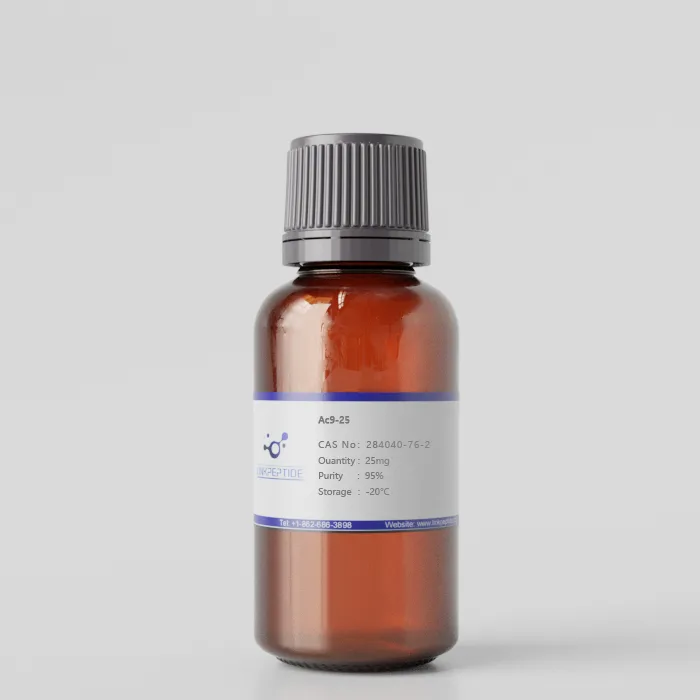
Product Name:Ac9-25
CAS No:284040-76-2
Purity:95%
Molar Mass:2183.35
Chemical Formula:C99H143N23O33
Storage:Store at -20 degrees Celsius
Sequence:QAWFIENEEQEYVQTVK
Target:FPR1
Application:Ac9-25, also known as Ac-SDKP, is a peptide that functions as an antagonist of the formyl peptide receptor 1 (FPR1). FPR1 is a G protein-coupled receptor involved in inflammatory responses, particularly in leukocyte chemotaxis and activation. By blocking FPR1, Ac9-25 can modulate immune cell migration and inflammatory processes, making it a valuable tool for research into inflammatory diseases and immune system regulation. Its use in experimental settings helps to better understand the role of FPR1 in inflammation and to develop potential therapeutic strategies for related conditions.
Current Research:
Ac9-25, a synthetic peptide derived from the N-terminal region of Annexin I, has garnered attention in immunological research for its role as a formyl peptide receptor (FPR) agonist. With the sequence Ac-Gln-Ala-Trp-Phe-Ile-Glu-Asn-Glu-Glu-Gln-Glu-Tyr-Val-Gln-Thr-Val-Lys, Ac9-25 selectively activates FPR1, a G protein-coupled receptor critical in innate immunity. Its ability to stimulate neutrophil NADPH oxidase activity highlights its involvement in modulating immune defense mechanisms.
Biological Activity
The interaction of Ac9-25 with FPR1 initiates signaling cascades that lead to the activation of NADPH oxidase, an enzyme complex responsible for generating reactive oxygen species (ROS) during the respiratory burst. This process is vital for neutrophil-mediated antimicrobial activity and pathogen clearance. Moreover, Ac9-25 has been shown to promote chemotaxis and neutrophil recruitment, further amplifying immune responses. These properties make it a valuable tool for dissecting the molecular pathways involved in innate immunity and inflammation.
Current Applications
Ac9-25 is widely used in research to investigate FPR-mediated processes in immune cells. Recent studies have explored its role in:
Understanding neutrophil function in inflammatory conditions, such as rheumatoid arthritis and sepsis.
Characterizing the molecular mechanisms of FPR signaling and its cross-talk with other immune pathways.
Evaluating potential therapeutic strategies for targeting FPRs to modulate excessive inflammation or enhance host defense mechanisms.
Therapeutic Implications
Given the critical role of FPRs in immune responses, Ac9-25 is being studied as a potential therapeutic lead for diseases involving dysregulated inflammation, such as chronic obstructive pulmonary disease (COPD) and autoimmune disorders. Its ability to mimic endogenous immune signals positions it as a candidate for developing peptide-based immunomodulatory therapies.
Conclusion
Ac9-25 is a pivotal research tool in the study of neutrophil activation and FPR biology. Its applications in understanding immune regulation and inflammation continue to provide insights that could inform the development of novel therapies for inflammatory and infectious diseases.
Reference:
Get a Quote
 LinkPeptide